
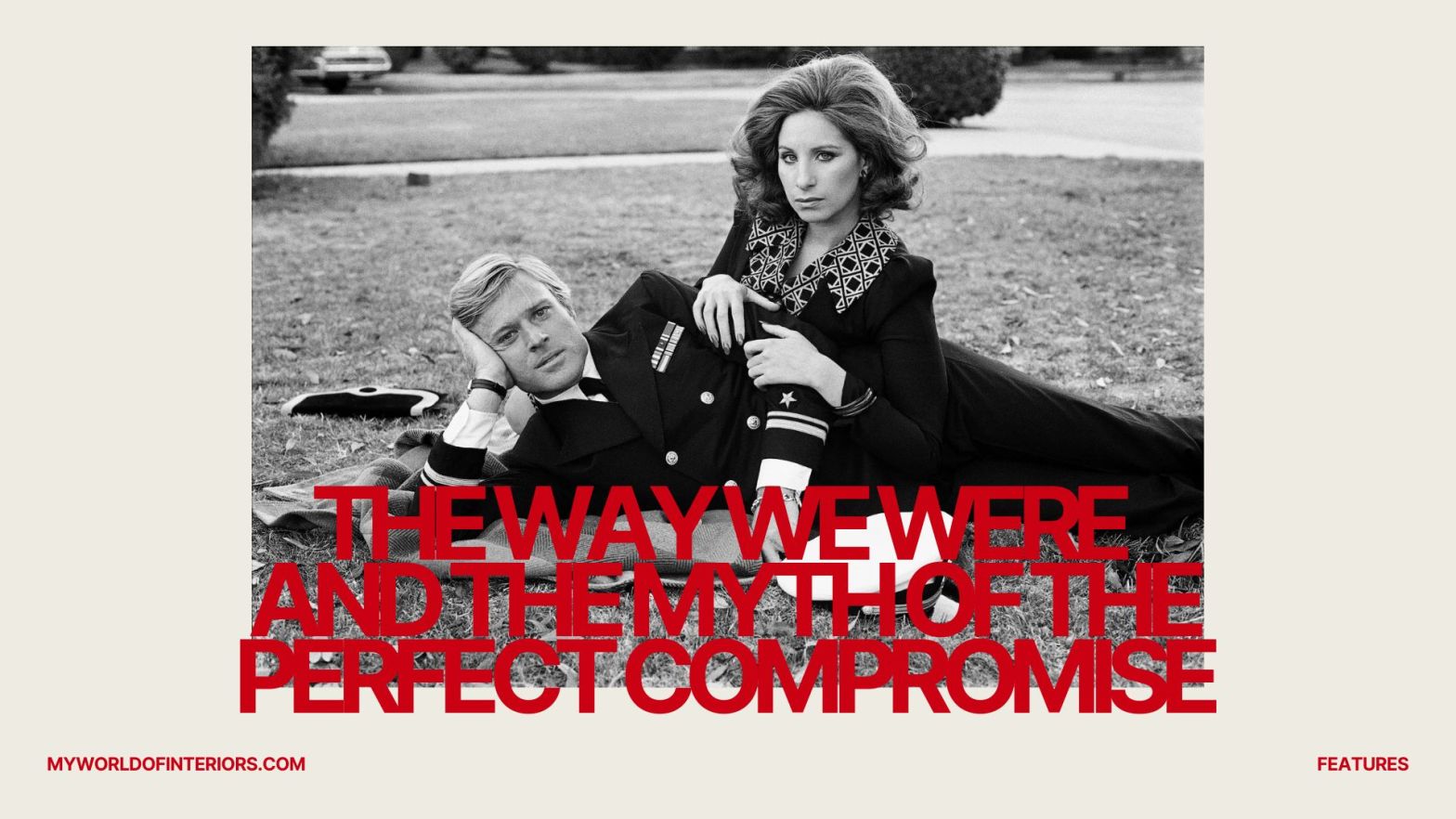
It was sold as a love story. It was actually an argument about America — about politics, memory, and the terrible cost of choosing comfort over conviction.
By Bergotte
There is a moment near the end of The Way We Were, Sydney Pollack’s 1973 film, that has lodged itself in the cultural memory with a persistence quite disproportionate to its brevity. Barbra Streisand, playing Katie Morosky, stands outside the Plaza Hotel on a Manhattan afternoon, her hair shorter now, her clothes quieter, the years of argument and passion and incompatibility behind her. She reaches up and brushes the hair from the forehead of Hubbell Gardiner — Robert Redford, as golden and at ease as he has ever been — with a tenderness so precisely calibrated between love and grief that it is almost impossible to watch. Then she walks away. He watches her go. The credits roll over a reprise of Marvin Hamlisch’s theme, Streisand’s voice swelling into something that sounds less like a song than an ache made audible.
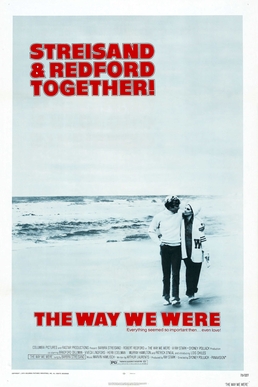
Audiences wept. Critics were divided. The film earned nearly fifty million dollars on a budget of a little over fifteen, made Streisand a film star in a register she had not previously occupied, confirmed Redford as the defining masculine icon of his generation, and entered the vernacular with a completeness that only a handful of films in any decade achieve. Forty years on, the question worth asking is not whether it was a good film — the answer to that is yes, though more complicatedly yes than either its devotees or its detractors have generally allowed — but what it was actually about, and why it continues to matter.
Because The Way We Were is not, finally, a love story. Or rather: it is a love story in which the love story is the vehicle for something else, something that the film’s enormous popular success has tended to obscure. It is a film about American political life, about the cost of accommodation, about what happens to people — to their integrity, their self-understanding, their capacity for genuine relationship — when they choose safety over principle. That this argument is conducted through a romance, through glamour, through one of the most effective musical scores in Hollywood history, is not a flaw. It is a strategy. And it is a strategy that has proven, over the decades, more durable than almost anyone in 1973 could have anticipated.
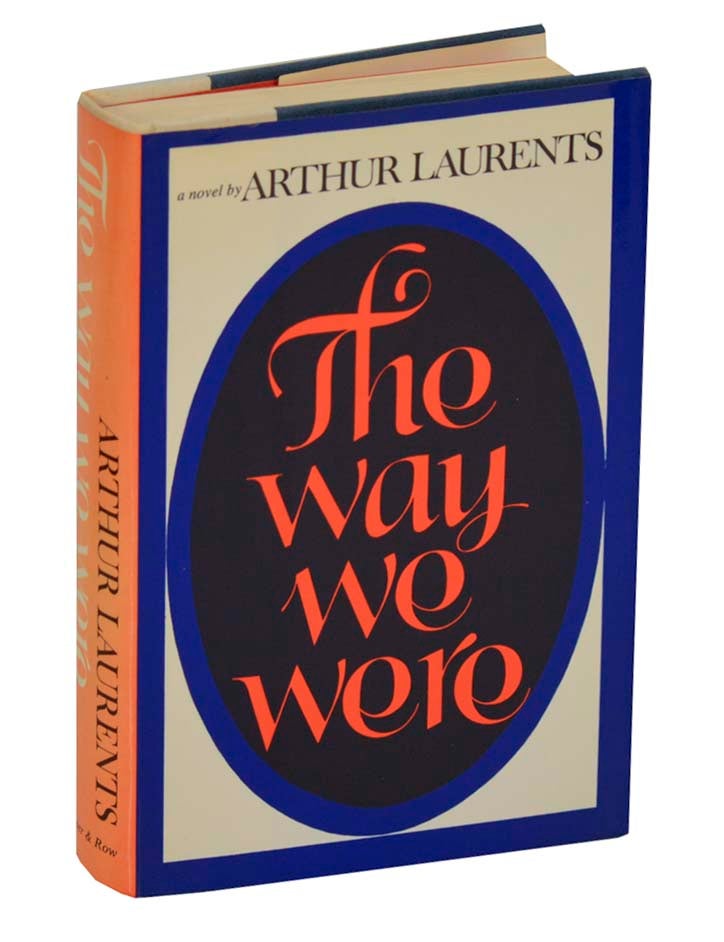
The film is based on Arthur Laurents’s novel of the same name, published in 1972, and Laurents — who also wrote the screenplay — drew directly on his own experience as a left-wing Jewish writer navigating the Hollywood blacklist of the late 1940s and early 1950s. The blacklist hangs over the film’s second half like a weather system: threatening, inevitable, ultimately catastrophic. What Laurents understood, and what Pollack’s film transmits with real intelligence, is that the blacklist was not merely a political phenomenon but a psychological one. It did not only destroy careers; it destroyed relationships, self-images, the stories people told themselves about who they were and what they believed.
Katie Morosky is a Communist — or at least a committed activist, a Young Communist League member when we first encounter her in the film’s 1930s prologue, later a union organiser and peace campaigner and the kind of person who cannot enter a room without reading its politics. She is Jewish, working-class, loud, difficult, and right about nearly everything in ways that make her almost unbearable to be around. Hubbell Gardiner is a WASP from old money, naturally gifted, constitutionally conflict-averse, the kind of man for whom everything has always come easily and who has, as a consequence, never had to develop the moral muscle that difficulty builds. He is not a bad man. He is something more complicated and, in Laurents’s view, more dangerous: a good man who will not be inconvenienced by his goodness.
The love story that develops between them is not, pace the marketing, a story about opposites attracting. It is a story about irreconcilable values — not temperamental differences but genuine political and ethical divergences — and about the doomed attempt to build a life across that divide. When Hubbell, under pressure from the House Un-American Activities Committee and the studio system that fears its consequences, declines to resist the blacklist — declines, ultimately, to stand with Katie and her friends — it is not a failure of love. He loves her. It is a failure of something for which the film, with considerable precision, does not provide a comfortable name.
The production history of The Way We Were is, famously, a story of creative conflict that mirrors the conflict at the film’s centre. Pollack, working under pressure from Columbia Pictures, cut nearly forty minutes from Laurents’s original cut — almost all of it political material, scenes of left-wing organising, arguments about the nature of American democracy, the texture of a life lived in committed opposition to received opinion. What remained was a romance with political coloring, a love story with a backdrop, and the film’s critics have never entirely forgiven the studio for this amputation.
They are not wrong to note the loss. The extant scenes suggest a film of genuine political seriousness, and there are moments in the released version — particularly in the Hollywood sequences, where Hubbell and his screenwriting colleagues weigh the risks of signing a petition against the blacklist — where the argument surfaces with a clarity that makes you wish for more. Redford, in these scenes, does some of the finest work of his career: his Hubbell is not a coward in any simple sense, but a man who is constitutionally unable to bear the cost of his own convictions, who retreats into pragmatism because pragmatism feels, from the inside, indistinguishable from wisdom.
And yet what survived the cutting is, in its own terms, more effective than the uncut version might have been. The political argument, pruned to its emotional essentials, becomes something the film’s vast popular audience could absorb through the love story rather than despite it. You do not need to know what the House Un-American Activities Committee was to understand what is happening when Hubbell declines to fight. You need only to understand that he is choosing something over Katie — choosing ease, choosing safety, choosing the version of himself that does not have to struggle — and that this choice is, in every sense that matters, a betrayal. The political specificity has been generalised into something archetypal, and in the process it has become, paradoxically, more lasting.
Streisand’s performance is the film’s great achievement, and it is worth dwelling on what she actually does rather than simply noting its emotional impact. Katie Morosky was, in many respects, a radical departure for Hollywood in 1973 — a female character who is explicitly and unashamedly political, whose political commitments are not softened by the narrative, who is not punished for her convictions by the story even as she pays an enormous personal price for them. She is also, in ways that the period’s gender politics made relatively unusual, the film’s moral centre: the character whose understanding of events is most accurate, whose values are most consistently applied, whose choices are most clearly drawn. Hubbell is more beautiful and more charming and ultimately less interesting and less right.
What Streisand brings to this is something beyond technique — though the technique is extraordinary, particularly in the scenes where Katie must negotiate between her politics and her desire, between what she believes and what she wants. She plays the character’s difficulty without apology, her abrasiveness without softening, her certainty without making it merely a form of arrogance. There is a scene in which Katie, having learned that Hubbell intends to cooperate with the committee, argues with him through the night in a hotel room that feels, by the end, like a room that has been through a war. Streisand gives this scene everything: the desperation, the love, the political fury, the grief of someone watching a person she loves reveal a limitation she had perhaps always suspected but hoped not to confirm. It is, by any measure, one of the great performances in 1970s Hollywood cinema.
Redford’s performance has been somewhat underestimated, perhaps because the character he is playing requires understatement where Streisand’s requires full expression. But Hubbell is a genuinely difficult creation — a man whose very attractiveness is an argument about a certain kind of American failure, the failure of the gifted and the comfortable to be equal to the demands of their moment — and Redford inhabits him with more self-awareness than the golden surface might suggest. There is something in his eyes, in this film, that is not entirely comfortable with itself. He knows what he is. He simply cannot, quite, be otherwise.
The Way We Were arrived in October 1973, two months after the Senate Watergate hearings had concluded and one month after Spiro Agnew resigned the vice presidency. The political atmosphere of the country was saturated with questions about loyalty and integrity and the cost of choosing self-preservation over principle — precisely the questions the film was asking about a different American moment, twenty years earlier. Audiences in 1973 were watching the film through the lens of Watergate, and the resonance was not accidental. Laurents had written the novel with the present very much in mind; the blacklist as a mirror for Nixon’s America was a thesis the culture was ready to receive.
But the film’s timing also tells us something about the nature of its appeal. The early 1970s were a period of enormous disillusionment in American life — the failure of the counter-culture to produce lasting political change, the end of the civil rights movement’s legislative energy, the long unwinding of Vietnam — and audiences were primed for stories about idealism defeated. The Way We Were gave them something precise and beautiful and heartbreaking to attach that diffuse grief to. It was, among other things, a mourning song for a certain kind of political optimism, for the belief that conviction was sufficient, that if you wanted the right things enough and argued for them loudly enough and were unafraid of the cost, history would eventually be on your side.
Katie believes this, completely. The film does not exactly disconfirm it. But it is honest about what the belief costs, and about the fact that not everyone who loves you will be willing to pay the same price.
The cultural legacy of The Way We Were operates on several registers simultaneously, which is part of what makes it difficult to account for precisely. At the most obvious level, it is the film that established the template for what the 1970s and 1980s would call the “tearjerker” — the romantic drama with a political or social backdrop, a doomed or incomplete love story, and a musical theme of sufficient emotional force to carry the audience into a state they might otherwise resist. Ordinary People, Kramer vs Kramer, Out of Africa (also directed by Pollack, also starring Redford), and a long list of successors are all, in some sense, working in the wake of The Way We Were. The film proved that a serious political subject and an unapologetically sentimental treatment were not mutually exclusive, that you could have the argument and the weeping simultaneously, that the audience would not feel manipulated if the emotion was grounded in something real.
At a deeper level, the film contributed to a shift in how Hollywood represented women — specifically, how it represented women of strong political and intellectual commitment. Katie Morosky was not the first such character in American cinema, but she was among the first to be played with such complete absence of apology, and she influenced a generation of writers and directors who took seriously the idea that a female character’s mind and convictions were as dramatically interesting as her heart. The lineage runs through the Nora Ephrens and the Nancy Meyerses and beyond, through a tradition of American film that refuses to separate the emotional life from the political one.
The film’s depiction of the blacklist also had a durable effect on how that period was understood in popular culture. Scholars and critics had written about the blacklist; The Way We Were felt it. It translated a chapter of American political history into physical sensation — into what it felt like to be in a room with someone you loved while they decided not to stand with you — and this translation has proven more memorable than most of the academic accounts. When people who lived through the blacklist era spoke of it in later years, many of them described the film as the most accurate representation they had encountered, not because it was historically precise but because it had captured the emotional reality of a period in which private and political life were in constant, excruciating intersection.
What the film has to say about memory — about the way we reconstruct the past into something manageable — is perhaps its most enduring subject, the one that gives Hamlisch’s theme its particular ache. “Memories,” Streisand sings, “light the corners of my mind.” The lyric is almost willfully simple, but what the film does is use that simplicity as a kind of trap: the title sequence shows us the present Katie, the greyed and softened memory of the past relationship, before diving back into that past and showing us how different it was from the version memory has made comfortable. The film is, among other things, a meditation on the way nostalgia edits — on the way we remember our former selves as purer, the people we loved as better, the conflicts as more resolvable than they were.
The final scene at the Plaza does not give us resolution. It gives us exactly what time gives us: a glimpse of the person you once loved, briefly, across a distance that cannot be crossed, and then their absence. The Hubbell who walks away has made his choices. The Katie who watches him go has made hers. The love was real. The incompatibility was also real. The film holds these truths together without sentimentalising either and without offering the consolation of a lesson. There is no lesson. There is only what happened, what was lost, and the music that makes the loss feel, against all reason, beautiful.
This is what serious popular art does at its best: it takes the irresolvable and gives it a shape that the audience can carry. The Way We Were, for all the studio interference and the lost footage and the romantic gloss, does exactly this. It carries inside its gorgeous, tear-stained surface a genuine argument about American life, about the price of comfort and the cost of conviction, about what we sacrifice when we choose the easier version of ourselves. That argument has not dated. If anything, in a political culture that makes the dilemmas of the blacklist era feel newly legible, it has grown more urgent.
Katie Morosky was right about almost everything. It did her, in the conventional sense, very little good. The film has the honesty and the courage to leave it there.
The Way We Were (1973), directed by Sydney Pollack, written by Arthur Laurents, is available on most major streaming platforms. The original score by Marvin Hamlisch won the Academy Award. Barbra Streisand’s recording of the title theme reached number one in the United States in January 1974.
Discover more from My World of Interiors
Subscribe to get the latest posts sent to your email.
 My World of Interiors