
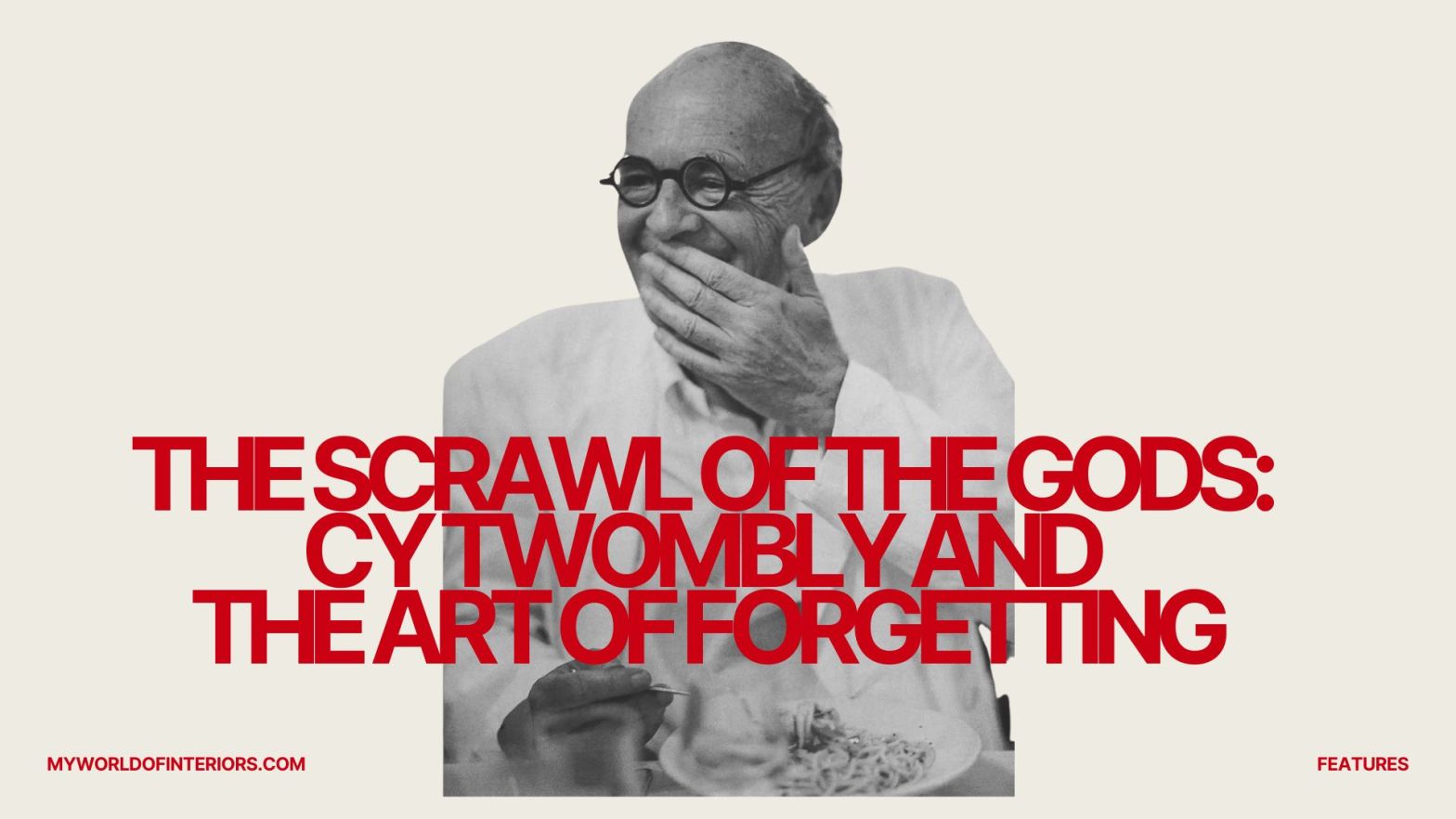
He made paintings that looked like vandalism, drawings that resembled the work of a distracted child, and sculptures that seemed to be falling apart. He also changed the course of Western art.
By Bergotte
There is a canvas in the Menil Collection in Houston, twelve feet wide, that appears, at first glance, to have been attacked. Grey paint has been dragged across it in loose, looping marks — the kind of marks a hand makes when it is trying to remember something and cannot quite retrieve it. There are smudges, erasures, something that might be a word and might be a number. The surface is restless, nervous, stratified in the way that geological formations are stratified: evidence of time, pressure, and a great deal of happening. It is not, in any conventional sense, beautiful. It is something more unsettling than that. Standing in front of it, you have the sensation of being in the presence of a consciousness at work — not a performance of consciousness, not a demonstration of skill, but the actual unedited activity of a mind moving through time.
Cy Twombly made this kind of work for more than fifty years, from his earliest experiments in the late 1940s until his death in Rome in 2011 at the age of eighty-three. He was, for much of that period, one of the most controversial figures in American art — praised extravagantly by a small number of critics, dismissed or ridiculed by a much larger audience, and essentially ignored by the mainstream until very late in his career. Today, the balance has shifted so dramatically that it can be difficult to recover the original bewilderment. His paintings sell for tens of millions of dollars. His late work — vast, blazing canvases of reds and yellows that came in a final burst of energy in the 2000s — hangs in the great museums of the world as if it had always been there, as if there had never been any question about its importance. The question, now, is how to look at the work clearly — to see what it actually does, rather than what the institutional endorsement tells us it does.
Edwin Parker Twombly Jr. was born in 1928 in Lexington, Virginia, the son of a former major-league pitcher. The sporting pedigree is a biographical detail that tends to amuse commentators, given that almost nothing about Twombly’s mature work suggests athleticism in any recognisable sense — and yet there is something in the gesture of throwing, in the relationship between the body and a mark made at speed and at distance, that finds an echo in the way his line moves across a surface. He studied at the School of the Museum of Fine Arts in Boston, then at Washington and Lee University, then at the Art Students League in New York, where he encountered Franz Kline and Robert Motherwell, two of the architects of Abstract Expressionism. A fellowship in 1951 took him to the Black Mountain College in North Carolina, the experimental institution that had already produced John Cage, Merce Cunningham, and Robert Rauschenberg, the last of whom became Twombly’s closest friend and, for a time, his travel companion on a formative journey through North Africa and Europe.
Black Mountain was, in the early 1950s, a place where the boundaries between disciplines were actively disputed. Cage was arguing that silence was music; Cunningham was arguing that dance did not need to express anything; the painters were arguing that the act of painting mattered as much as — or more than — the resulting object. Twombly absorbed all of this, but what he took from it was less the theoretical position than a set of practical permissions. He began, famously, to draw in the dark — to make marks without being able to see them, training his hand to act without the supervision of the eye, trying to find a line that was purely gestural, that had no intention other than its own existence. He also drew with his non-dominant hand. He drew while riding in the back of moving vehicles. He was trying, by any means available, to outrun deliberation.
The marks that resulted look like nothing that had been made before in Western painting. They resemble handwriting, but not any particular hand. They resemble mathematical notation, but the equations never resolve. They resemble graffiti — and this is the comparison that has caused the most trouble — in their casual violence, their sense of having been made quickly and without permission, their indifference to the decorum of the picture plane. When Twombly showed this work in New York in the mid-1950s, critics were largely baffled and not infrequently hostile. Clement Greenberg, the era’s most powerful tastemaker, was dismissive. The work looked unfinished, evasive, wilfully obtuse. There was no obvious way in.
In 1957, Twombly moved permanently to Italy. He settled first in Rome, later also maintaining a home in Gaeta on the Tyrrhenian coast, and this geographical relocation was also, crucially, a cultural one. He was immersing himself in a world saturated with antiquity — not the sanitised antiquity of the museum vitrine, but the lived, crumbling, graffiti-covered antiquity of Mediterranean streets and ruins, where ancient and modern existed in a state of continuous, unselfconscious overlap. In Rome, actual Latin inscriptions could be found scratched into actual walls by people who had been dead for two thousand years. The distance between mark-making as high culture and mark-making as casual daily act was essentially non-existent.
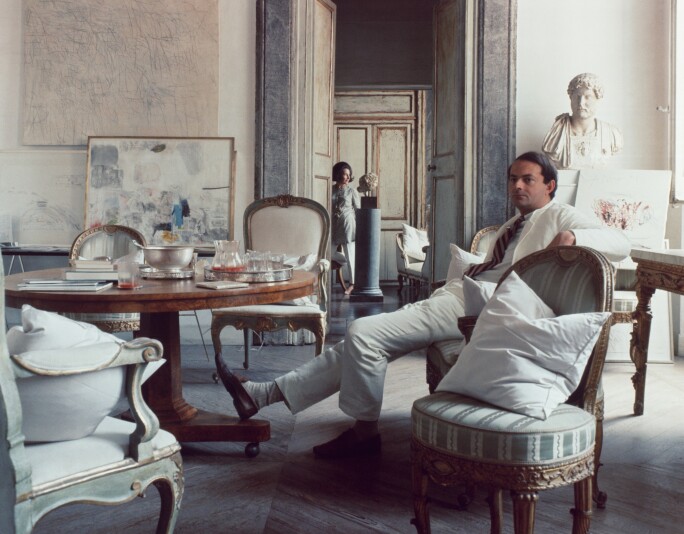
This environment gave Twombly’s instincts a context. His interest in antiquity was not nostalgic or academic; it was visceral. He read voraciously — mythology, lyric poetry, the pre-Socratics, Keats, Rilke — and he began to encode this reading into his paintings, not as illustration but as atmosphere, as a kind of tide pulled by the gravity of old things. Titles began to appear: Leda and the Swan, The Rape of the Sabine Women, Hero and Leandro, Fifty Days at Iliam, the monumental series of ten canvases based on the Iliad that now occupies a permanent room at the Philadelphia Museum of Art. The names pointed toward narratives without representing them. They were invitations to a mode of attention — slow, associative, willing to sit with ambiguity — that the works themselves demanded and that the speed of modern spectatorship tends to resist.
The Italian critics understood something that the New York establishment did not, or understood it sooner. Twombly’s work operated in the register of memory — not personal memory, though that was present, but cultural memory, the deep sediment of Western consciousness. His surfaces felt ancient not because they imitated ancient things but because they enacted the process by which things age: the accumulation of marks, the partial erasure, the layering of one moment of attention over another until the original surface is obscured but not gone. You could, if the light was right, excavate a Twombly canvas as you might excavate an archaeological site — and find, under the recent gestures, older gestures, older intentions, older colours.
The theorist who did the most to explain what Twombly was up to — and who, in doing so, changed the terms on which the work could be received — was Roland Barthes. In a short essay published in 1979, Barthes argued that Twombly’s line was neither writing nor drawing but something prior to both: a trace of the body before culture had organised the body’s movements into systems. He called it a “civilised” scrawl — a gesture that acknowledged the entire history of mark-making while refusing to be constrained by any of its conventions. For Barthes, the shock of Twombly was the shock of recognition: these marks looked like the marks everyone makes when they are alone, when no one is watching, when the hand moves without self-consciousness. That this should be art — that this should be great art — was both liberating and troubling, because it suggested that the line between the artistic and the merely human was thinner than the institution of art preferred to admit.
The essay was widely read and enormously influential, and it provided the intellectual scaffold that many viewers needed to approach work that had previously seemed impenetrable. But it also had an unintended consequence, which was to make Twombly’s paintings sound more comfortable than they are. The idea of the “civilised scrawl” — charming, intimate, body-based — did not quite account for the violence in the work, the occasional sense of rage or grief that moved through it. The Iliam paintings are not comfortable objects; they carry, in their reds and blacks and their accumulating marks, something of the weight of ten years’ war, of the heaped dead, of a civilisation destroying itself in the name of a passion it cannot fully explain. The mythology is not decoration. It is load-bearing.
Twombly’s sculpture, less discussed than the paintings but equally significant, is where this combination of the archaeological and the bodily is most immediately felt. The objects he assembled from the 1950s onward — wood, plaster, wire, found objects, all coated in white paint or wrapped in fabric — look like things rescued from abandonment, or things that are in the process of returning to it. They have the quality of relics: objects that were once part of a life now ended, that retain some residue of that life in their material form without being able to specify what it was. The whiteness — always white, the white of plaster, of sun-bleached bone, of ancient marble — unifies their disparate parts and removes them from the ordinary economy of objects, makes them strange in the way that things in dreams are strange: familiar in their components, unplaceable in their totality.
There is an obvious relationship here to Arte Povera, the Italian movement that emerged in the late 1960s and that shared Twombly’s interest in humble materials and anti-monumental gestures. But Twombly preceded the movement and was not of it, and his relationship to the objects he assembled was more literary than political: he was building ruins, constructing the remnants of a civilisation that had perhaps never existed, or that existed only in the imagination of someone who had spent too many afternoons in the Roman Forum. The sculptures were, in this sense, continuous with the paintings — both were artifacts of a consciousness saturated with antiquity and trying to find a form adequate to that saturation.
The late flowering, when it came, was startling in its chromatic boldness. The painter who had spent decades working in grey, white, and the muted earth tones of old frescoes suddenly, in the 1990s and then with even greater abandon in the following decade, began using colour with an almost shocking directness. The Rose paintings, the Blooming series, the extraordinary Bacchus canvases — great swooping loops of crimson applied with a paint roller in movements that are almost too large for a human arm to have made — arrived like a detonation. Here was an old man, in his seventies and eighties, producing work of an intensity that left younger painters standing. The physical scale and the emotional temperature of these late paintings recall Titian’s flayed final period, another artist who found, at the edge of life, that he had not yet said what he most needed to say.
His legacy is diffuse in the way that all genuinely original legacies are diffuse: it is difficult to point to a Twombly school because what he transmitted was not a style but a permission — the permission to be messy, to be literary, to be slow, to take antiquity seriously without being academic, to let the hand move in ways that the critical mind might censor. You can find him in the work of the sculptor Rachel Whiteread, in her attention to the residue left by objects and bodies. You can find him in certain painters — Julie Mehretu, whose vast canvases layer mark over mark in a way that consciously engages his archaeological model; Christopher Wool, whose stencilled letters on white ground shares something of the tension between word and image that Twombly spent his career exploring. You can find him in photography, in fashion, in graphic design — wherever the scrawl has been reinstated as a form of intelligence rather than a failure of discipline.
The harder part of the legacy is the one the market has made difficult to discuss. Twombly’s paintings are, today, among the most expensive objects in the world, and the fetishisation of price has a tendency to close down precisely the kind of open, wandering attention his work requires. When a painting costs eighty million dollars, it becomes an investment before it becomes an experience; it enters the logic of asset management, of storage facilities and insurance valuations, a logic that is entirely inimical to the mode of seeing the work demands. There is a bitter irony in this for an oeuvre so persistently concerned with transience, with the trace, with the way things age and fade and are incompletely remembered. Twombly made paintings about the pathos of time; the art market has made them timeless, in the worst sense — sealed, inert, endlessly monetisable.
What survives the market, what continues to work on the viewer who encounters the paintings in a museum context with enough time and enough quiet, is something that no price can account for. It is the sense, almost physiological, of being in the presence of a mind that took the whole of Western culture seriously and found, in doing so, not a burden but a liberation. Twombly’s paintings are full of things — myths, wars, seasons, the names of poets, the smell of the Mediterranean in August — and simultaneously full of nothing, of pure mark, pure gesture, pure time. They hold these states together without resolving them, as consciousness itself holds irreconcilable things together without resolution.
The room in the Menil is still there. The grey loops still move across the canvas. The light in Houston in the afternoon falls at a specific angle that makes the marks look, for a moment, like they were made this morning by someone who has just left the building. Perhaps that is Twombly’s final, most durable achievement: to have made work that has no fixed moment of creation, that belongs as much to the present of the viewer as to the past of the maker — work that is, in the deepest sense, perpetually unfinished, perpetually becoming, perpetually, restlessly, alive.
The largest permanent collection of Twombly’s work is housed at the Cy Twombly Gallery within the Menil Collection, Houston, designed by Renzo Piano. His Fifty Days at Iliam is on permanent display at the Philadelphia Museum of Art.
Discover more from My World of Interiors
Subscribe to get the latest posts sent to your email.

