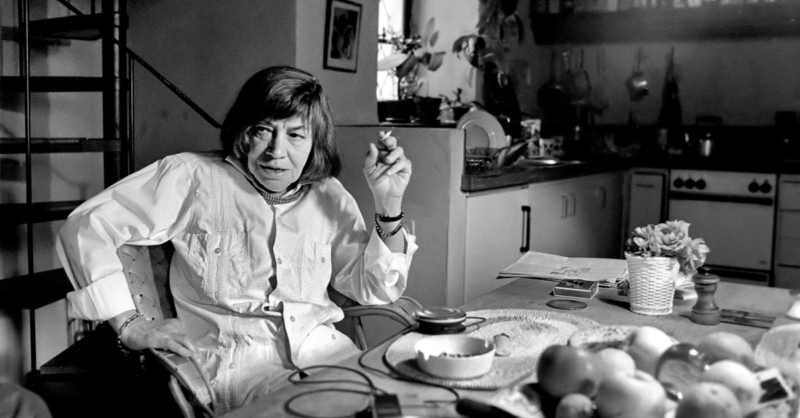
When Patricia Highsmith published The Talented Mr. Ripley in 1955, she created a new kind of antihero: elegant, amoral, adaptable, and disturbingly successful. Tom Ripley not only survives but thrives, slipping into identities, murdering when necessary, and always convincing us — against our better judgment — to follow him. Over five novels (collectively known as The Ripliad), Highsmith traced Ripley’s evolution from insecure conman to settled country gentleman, his crimes smoothed into habit.
Cinema has returned to Ripley again and again. Each adaptation reshapes him for its own moment, altering the balance between glamour and menace, eroticism and calculation, triumph and punishment. Taken together, these Ripleys form a mosaic of cultural anxieties across decades: postwar Europe, Cold War dislocation, late-20th-century queer desire, 21st-century noir minimalism.
Highsmith’s Creation: Ripley the Survivor
In the novels, Ripley is never a simple villain. He is insecure, envious, resourceful, and strangely sympathetic. Highsmith’s prose places us inside his head, aligning us with his paranoia and improvisation. He murders, deceives, and yet escapes — not once, but repeatedly. By the later novels (Ripley Under Ground, Ripley’s Game), he is a man of means, married, living in a villa outside Paris, his violent past buried under layers of respectability.
The moral audacity of Highsmith’s design is that Ripley wins. He is not destroyed by guilt, nor caught by law. His triumph is unsettling because it undermines our expectation that crime stories end with justice.
The Novels: The Ripliad
- The Talented Mr. Ripley (1955) – Ripley murders Dickie Greenleaf in Italy and assumes his life.
- Ripley Under Ground (1970) – Ripley manipulates the art world through forgeries and fraud.
- Ripley’s Game (1974) – Ripley orchestrates contract killings, more puppet-master than participant.
- The Boy Who Followed Ripley (1980) – Ripley befriends a troubled youth, testing his moral detachment.
- Ripley Under Water (1991) – Past crimes threaten to resurface, but Ripley remains unrepentant.
Ripley on Screen: A Gallery of Impostors
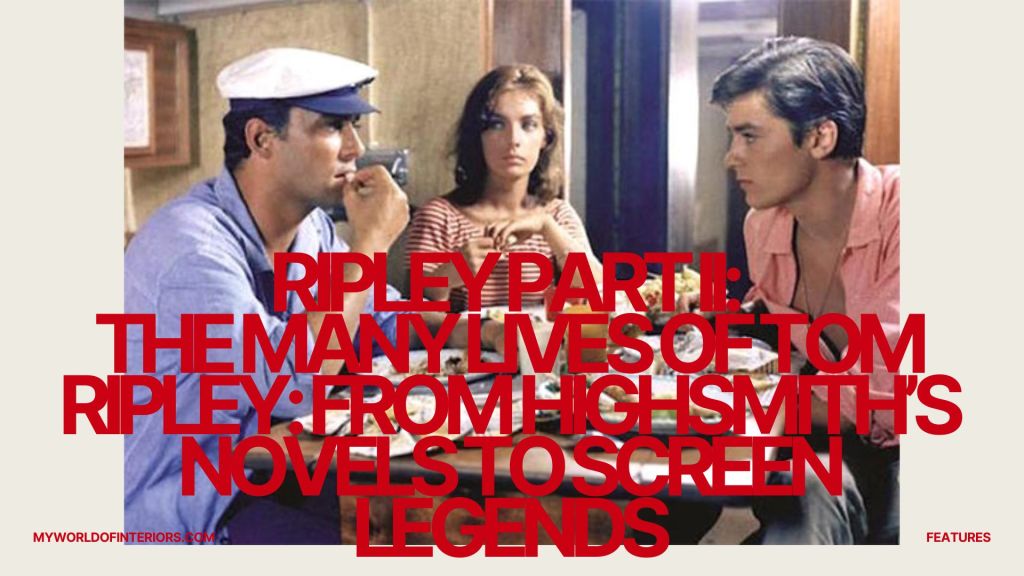
Purple Noon (1960, dir. René Clément)
The first major adaptation stars Alain Delon at his most beautiful, embodying Ripley as dangerously glamorous. Shot in luminous color on the Mediterranean coast, it captures the allure of Dickie Greenleaf’s world but changes the ending: Ripley is caught. 1960s audiences got Delon’s elegance but not Highsmith’s amorality.
The American Friend (1977, dir. Wim Wenders)
Adapting Ripley’s Game, Wenders cast Dennis Hopper as Ripley — a surprising choice that turns him into a shaggy, alienated American drifting through Hamburg. The film fuses Highsmith’s paranoia with Wenders’ existential melancholy, and the result is Ripley as trickster, more spectral than seductive.
The Talented Mr. Ripley (1999, dir. Anthony Minghella)
Minghella’s lush, operatic version re-centers Ripley (Matt Damon) as a tragic outsider. The Mediterranean becomes a theatre of desire and exclusion, Dickie (Jude Law) its golden idol. Minghella makes explicit what Highsmith only suggested: Ripley’s homoerotic longing. The ending, in which Ripley murders Peter and condemns himself to eternal solitude, reframes him not as survivor but as tragic figure.
Ripley’s Game (2002, dir. Liliana Cavani)
Here Ripley is played by John Malkovich: urbane, middle-aged, settled in his villa. This Ripley is past youthful insecurity. He is elegant, sardonic, entirely comfortable with killing. Malkovich’s chilly charisma shows a Ripley closer to Highsmith’s later novels: the murderer as gentleman.
The Return of Mr. Ripley (2005, dir. Roger Spottiswoode)
A made-for-TV adaptation of Ripley Under Ground, with Barry Pepper as Ripley. Less celebrated than other versions, it nonetheless underscores Ripley’s adaptability: here he is enmeshed in the art world, coolly manipulating forgeries and deaths.
Ripley (Netflix, 2024, dir. Steven Zaillian)
Andrew Scott takes on Ripley in a noir reinvention: shot in stark black-and-white, the eight-episode series stretches Highsmith’s first novel into a slow, meticulous study of deception. This Ripley is older, more austere, less erotic than Damon’s or Delon’s — a solitary craftsman of lies, his duplicity rendered with minimalist elegance.
Why Ripley Endures
Each Ripley reflects its cultural moment:
- Delon’s Ripley (1960) — glamorous, punished, a cautionary tale for postwar audiences still clinging to moral order.
- Hopper’s Ripley (1977) — alienated, existential, mirroring the uncertainties of a drifting Cold War era.
- Damon’s Ripley (1999) — tragic, queer-coded, embodying anxieties around identity and repression at the turn of the millennium.
- Malkovich’s Ripley (2002) — urbane, comfortable, a reflection of a globalized early-2000s world where amorality had become normalized.
- Scott’s Ripley (2024) — noir, austere, a meditation on duplicity in an age of image and surveillance.
What unites them is Ripley’s fundamental slipperiness. He is always performing, always in-between, never quite villain or victim. Each performance is a mask — but the mask is the truth.
Conclusion: The Chameleon’s Legacy
Tom Ripley is less a character than a cultural mirror. Highsmith created him to disturb, to make us complicit in his triumph. Cinema has reshaped him over sixty years into glamour, tragedy, noir, and irony. No single Ripley is definitive — Delon’s beauty, Damon’s pathos, Malkovich’s chill, Scott’s shadows all reveal facets of the same enigma.
That he keeps returning is testament to his resonance. Ripley embodies the fantasy of reinvention, the terror of exposure, the allure of duplicity. He is our double, our imposter, our talented nobody who dares to become somebody — no matter the cost.
