Encounters
America Laid Bare
Cady Noland made some of the most disturbing art of the late twentieth century from beer cans, shopping carts, silkscreened celebrity mugshots, and the hardware of American violence. Then she stopped. She has barely spoken since. The silence is part of the work.
By Bergotte
There is a work by Cady Noland from 1989 called Tanya. It is a silkscreen on aluminium of Patricia Hearst — the newspaper heiress kidnapped by the Symbionese Liberation Army in 1974, who subsequently joined her captors, took the name Tanya, and was photographed robbing a bank with an assault rifle. The image is the famous bank surveillance photograph, grainy and flat, the figure of Hearst/Tanya standing with the weapon in the neutral posture of someone carrying out a task that has become, through repetition or ideology or both, entirely ordinary. Noland has printed it on brushed aluminium, the metal surface giving the image a cold, slightly industrial sheen, the kind of surface you associate not with art but with the panelling of a commercial refrigerator or the inside of an elevator. The effect is to make the image neither more nor less disturbing than it already is — which is to say: very. The aluminium does not aestheticise. It simply presents.
This is Noland’s method in miniature: the found image, the found object, the refusal to transform or elevate or comment, the insistence that the material is already saying everything that needs to be said and that the artist’s job is to arrange the conditions in which that everything can be heard. She made work from 1987 to approximately the late 1990s — a decade, more or less — and in that decade produced a body of work so concentrated and so formally intelligent and so genuinely uncomfortable that it has not been matched in American art since. Then she stopped. She has given almost no interviews. She has refused almost all documentation of her work. She has sued auction houses and collectors over the presentation and condition of pieces she no longer controls. She exists, in the art world, as a presence defined almost entirely by absence — the artist who stopped, who will not explain why, who insists on her right to be unavailable.
She insists that the material is already saying everything that needs to be said and that the artist’s job is to arrange the conditions in which that everything can be heard.
New York, 1987
Cady Noland was born in Washington D.C. in 1956, the daughter of the painter Kenneth Noland, whose stained canvases of concentric circles and chevrons in the Colour Field tradition were among the most celebrated American paintings of the 1960s. She grew up, in other words, in the heart of the American art world, with a father whose relationship to the canvas was one of pure formal exploration — the painting as an investigation of colour and shape, stripped of narrative, stripped of politics, stripped of the figure and the world it inhabits. Her own work could not be more different. It is all narrative, all politics, all figure, all world. The formal exploration, if that is what it is, is of the ugliest and most contested surfaces of American life — the celebrity, the criminal, the icon of violence, the ordinary consumer object in its capacity to carry and conceal the social forces that produced it.
She arrived in the New York art world in the late 1980s, at a moment when the market was at its most inflated and most confident, when the distinction between the artwork and the commodity had become, in certain quarters, effectively meaningless, and when a generation of artists — Jeff Koons, Haim Steinbach, Ashley Bickerton — were exploring the aesthetics of consumer culture with a knowing irony that the market found, paradoxically, entirely comfortable. Noland’s work arrived in this context and immediately registered as something different — harder, less ironic, less comfortable, less willing to make the critique into something that could be collected and displayed without consequence.
The Objects
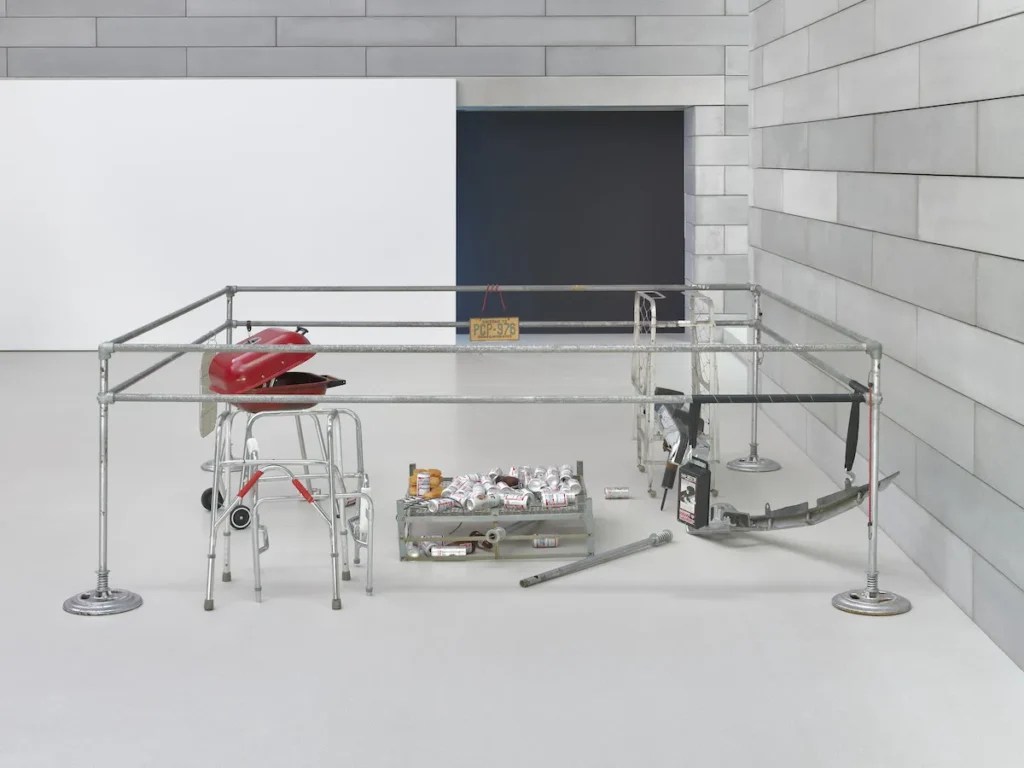
The materials of Noland’s work are specific and consistent: aluminium, stainless steel, beer cans, shopping carts, the hardware of American recreational violence — leg irons, handcuffs, the aluminium poles used in American football practice — and the found images of American celebrity disaster. Patty Hearst. Lee Harvey Oswald. Charles Manson. Sid Vicious. The faces that the American media had turned into icons of violence or transgression, reproduced on aluminium with the flat, deadpan fidelity of the surveillance photograph or the police mugshot.
The beer cans are among her most disarming works. She arranged them — empty Budweiser and Miller cans, the standard vessels of American mass culture — in geometric formations on the floor or the gallery wall, or incorporated them into floor pieces with metal poles and wooden planks, the casual detritus of a backyard or a tailgate party given the formal attention of an installation. The cans are not ironic in the Warhol sense — they are not being elevated into art by the simple gesture of the artist’s attention, not being reframed as icons of consumer beauty. They are being used as evidence. Evidence of a specific culture, a specific set of social habits, a specific relationship between the individual and the market that has produced and distributed and discarded them.
The cans are not ironic in the Warhol sense. They are not being elevated into art by the simple gesture of the artist’s attention. They are being used as evidence.
The shopping carts — several works from the late 1980s and early 1990s use them as primary material, sometimes upright, sometimes tipped on their sides, sometimes incorporated into larger assemblages — carry a similar charge. The shopping cart is the most democratic object in American consumer culture: available to everyone, owned by no one, the vehicle of acquisition and the symbol of the supermarket economy that has organised American life since the 1950s. Tipped on its side, it becomes something else: the residue of a disturbance, the aftermath of a riot or a rage or simply the exhaustion of the system that the cart was designed to sustain.
America as Crime Scene
The theoretical framework behind Noland’s work — she wrote several texts in the late 1980s and early 1990s that remain among the most rigorous pieces of critical writing produced by an American artist of her generation — draws heavily on sociological and psychoanalytic accounts of American culture, particularly on concepts of scapegoating, of the outsider figure who absorbs the society’s violence and dysfunction and is then expelled or destroyed. The celebrity criminals who appear in her work — Hearst, Manson, Oswald — are not there as subjects of fascination or as icons of transgression to be celebrated. They are there as diagnostic material: figures through whom the culture reveals something about itself that it would prefer not to acknowledge.
Noland’s America is a place of extraordinary violence operating beneath an extraordinarily cheerful surface — beer cans and shopping carts and the Stars and Stripes, the visual language of a culture that has decided that abundance and freedom are the same thing, and that the violence required to maintain both is best acknowledged through the mechanisms of celebrity: the scapegoat elevated and then destroyed, the criminal turned into an icon, the icon turned into a product, the product sold back to the culture that produced the original violence. The loop is closed. The aluminium surface reflects nothing back. The shopping cart lies on its side.
The Flag
Several of Noland’s works use the American flag, or its formal elements, in ways that are neither celebratory nor straightforwardly critical. One installation places a flag on the floor — not hung, not displayed, but laid flat, walked over, treated as a surface rather than a symbol. The gesture has a long history in American art, from Jasper Johns’s flags onward, but Noland’s use of it has a specific quality that distinguishes it from the tradition: where Johns’s flags are about the ambiguity of the image, about the gap between the object and its representation, Noland’s floor flag is about use — about the relationship between the symbol and the body, about what it means to walk on the thing you are supposed to revere, about the violence that the flag has historically been used to authorise and conceal.
The Stars and Stripes appears in her work the way the beer cans appear: as evidence, as an object carrying a weight of meaning that the culture has both produced and refused to examine. To put it on the floor is not a political statement in the simple sense. It is an analytical gesture — a way of looking at the object from an angle the culture does not usually permit, of seeing what it looks like when it is no longer performing its official function.
The Withdrawal
Noland stopped exhibiting new work in the late 1990s. The reasons have never been fully explained, because she has declined to explain them. What is known is that she has remained actively engaged with the fate of works she made in her productive decade — engaged, specifically, in litigation. She has sued to disavow works that have been damaged or restored without her authorisation, arguing that the altered work no longer represents her intention and that she should not be credited as its maker. The cases have been legally and philosophically complex, raising questions about the relationship between the artist’s intention and the physical object that carries it, about the limits of the artist’s authority over work that has entered the market and passed through multiple hands.
The litigation is, in its way, continuous with the work itself. Noland spent her productive decade examining the mechanisms by which American culture produces, circulates, and consumes its objects — how things move from maker to market to collector to institution, accumulating value and losing context at each stage. Her subsequent legal battles are an examination of the same mechanisms from the other side: the artist’s attempt to maintain some form of authority over objects that the market has turned into investments, to insist that the intention behind the work matters even after the work has been sold and resold and altered and displayed in conditions she did not sanction.
The litigation is continuous with the work itself — the artist’s attempt to maintain authority over objects that the market has turned into investments, to insist that intention matters even after the work has been sold and resold and altered.
She is, as a result, one of the most expensive and least seen artists in the contemporary art market. Her works change hands at auction for sums in the millions. They are rarely exhibited publicly, partly because institutions are wary of her legal responses to any exhibition that does not meet her standards of presentation and condition, and partly because the works themselves — floor pieces, wall-mounted aluminium, assemblages of industrial hardware — are difficult to present correctly and easy to damage. She is famous and invisible simultaneously, which is, for an artist whose work is about the mechanisms of American celebrity, either a coincidence or the most elegant final statement she could have made.
What She Left
A decade of work. A handful of texts. A series of legal actions. An absence so complete that it has become, in the art world’s telling, a presence — the silence of Cady Noland read as a refusal, a protest, a continuation of the argument the work was making. This may be giving the silence more credit than it deserves; withdrawal from the art world has many causes, not all of them philosophical. But the silence does rhyme with the work in a way that is difficult to ignore. An artist who spent a decade examining what American culture does to its objects, how it produces and circulates and discards them, has declined to be produced and circulated and discarded herself. She made the work. She released it into the market. She watched what the market did with it. She stopped.
The beer cans are still arranged on the gallery floor, in the institutions that own them, in the configurations she established. The aluminium Patty Hearst is still reflecting the light back at nothing. The shopping cart is still on its side. The work does not need her present to make its argument, which was always the argument that the objects make about themselves when you give them the right conditions and then step back and let them speak. She stepped back. The conditions remain. The objects are still speaking, in the flat, deadpan, slightly industrial voice that she gave them — the voice of American culture describing itself without knowing it is being recorded.
Works referenced: Tanya (1989); Set Up (1989); Oozewald (1989); Manson Guitar (c.1990); Cowboy Bootstraps (1990); The American Trip (1988). Cady Noland’s written texts include “Towards a Metalanguage of Evil” (1989) and “Sited Bootstraps” (1990). Her work is held in major institutional collections but is rarely exhibited publicly. This essay is part of an ongoing series, Encounters, on artists whose practice cannot be easily categorised.

Leave a Reply