
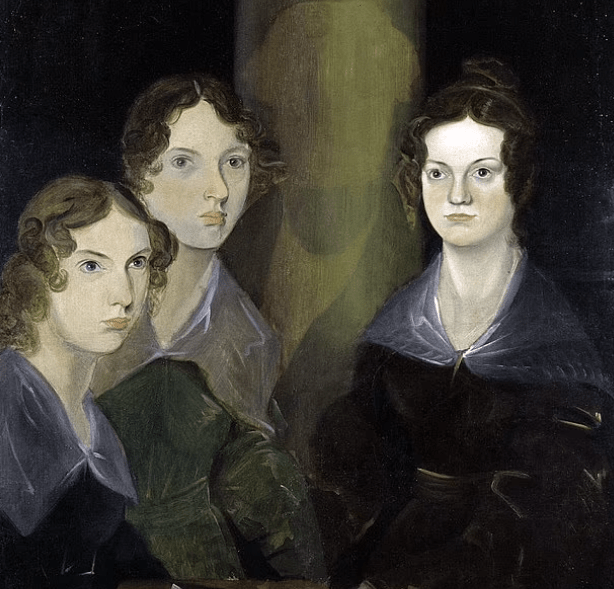
Rochester broods. Heathcliff rages. Huntingdon drinks. The men of the Brontë novels have been romanticised for nearly two centuries. It may be time to look at them more carefully.
By Bergotte
There is a moment in Jane Eyre that readers have been arguing about since 1847. Edward Rochester, master of Thornfield Hall, has just revealed to his assembled wedding guests — and to Jane, standing beside him at the altar — that he has a wife living in the attic of his house. The wife, Bertha Mason, is Creole, Jamaican-born, and has been locked upstairs for years, periodically restrained when she escapes to set fire to things or slash the throats of visiting relatives. Rochester’s explanation for this arrangement is offered with the implication that he expects, and perhaps deserves, sympathy: he was tricked into the marriage, he did not know about the madness in her family, he has been denied the companionship and love that he needed, and he has found it at last in Jane, and is it not monstrously cruel that the law and the church and the presence of a woman he cannot bring himself to call his wife should stand between him and the happiness he has finally, deservedly found?
He gets the sympathy. Not from Jane — Jane leaves, at enormous personal cost, with a moral clarity that is the finest thing in the novel — but from generations of readers who have taken Rochester’s self-description largely at face value, who have found in his brooding, his damage, his intensity, and his eventual blinding and humbling at the hands of a burning house, the outlines of a romantic hero. He has been voted, in any number of reader polls, the most desirable hero in English fiction. Colin Firth played him. Toby Stephens played him. Michael Fassbender played him, with cheekbones that went some way toward explaining why the romantic interpretation persists. He has become, in the cultural imagination, the template for a certain kind of difficult man whom love might redeem — dark, complicated, haunted, fundamentally worthy beneath the surface damage.
Your instinct — that there is something excessive in the brooding, something that requires more scrutiny than it usually receives — is, this essay will argue, not merely defensible but critically overdue.
The Brontë sisters wrote their major novels within a few years of each other in the late 1840s, in the parsonage at Haworth on the West Yorkshire moors, in conditions of geographical isolation and domestic intimacy that shaped what they produced in ways that remain only partially understood. Charlotte published Jane Eyre in 1847. Emily published Wuthering Heights in the same year. Anne published The Tenant of Wildfell Hall in 1848, the year before her death at twenty-nine. Three novels, three sisters, three takes on the question of men — and the takes are, if you read them together rather than in isolation, more divergent and more interesting than the cultural packaging of the Brontë myth tends to suggest.
The myth packages all three sisters together as romanticists, as writers of passion and moor and stormy weather and difficult men who are worth the difficulty. This packaging is convenient and substantially wrong. Charlotte was indeed a certain kind of romantic, with qualifications. Emily was something stranger and darker than romance. And Anne, the youngest and least celebrated, was the one writing what we would now call feminist realism — was writing, with a clarity her sisters did not quite achieve, about what men like Rochester and Heathcliff actually do to the women who love them, and what the consequences look like in the morning.
Rochester first, since he is the most discussed and in many respects the most instructive case. He is forty to Jane’s eighteen when they meet, her employer, the master of the house she has been hired to govern as governess. The power differential is absolute by the standards of any era, and more absolute still by the standards of 1847, when a governess occupied a peculiarly precarious social position — educated enough to be present in the drawing room, employed enough to be excluded from it, entirely dependent on the goodwill of the family who had taken her in. Rochester knows this. He is not unaware of the structural advantages he possesses. He uses them, not brutally, but consistently — the intimacy he encourages, the confidences he extracts, the emotional dependency he fosters, are all cultivated in conditions that Jane cannot, realistically, refuse.
This does not make him a villain. Charlotte Brontë is too good a novelist, and too honest about her own psychology, to write a villain. What makes Rochester interesting, and what makes him more troubling than the romantic template allows, is his self-knowledge. He knows what he is doing. He knows he is managing Jane — drawing her in, testing her, performing a vulnerability that is not entirely authentic, constructing around himself a narrative of suffering that invites her sympathy and explains, in advance, any behaviour that might otherwise require justification. He is, in modern terms, a man who has understood that the way to manage women is to present yourself as a man who has been insufficiently understood by women, and who requires the right woman — patient, intelligent, uncorrupted by worldliness — to finally see you as you truly are.
Jane sees him truly. This is the novel’s great achievement and its great complication. She sees through the performance to something real — a genuine intelligence, a genuine capacity for feeling, a loneliness that is not entirely manufactured — and she loves what she sees. But she does not, at the crucial moment, allow what she loves to override what she knows. When she leaves Thornfield, after the revelation of Bertha, she is not leaving because she does not love Rochester. She is leaving because she cannot remain and continue to be Jane — cannot remain and continue to be a person whose self-respect is intact, whose moral understanding of her own situation is honest. “I care for myself,” she tells him, in the novel’s most important sentence. “The more solitary, the more friendless, the more unsustained I am, the more I will respect myself.”
It is a magnificent line. It is also, in the context of the novel’s eventual resolution, slightly complicated by the fact that Jane does return, does marry Rochester, does get the life she wanted with the man she loved. Charlotte Brontë is not Anne. She cannot quite resist the happy ending, and the happy ending requires that Rochester be sufficiently punished — blinded, maimed, reduced — to receive Jane on something approaching equal terms. Whether this is emotionally satisfying or narratively convenient or some mixture of both is a question each reader has to answer for themselves. What it does not do is resolve the structural problem at the novel’s centre, the problem of a love story conducted under conditions of such radical inequality that its romance has always depended on not looking too carefully at the conditions.
Heathcliff is a different and in many ways more extreme case, and the cultural romanticisation of him is one of the more puzzling phenomena in the history of literary reception. He is introduced as a child foundling of ambiguous racial origin — dark enough that the novel’s characters consistently describe him in terms that invoke the racialised anxieties of nineteenth-century England — and he grows up in conditions of sustained cruelty and neglect at Wuthering Heights that would, in a realistic novel, produce a psychologically damaged adult. Wuthering Heights is not, in any straightforward sense, a realistic novel, but it does not entirely abandon the logic of cause and effect. Heathcliff becomes what he becomes because of what was done to him. This is the most charitable reading, and it is the one the novel makes most available.
What Heathcliff becomes is: a man who marries a woman he does not love in order to acquire property and cause pain to her brother; a man who treats his wife with comprehensive cruelty that stops just short of the physical violence he clearly contemplates; a man who, having acquired legal control over her son after her death, uses the child as an instrument of further vengeance; a man who effectively imprisons a young woman, forces her into marriage with his dying son, and arranges matters so that her property and her future are entirely in his hands. In between all of this, he maintains an obsessive, consuming, arguably genuine passion for Catherine Earnshaw that has convinced generations of readers to view everything else as peripheral.
The passion is real. Emily Brontë makes it real, with a force and a strangeness that has never quite been explained — the sense that Heathcliff and Catherine are not simply two people in love but two halves of something that should not have been separated, that their union is less a romance than a metaphysical necessity. “He’s more myself than I am,” Catherine says, in one of the most extraordinary sentences in the English novel. “Whatever our souls are made of, his and mine are the same.” This is not the language of romance. It is the language of mystical union, of something that predates and will outlast the ordinary categories of human relationship. Emily Brontë is not writing a love story in any conventional sense; she is writing something closer to a myth, and myths are not subject to the same moral accounting as realistic fiction.
And yet the accounting exists alongside the myth, insisted upon by the novel’s structure and its secondary characters and particularly by Nelly Dean, the housekeeper narrator whose reliability is the subject of considerable critical dispute but whose observations about Heathcliff’s behaviour are consistently borne out by events. The romanticism and the realism coexist in Wuthering Heights without resolving into each other, and this irresolution is the source of the novel’s power and its discomfort. You can be moved by the passion and horrified by the behaviour simultaneously. What you cannot honestly do — though the culture has been doing it for nearly two centuries — is treat the passion as redemption for the behaviour, treat the love as a reason why the cruelty doesn’t count.
Which brings us to Arthur Huntingdon, of The Tenant of Wildfell Hall, and to the question of why Anne Brontë has been so consistently undersold by the literary culture that has celebrated her sisters.
Arthur Huntingdon is the man Helen Graham marries at the beginning of the novel, drawn by his charm and his good looks and her conviction that her love can improve him. He is not brooding. He is not dark. He does not have a Creole wife in the attic or an orphan’s tragic backstory to explain his behaviour. He is, instead, something that the romantic novel of the period had not quite got around to depicting with full honesty: a man who drinks too much, spends money he does not have, is casually and then seriously unfaithful, conducts his affairs in his own house in front of his wife, and — the novel’s most radical element — begins to corrupt his young son, teaching the child to drink and to swear and to treat women as his father treats them, as a form of entertainment and convenience.
Helen leaves him. This was, in 1848, a genuinely radical act for a fictional heroine, and Anne’s depiction of it is precise about the difficulty — the legal situation that means the child belongs to the father, the social stigma that attaches to the wife who leaves, the economic vulnerability of a woman without independent means. She does not sentimentalise any of it. She does not suggest that Helen’s departure is easy or that the culture around her treats it as anything other than a scandal. She simply insists, through Helen’s journal and through the moral architecture of the novel, that it is the right thing to do — that a woman’s self-preservation is not selfishness, that a marriage that destroys its participants does not become sacred by virtue of its legal status, that the children of such marriages are better served by honesty than by the maintenance of a fiction.
Charlotte, reviewing the novel after Anne’s death and making decisions about its republication, wrote of it as too harsh, too unsparing, too willing to depict the ugliness of male behaviour without the romantic mitigation that made such depictions palatable. She was describing, with characteristic precision, exactly what made it the most important of the three sisters’ novels for any reader interested in what the nineteenth century actually did to women. Anne had no patience for the brooding hero. She had seen too clearly where brooding heroes ended up.
It is worth asking what personal experience the Brontë sisters were drawing on, though the question must be handled with care since biography is not criticism and the novels are not confessions. What we know is that Branwell Brontë — their brother, the only son, the one on whom the family’s hopes had been most completely placed — spent the last years of his life in a condition of alcoholism, opium addiction, and comprehensive personal failure that the sisters witnessed at close quarters. He died in 1848, the same year as The Tenant of Wildfell Hall‘s publication, at thirty-one. The Arthur Huntingdon of Anne’s novel — charming, self-destructive, impossible to help, catastrophic to those who love him — is not Branwell, but Branwell is somewhere in him, just as something of Branwell’s romantic grandiosity and genuine intelligence is somewhere in Rochester and perhaps in Heathcliff.
The sisters were not writing about types. They were writing about a specific kind of masculine damage they had observed, from the inside of a family in which it was present, and they were each working out a different answer to the question of what you do with it. Charlotte’s answer was: love it, survive it, wait for it to be humbled, then receive it on better terms. Emily’s answer was: understand that some passions are beyond the categories of good and bad, and that the myth is real even when the man is monstrous. Anne’s answer was: leave.
The contemporary reader who finds the brooding heroes excessive is not wrong, exactly, but may be responding to a later cultural accretion rather than to the novels themselves. Two centuries of adaptation, romanticisation, and the production of a Brontë brand built substantially on atmospheric moors and tortured masculinity have created a set of expectations that the novels, read carefully, do not entirely support. Jane Eyre is as much about Jane’s intelligence and moral autonomy as it is about Rochester’s charisma. Wuthering Heights is as much a novel about class, about inheritance, about the violence that property relations do to human beings, as it is about passionate love. And The Tenant of Wildfell Hall is not a romantic novel at all, but something closer to a case study in why the romantic novel’s conventions were insufficient for the reality it was supposed to describe.
What the three novels share, underneath their different temperaments and different arguments, is a remarkable honesty about power — about the way it flows between men and women, about what it does to the people who hold it and the people who don’t, about the difficulty of love in conditions of radical inequality. The brooding heroes are not simply romantic archetypes; they are men shaped by specific social conditions that gave them enormous power and very little accountability, and the interesting thing about each of the sisters is the clarity with which they see this, even when — especially when — their narratives are most emotionally invested in the men they have created.
Rochester is worth loving. Heathcliff is worth being haunted by. Arthur Huntingdon is worth leaving. The Brontës knew all three of these things. The culture, which has preferred the first two to the third, has been slower to catch up.
Jane Eyre and Wuthering Heights were both published in 1847, the former under the pseudonym Currer Bell, the latter under Ellis Bell. The Tenant of Wildfell Hall was published in 1848 under the name Acton Bell. All three sisters died before the age of forty. Anne, the youngest, died in 1849. The parsonage at Haworth, West Yorkshire, where all three novels were written, is now a museum and receives more than eighty thousand visitors a year.
Discover more from My World of Interiors
Subscribe to get the latest posts sent to your email.

