
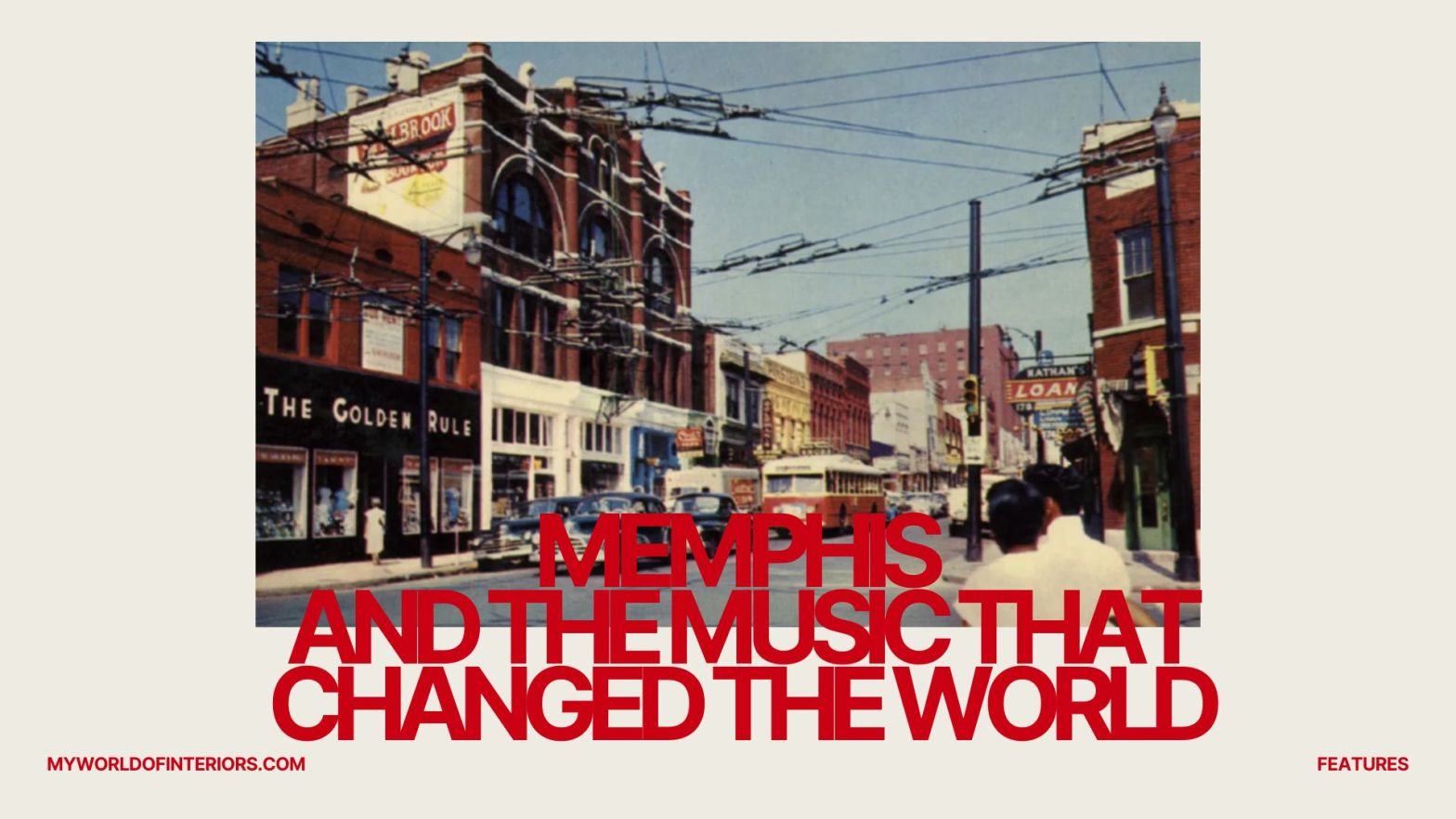
It is the most productive square mile in American cultural history. A city of grief and genius, of violence and transcendence, built on cotton and the blues and the unsettled accounts of race — Memphis made the modern world’s soundtrack and has never quite recovered from the effort.
By Bergotte
Begin with the geography, because in Memphis the geography is everything. The city sits on a bluff above the Mississippi River at the point where Tennessee meets Arkansas and Mississippi, at the northern tip of the Delta, where the great flat alluvial plain of the most American of rivers gives way, almost without warning, to a different kind of country. The river is not, here, a picturesque backdrop. It is a presence — brown and enormous and indifferent, carrying the continent’s interior toward the Gulf of Mexico, carrying, once upon a time, the cotton that made the fortunes and the enslaved people whose labour produced both the cotton and, centuries later, the music. The river is in the music. You can hear it in the way a certain kind of Memphis bass line moves — slow and wide and unstoppable, like something being transported rather than driven. You can hear it in the gaps between the notes, the negative spaces that Delta musicians understood instinctively as structural rather than merely empty. The river taught Memphis musicians how to breathe, and Memphis musicians taught the world.
The city that grew up on that bluff was, from its founding, a place of transit and transaction. Cotton came in from the Delta plantations. Timber came down from the Appalachians. Mules were bought and sold in the largest mule market in the world. Enslaved people were bought and sold too, at the Slave Mart on Adams Avenue, until the Civil War ended that particular commerce — though it did not, of course, end the systems of exploitation and racial subjugation that had produced it, and that would continue, in modified but barely disguised forms, through Reconstruction and the Jim Crow decades and the long, agonising, incomplete process of emancipation that the civil rights movement represented. Memphis was always a city where the money moved and where the people who generated the money saw very little of it. This fact — which is an economic and political fact, but also a human one, a fact about lives lived under conditions of radical inequality — is the ground from which the music grew. To understand Memphis music is to understand, at some level, what it cost.
The Delta, the Blues, and the Cartography of Feeling
The blues did not originate in Memphis. It originated — insofar as something as various and deeply rooted as the blues can be said to have originated anywhere — in the Delta south of the city: in the plantations of Coahoma and Sunflower and Bolivar counties, in the work songs and field hollers and church music that African-American communities had developed over generations as forms of expression under conditions that forbade almost every other form. The blues was, at its root, a response to an impossible situation: it was music that acknowledged the worst of what life had become without consenting to the worst of it, that named the suffering without being consumed by it, that found, in the act of naming, something that was not exactly consolation but was something in the vicinity of freedom.
What Memphis did was receive the blues and transmit it. The city was the nearest major urban centre to the Delta, and from the 1890s onward it drew African-American musicians who were looking for audiences, for money, for the relative freedom of an urban environment after the enforced immobility of the plantation system. They brought their instruments and their traditions to Beale Street, the commercial and entertainment heart of Black Memphis, which by the early decades of the twentieth century had become one of the most vibrant musical communities in the American South: a dense, competitive, mutually stimulating ecosystem of juke joints and theatres and barbershops and street corners where music was played around the clock and where styles and techniques were exchanged and refined and transformed.
W.C. Handy arrived in Memphis in 1909 and began the process of transcribing and publishing the blues — a process that was, from the beginning, commercially and culturally complicated, involving the translation of a largely oral, improvisational, and community-bound music into the written form and commercial medium of Tin Pan Alley, with all the distortions that translation required. His “Memphis Blues” (1912) and “St. Louis Blues” (1914) introduced the form, or a version of it, to audiences far beyond the Delta and beyond the Black community that had produced it. This was the beginning of a pattern that would repeat, with variations, throughout the twentieth century: Memphis music moves outward, travels upriver and across the country and across the ocean, and in the course of its travels it is adopted and adapted and commercially exploited by people who understand its power without always understanding its origins. The music survives this process, and sometimes flourishes through it, but the people who made it do not always share in the flourishing.
Sun Records and the Sound of Something New
The studio that Sam Phillips built at 706 Union Avenue in 1950 was, by any objective standard, modest: a single room, roughly thirty feet by eighteen, with acoustic tiles on the walls and a modest collection of equipment that would be considered primitive by any subsequent standard. Phillips was a white man from Alabama who had grown up hearing Black music and who believed, with a certainty that verged on the evangelical, that the music being made in the Black communities of Memphis and the surrounding Delta was the most vital and the most important music in America — and that it was, in the early 1950s, almost entirely invisible to the white mainstream.
His original mission was documentation: he recorded Black artists — Howlin’ Wolf, B.B. King, Ike Turner, Little Junior Parker — and leased the recordings to larger labels, Chess in Chicago and Modern in Los Angeles, who distributed them to the “race records” market, as it was then called. He was, in this phase, a conduit: a white man with technical skills and commercial connections who recognised the value of what the Black musicians around him were doing and found ways to bring it to a wider audience. This was both a genuine contribution and an imperfect one — the economics of the arrangement, as with almost all early rhythm and blues recording, were weighted heavily in favour of the labels and the distributors rather than the artists.
But the moment for which Sun Records is most remembered — the moment that changed, with a speed and a completeness that still seems barely believable, the entire trajectory of American popular music — came in the summer of 1954, when a twenty-year-old truck driver from Tupelo, Mississippi, named Elvis Aaron Presley walked into 706 Union Avenue to cut a record as a birthday present for his mother. Phillips had been looking for something specific: a white performer who had absorbed the rhythms and the feeling of Black music so completely that the music was genuinely his, not merely imitated. He was not looking to appropriate Black music for white audiences in the reductive sense. He was looking for a synthesis — for a performer in whom the Black and white traditions of Southern music, which had always existed in proximity and which had always influenced each other despite and through the enforced separations of segregation, could meet and produce something new.
What happened on the night of July 5th, 1954, when Presley, the guitarist Scotty Moore, and the bassist Bill Black were taking a break during a session that wasn’t quite working and began fooling around with Arthur Crudup’s “That’s All Right” — playing it faster, looser, with a lightness that was quite different from the gravity of the original — has been described so many times that it has acquired the quality of myth. Phillips came out of the control room and asked what they were doing. They didn’t know. He told them to do it again, from the beginning. He pressed record. The result was, in some senses, the beginning of rock and roll: a sound that was simultaneously Black and white, Southern and modern, rooted in tradition and genuinely unprecedented. When the record went out to Memphis radio stations, listeners called in asking who it was, asking whether the performer was Black or white, unable to categorise what they were hearing. Their inability to categorise it was the point. The categories had been broken.
Phillips went on to record Carl Perkins, Jerry Lee Lewis, Roy Orbison, Johnny Cash — a roster that reads, in retrospect, like a roll call of the founding figures of American popular music. Each of these men had absorbed the Black Southern music tradition in different ways and to different degrees, and each brought something specific to the synthesis that Sun Records was attempting. Perkins brought the rawness of country and the rhythmic drive of the blues and produced, in “Blue Suede Shoes,” the first rock and roll record to reach number one simultaneously on the pop, country, and rhythm and blues charts. Lewis brought a piano style descended directly from the barrelhouse tradition and a performance energy that frightened people in the way that only the genuinely new ever does. Cash brought a baritone that seemed to come from somewhere geological, from the bedrock of American experience, and an instinct for narrative that was as much literature as music.
But it was Presley who carried the synthesis furthest and who propagated it most widely. By 1956 he had moved from Sun to RCA, from Memphis to national and then global visibility, and the music was moving with him — moving into radio formats and television appearances and film and all the other vectors by which American popular culture was already beginning its conquest of the world’s imagination. What was lost in that movement, and what was gained, remains one of the central arguments in the historiography of popular music: the argument about commercialisation, about racial appropriation, about what happens to a music when it leaves the community that made it and enters the commodity stream. There are no easy resolutions to this argument. There are only the records, which remain extraordinary.
Stax and the Sound of Solidarity
A decade after Sun changed the sound of popular music, another Memphis studio was in the process of changing it again — or rather, of producing a counter-statement so powerful that it effectively created a whole other tradition running parallel to what Sun had started. The Stax Records studio at 926 East McLemore Avenue, in a former movie theatre in a working-class Black neighbourhood of South Memphis, was, by the early 1960s, making soul music — a genre that drew on gospel and rhythm and blues and that combined a formal sophistication with an emotional directness that was quite different from the white rock and roll of the previous decade.
The Stax story is, among other things, a story about racial collaboration of an unusual kind. The studio was founded by a white bank teller named Jim Stewart and his sister Estelle Axton, but its sound was created by an integrated house band — Booker T. and the MGs — whose interracial composition was, in the Memphis of 1962, an act of quiet defiance. Booker T. Jones and Al Jackson Jr. were Black; Steve Cropper and Donald “Duck” Dunn were white. They played together, ate together, argued together, refined together the specific rhythmic and harmonic language that would define the Stax sound: the tight, punchy rhythms, the economy of arrangement, the space — always the space — in which the voices of Otis Redding and Wilson Pickett and Sam and Dave could do their work.
The contrast with the Motown sound, which was emerging simultaneously in Detroit, is instructive. Motown’s genius was for smoothness: for the high-production finish, the orchestral arrangements, the careful calibration of Black music for crossover white audiences. Stax’s genius was for roughness — for the grain in the voice, the squeak of the guitar string, the imperfect synchrony of musicians playing together in a room and making the imperfection part of the music. If Motown was integration as aspiration — the demonstration that Black artists could achieve the same level of surface perfection as any mainstream pop act — Stax was integration as fact: a genuinely integrated environment making music that did not ask for white permission or white approval, that was entirely confident in its own aesthetics and its own audience.
Otis Redding was the centrepiece. To listen to his voice — which he possessed from the very beginning of his recording career, fully formed and fully extraordinary — is to encounter one of the authentic wonders of American musical culture: a voice that could whisper and shout in the same breath, that contained tenderness and desperation in proportions that shifted from moment to moment, that managed the almost impossible trick of sounding simultaneously spontaneous and completely controlled. He died in December 1967, at twenty-six, when his plane went down in Lake Monona in Wisconsin, three days before a scheduled appearance on the Ed Sullivan Show. He had recorded “(Sittin’ On) The Dock of the Bay” seven days before his death. It was released posthumously and became his only number one single. The song has a quality of premonition that is unbearable in retrospect, though this may be partly the retrospect talking: the stillness of it, the absence of the urgency that had characterised his earlier work, the sense of a man watching the tide come in with a new acceptance that sounds, now, like something else.
The assassination of Martin Luther King Jr. in Memphis in April 1968 — he was shot on the balcony of the Lorraine Motel, a few miles from Stax — devastated the studio’s community in ways that were both personal and structural. King had been in Memphis in support of the sanitation workers’ strike; he had friends and allies in the Black musical community; his death was not an abstraction. It was also, in a commercial and cultural sense, the beginning of the end of the integrated experiment that Stax represented. The label’s distribution deal with Atlantic Records — which had been the commercial foundation of its success — fell apart that year. The internal racial tensions that had always been managed rather than resolved began to reassert themselves. The label lurched through a series of crises through the early 1970s and declared bankruptcy in 1975. The building on McLemore Avenue was eventually demolished in 1989; a church was built on the site. In 2003, a new Stax Museum of American Soul Music opened on the original location — a reconstruction, an act of cultural memory, necessary and somehow insufficient.
Al Green and the Sacred and the Profane
In the early 1970s, as Stax was beginning its long decline, a young minister’s son from Forrest City, Arkansas, was recording a series of albums at Hi Records, in the Royal Studios on South Lauderdale Street in Memphis, with the producer Willie Mitchell, that represent one of the sustained peaks of American popular music. Al Green’s run of records from 1971 to 1974 — Let’s Stay Together, I’m Still in Love with You, Call Me, Livin’ for You — are so consistently extraordinary that it requires an act of critical discipline not to simply list them and fall silent.
What Mitchell and Green created together at Royal Studios was a sound of almost implausible intimacy — close-miked vocals that placed Green’s voice inside your ear, string arrangements so gentle they were barely present, rhythms so perfectly calibrated to the body’s natural movement that the music seemed less performed than metabolised. Green’s voice was, and remains, one of those voices that seems to dissolve the boundary between music and the other things — desire, grief, the complicated feeling of being alive — that music is trying to describe. He could be a falsetto that made you feel you were listening to something barely earthly, and a baritone that felt like it was coming from the same place as your own longing.
The tension in the music, which is part of what makes it so affecting, is between the erotic and the sacred — between the song as a love song and the song as a kind of prayer. Green grew up in the church, in the Pentecostal tradition in which the boundary between the worship of God and the expression of physical feeling is deliberately thin, in which the body’s pleasures and the spirit’s ecstasy are not opposites but aspects of the same experience. He brought this ambiguity into secular music and refused to resolve it. His love songs feel like hymns; his hymns feel like love songs. The “you” in the songs is perpetually uncertain — a woman, God, the listener — and the uncertainty is not a flaw but the point.
In 1974, following a personal crisis that has been documented and mythologised in equal measure, Green left secular music and was ordained as a pastor of the Full Gospel Tabernacle church, which he still leads, in Memphis. He has recorded gospel music since, returned periodically to secular recording, performed at the White House, received the Kennedy Center Honors. But nothing he has done since the early seventies quite matches the run of records he made with Willie Mitchell. This is not a criticism. The records from that period are not a standard that most artists could sustain for a career, let alone match after a twenty-year absence. They are simply, and permanently, among the finest things ever recorded in American music.
Three 6 Mafia and the Sound of the Underground
The story of Memphis music does not end with soul, and it does not end with the respectable. Thirty years after Otis Redding and Al Green were making some of the most beautiful music in American history, a group of producers and rappers operating under the collective name Three 6 Mafia — founded in the early 1990s by DJ Paul and Juicy J, working out of home studios and cars and the margins of a city that had by then been largely abandoned by the industries and institutions that had once given it economic coherence — were making something that sounded like nothing before it and that would, in the course of the following two decades, remake the entire sonic landscape of American popular music.
The Memphis rap scene of the early nineties was not, in the first instance, a commercial phenomenon. It was a subculture — dense, self-referential, operating almost entirely through mixtapes and word of mouth, distributed from car boots and informal networks with a complete indifference to the existing structures of the music industry. The music was dark in the way that certain Southern Gothic literature is dark: not for effect, not as a pose, but as an honest response to conditions of life that were genuinely harsh. The deindustrialisation of Memphis, the crack epidemic, the collapse of the public infrastructure that had once served the city’s Black communities — all of this is in the music, not thematised or allegorised but present as texture, as atmosphere, as the sonic correlate of living in a city where the institutions had largely given up.
Three 6 Mafia’s sound was built from samples — horror movie soundtracks, obscure soul records, synthesiser lines that seemed to come from the bottom of the Mississippi — layered into beats of unusual complexity and then decorated with a style of rapping that was less about lyrical dexterity in the conventional hip-hop sense than about texture and flow, about the way words could become almost purely rhythmic objects, syllables arranged for their sonic weight rather than their semantic content. They called their approach “Memphis rap” and also “triple six” and a variety of other names, and it was sufficiently distinctive that it generated its own regional scene — a network of affiliated artists and producers, Tear Da Club Up Thugs and Gangsta Boo and La Chat and others, whose combined output in the nineties constitutes one of the most sustained and least adequately documented achievements in the history of American hip-hop.
The influence of this scene — long unacknowledged, the way that Black music from the South has always been slow to receive its due — is now everywhere. The slow, ominous, bass-heavy production style that Three 6 Mafia pioneered is the direct ancestor of trap music, which is the direct ancestor of the dominant aesthetic of contemporary popular music in everything from hip-hop to pop to electronic music. When Drake or Future or Cardi B makes a record, they are making it in a sonic environment that was substantially created by a group of young Black men working in Memphis in conditions of poverty and marginalisation and complete commercial indifference. In 2006, Three 6 Mafia won the Academy Award for Best Original Song, for “It’s Hard Out Here for a Pimp” from the film Hustle and Flow — a moment of such concentrated cultural strangeness, the Memphis underground receiving the imprimatur of Hollywood’s most establishment institution, that it felt like a kind of joke, though whose joke and at whose expense was genuinely unclear.
The City and the Cost
To write about Memphis as a cultural phenomenon without writing about Memphis as a place — as a city with specific political and economic and social conditions that have made it, simultaneously, extraordinarily productive and extraordinarily damaged — would be a form of dishonesty. The music did not come from nowhere. It came from a city with one of the highest poverty rates in the United States, one of the highest rates of violent crime, one of the most racially segregated housing patterns, one of the most underfunded public school systems. It came from communities that had been systematically denied the benefits of the prosperity that their ancestors’ labour and their own cultural production had generated for others.
The relationship between suffering and art is one of the oldest and most contested questions in aesthetics, and it is not one that admits of a simple answer. It would be sentimental and false to suggest that the poverty and the violence and the racial inequality of Memphis were necessary conditions for the music — as if suffering were a productive input, as if the extraction of cultural value from marginalised communities were a tolerable cost. It would also be false to pretend that the specific conditions of Memphis had nothing to do with the specific character of what was produced there. The blues is not a music of comfortable people. Soul music is not the expression of a satisfied community. Memphis rap is not made by people who have no complaints. The music is shaped by the conditions of its making, and the conditions of its making have been, consistently and across more than a century, conditions of deprivation and resilience and the complicated creativity that emerges when there is very little else available to express the full range of human experience.
The great Memphis music critic and historian Robert Gordon has written, with careful and sustained attention, about the relationship between the city’s politics and its culture. His book It Came from Memphis (1995) is the best account of the specific ecosystem — the network of radio stations, record stores, studios, churches, clubs, and informal social networks — that produced the music. What his account makes clear is that the music was never the product of isolated genius: it was always the product of community, of the kind of dense, mutually stimulating environment that generates creativity through competition and collaboration in equal measure. The genius of Presley or Redding or Three 6 Mafia is real. But it is not separable from the community that produced it and that the music, in turn, helped to sustain.
What Memphis Gave the World
It is worth trying to inventory what came out of 906 square miles of bluff above the Mississippi, because the inventory is almost absurd in its richness. Rock and roll. Soul music. The specific strain of country music that produced Cash and Perkins. The blues tradition, received from the Delta and transmitted to the world. Gospel music in a form that influenced everything else. Trap music and its descendants. The interview style — let Rufus Thomas talk for five minutes and you understand what Southern radio did that nothing else could — the deejay as performer, as personality, as community anchor. The concept of the independent record label, the small studio, the producer as auteur: Sam Phillips and Willie Mitchell and Al Bell at Stax all developed models of record production that shaped the entire subsequent industry.
And beyond music, strictly defined: the visual culture of album sleeves and concert posters and the vernacular graphic design of the South. The fashion — the process by which Black Southern style filtered upward into mainstream American culture, a process that is still ongoing, a process that is still largely unattributed. The language: the Southern vernacular, filtered through music and radio and film, that has permanently altered the American idiom. The religious culture: the Pentecostal and Baptist traditions that gave the music its formal structures and its emotional ambitions are themselves cultural phenomena of the first order, and they are, in Memphis, more present and more alive than in almost any other major American city.
Beale Street still exists, though it is now largely a tourist attraction, its original social function hollowed out and replaced by a simulacrum designed for consumption rather than habitation. This is the fate of most of the physical infrastructure of the Memphis musical tradition: the Sun Studio building survives as a museum and, still, occasionally, a working studio; the Stax building does not survive but its reconstruction does; the Lorraine Motel is now the National Civil Rights Museum, which is important and necessary and which gives the place the weight it deserves while also, inevitably, converting the site of a murder into a site of contemplation for visitors who arrive by bus and depart for dinner. What is preserved is the record. The vinyl, the tape, the digital files that carry those recordings into an indefinite future: that is what Memphis actually left behind, and it is enough. It is more than enough. It is, arguably, the most significant body of recorded music produced in any single city in the twentieth century.
The River Still Running
There is a recording — made at the Royal Studios in 1971, not released in its original form until decades later — of Al Green warming up before a session, running through a fragment of a hymn, barely accompanied, his voice doing what it does in those unguarded moments when the performance has not yet begun and the voice is just itself, exploring. The recording lasts perhaps ninety seconds. In those ninety seconds you can hear the entire history discussed in this essay: the gospel tradition, the blues tradition, the soul tradition, the church and the juke joint and the recording studio and the Mississippi River all present simultaneously in a single voice in a small room in a city that had been making music of this kind, in this spirit, for longer than most countries have been making anything.
Memphis is not finished. The city is in the middle of the kind of difficult, incomplete, frequently contradicted process of reinvention that postindustrial American cities are all engaged in — some more hopefully than others. The music continues, in forms that are continuous with the tradition and forms that have diverged from it so far that the connection is audible only to the careful listener. Young producers are working in home studios in North Memphis and Whitehaven and Orange Mound, making music that will, in all probability, influence the mainstream culture of the next decade in ways that will be acknowledged, if they are acknowledged at all, only after the fact.
The river runs. The bluff holds. The city, which has been written off and mourned and celebrated and exploited and loved and neglected for the better part of two centuries, continues to produce, out of conditions that no cultural policy would design and no institution could replicate, music of an intensity and an originality that has no adequate explanation except the one that the music itself provides: that human beings, placed under sufficient pressure, in sufficient proximity to each other, with sufficient need to express what their lives have cost them, will make something extraordinary. Memphis made something extraordinary. It made it over and over again, across more than a century, in genres and styles and forms that could not have been predicted from any prior trajectory. It made music that changed what music was.
That is the legacy. That is what Memphis did. And the doing of it — the specific human cost, the lives spent and sometimes consumed in the production of a beauty that enriched the world more generously than it enriched the city that produced it — is the part of the story that the music carries with it, permanently, in every bar and every silence and every voice raised in a room above the river.
Robert Gordon’s It Came from Memphis is published by Faber & Faber. Peter Guralnick’s two-volume Elvis biography, Last Train to Memphis and Careless Love, is published by Abacus. His study of soul music, Sweet Soul Music, is also published by Penguin. Rob Bowman’s Soulsville U.S.A.: The Story of Stax Records is published by Schirmer Books.
Discover more from My World of Interiors
Subscribe to get the latest posts sent to your email.

