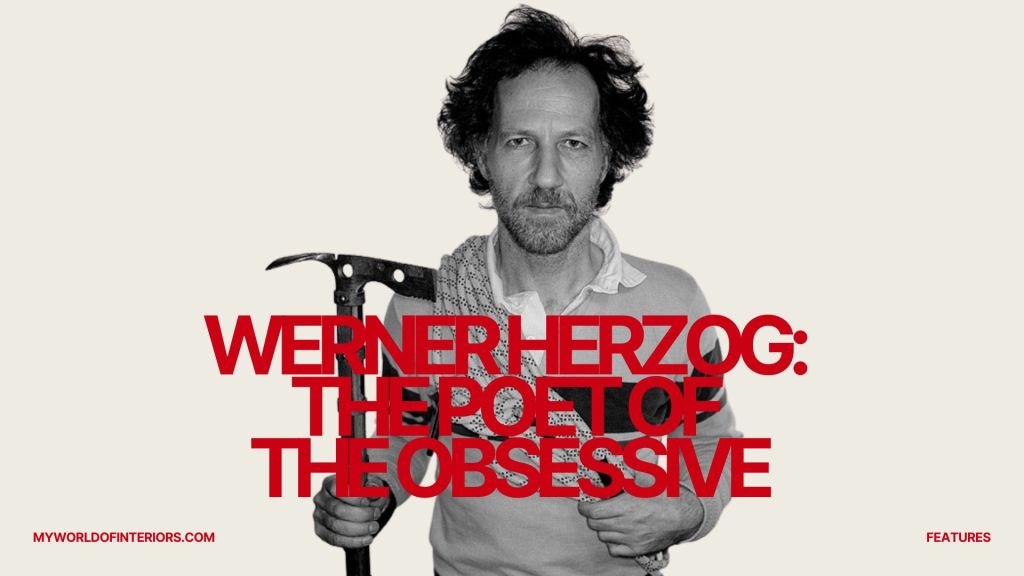
Werner Herzog walks through cinema like an adventurer through uncharted territory. Born in 1942 in Bavaria and raised in a remote village without electricity, he grew up with little sense that cinema even existed. When he first encountered film as a teenager, it struck him like lightning. By nineteen he had “borrowed” a camera from a Munich film school and was teaching himself to make movies. That spirit — reckless, determined, guided by instinct — never left him.
For more than six decades, Herzog has created films that confront madness, dream, nature, and obsession. His world is one of conquistadors descending into delirium, rubber barons dragging steamships over mountains, penguins marching toward their deaths, and bear enthusiasts devoured by the very creatures they loved. Yet through it all, his voice — at once calm, deadpan, and philosophical — has carried a singular conviction: that cinema must face the abyss and wrestle meaning from it.
New German Cinema’s Outlier
In the 1960s, Herzog rose alongside the New German Cinema, a movement that sought to reinvent the country’s filmmaking in the shadow of World War II. While contemporaries like Rainer Werner Fassbinder and Wim Wenders examined urban malaise and political history, Herzog looked outward — to deserts, mountains, jungles. His early films such as Signs of Life (1968) revealed a fascination with isolation and madness, while The Enigma of Kaspar Hauser (1974) explored innocence corrupted by society.
But it was Aguirre, the Wrath of God (1972) that defined him. Starring Klaus Kinski as a conquistador spiraling into delusion in the Amazon, it is both a historical epic and a fever dream. Shot in near-impossible conditions, with Herzog himself reportedly pulling a gun on his actor to keep him from leaving, it remains one of the most audacious films of the 20th century.
Herzog and Kinski: Art as Warfare
The Herzog–Kinski collaboration became legend. Across five films, Kinski’s deranged charisma and Herzog’s relentless drive collided in what the director later called “a love-hate relationship of great intensity.”
Their most infamous project was Fitzcarraldo (1982), in which Kinski played a man determined to haul a steamship over a mountain to bring opera to the Amazon. Herzog insisted on doing it “for real”: no models, no effects. A 320-ton boat was dragged across the rainforest by hand, at enormous physical cost. The production nearly collapsed. Lives were endangered. Herzog claimed at one point he would kill Kinski if he quit. The film is madness incarnate — and a monument to Herzog’s belief that cinema must test human limits.
Later, Herzog would revisit the story in My Best Fiend (1999), a documentary portrait of his love, rage, and fascination with Kinski. Few films more candidly depict the line between art and destruction.
Documentary and the “Ecstatic Truth”
If Herzog’s features created legends, his documentaries shaped an entire genre. He rejects journalistic neutrality, preferring what he calls “ecstatic truth” — a poetic reality more profound than factual detail.
- Grizzly Man (2005) is a chilling study of Timothy Treadwell, who lived among Alaskan bears until one killed him. Herzog listens to the audio of Treadwell’s final moments but refuses to play it for the audience, insisting some truths are too sacred. His verdict: nature is not kind, but indifferent.
- Encounters at the End of the World (2007) journeys to Antarctica, where Herzog turns penguin colonies, divers, and scientists into metaphysical allegories.
- Cave of Forgotten Dreams (2010) explores prehistoric cave art in 3D, treating 30,000-year-old paintings as a communion with humanity’s earliest imagination.
- Into the Inferno (2016) gazes into active volcanoes, where geology and mythology fuse.
In each, Herzog narrates with a voice at once hypnotic and mordantly funny, turning documentary into philosophical meditation.
Themes: The Herzogian Universe
Across his career, Herzog has returned obsessively to certain ideas:
- Nature’s Indifference — The jungle, tundra, and desert as forces larger than humanity.
- The Mad Visionary — Aguirre, Fitzcarraldo, Kaspar Hauser, Treadwell: dreamers pursuing the impossible.
- The Sublime and the Absurd — The grandeur of dragging ships up mountains, the absurdity of penguins wandering toward certain death.
- Cinema as Test — Films not just made but endured, productions as ordeals equal to their subjects.
Legacy
Herzog’s influence stretches across cinema. Christopher Nolan has cited him. Paul Thomas Anderson once called Aguirre a cornerstone of his education. Documentarians worldwide have embraced his notion of “ecstatic truth.” Even in popular culture — his cameos in The Mandalorian or voice appearances in Rick and Morty — Herzog has become shorthand for existential intensity.
His legacy is not just a body of films, but a philosophy: that cinema must venture into danger, risk collapse, and confront the mysteries of existence head-on.
Ten Most Herzogian Anecdotes (Yes, They’re True)
- The Walk to Save Eisner (1974) – He walked from Munich to Paris in the dead of winter, convinced that his mentor Lotte Eisner would live if he arrived at her bedside. She survived.
- The Stolen Camera – As a teenager, he “borrowed” a film school camera without asking. He used it for his first films and returned it later.
- Cooking His Own Shoe – After losing a bet to critic Roger Ebert, Herzog literally cooked and ate one of his shoes on stage in 1980. Les Blank filmed it.
- The Boat Over the Mountain – Fitzcarraldo’s most notorious stunt: dragging a real steamship over a hill in the Amazon.
- Pulled a Gun on Kinski – On the set of Aguirre, when Klaus Kinski threatened to leave, Herzog allegedly pointed a gun at him and told him he’d shoot him first.
- Shot During an Interview – In 2006, while being interviewed by the BBC, Herzog was hit by a sniper’s bullet with an air rifle. His reaction: “It was not a significant bullet.” He finished the interview.
- Rescue of Joaquin Phoenix – In 2006, Herzog pulled actor Joaquin Phoenix from a car wreck near his Los Angeles home. Phoenix later said he heard “a German voice” pulling him from the wreckage.
- Encounters with Bears – During Grizzly Man, he refused to play the fatal audio of Treadwell’s death, saying it should be destroyed.
- Penguin Suicide – In Encounters at the End of the World, Herzog filmed a penguin wandering alone into the Antarctic mountains, certain death ahead, without explanation. He called it “the mystery of existence.”
- The Amazon as Protagonist – On Aguirre and Fitzcarraldo, Herzog insisted the jungle itself was the real character — hostile, beautiful, beyond control.
Essential Films
- Aguirre, the Wrath of God (1972)
- The Enigma of Kaspar Hauser (1974)
- Nosferatu the Vampyre (1979)
- Fitzcarraldo (1982)
- Grizzly Man (2005)
- Cave of Forgotten Dreams (2010)
Conclusion: Cinema as Ordeal, Cinema as Revelation
Werner Herzog’s films remind us that cinema is not simply entertainment. For him, it is a confrontation with chaos, a search for “ecstatic truth” beyond mere fact. His works reveal both the grandeur and absurdity of human striving: men who dream too much, nature that cannot be tamed, beauty that exists on the knife-edge of folly.
To watch Herzog is to confront extremes — to feel awe, terror, and laughter at once. His legacy is not only in the images he has created but in his conviction that cinema must dare to go where reason falters.
Herzog once said: “I believe the common denominator of the universe is not harmony, but chaos, hostility, and murder.” And yet, in the heart of that chaos, his films uncover something radiant: a strange, ecstatic beauty.

Leave a Reply