
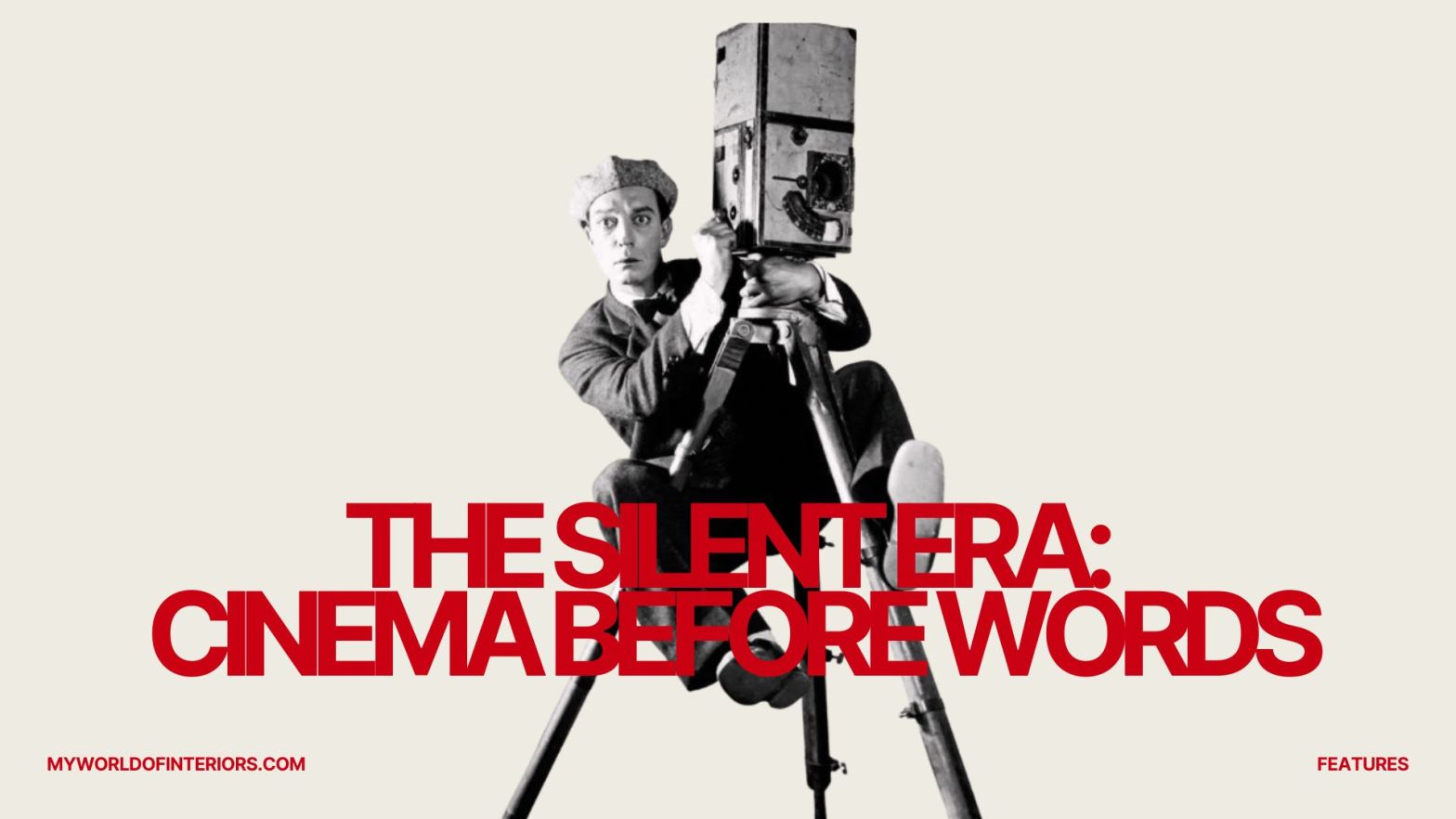
Before the world spoke in sync with film, it dreamed in silence. The silent movie era — stretching from the late 1890s through the late 1920s — was a time when cinema evolved from novelty to art form, from flickering short reels in nickelodeons to sprawling epics projected in ornate picture palaces. It was an age of experimentation, glamour, excess, and genius.
Though sound would eventually transform film, the silent era established the grammar of cinema: montage, close-ups, cross-cutting, lighting, mise-en-scène. Its stars became the first global celebrities, its directors the first auteurs, its films the foundation of everything that followed.
The Birth of a Medium
Cinema began as spectacle. The Lumière brothers’ Workers Leaving the Lumière Factory (1895) and Georges Méliès’ A Trip to the Moon (1902) demonstrated the medium’s dual possibilities: documentary realism and fantastical invention. By the 1910s, narrative filmmaking had become dominant, pioneered by directors like D. W. Griffith, who expanded the scope of film storytelling with The Birth of a Nation* (1915) and Intolerance (1916).
The United States quickly became cinema’s industrial center. Hollywood, with its abundant light and vast studio lots, rose to global dominance. But Europe — particularly Germany, Russia, and France — offered parallel innovations: Expressionism, Soviet montage, Surrealist experimentation.
By the 1920s, silent cinema was not primitive but highly sophisticated, with elaborate camera work, nuanced acting styles, and orchestral scores performed live in theaters. It was not an incomplete medium waiting for sound — it was a fully formed art in its own right.
The Stars
The silent era produced the first movie stars, icons whose faces became international currencies of glamour, comedy, or tragedy.
- Charlie Chaplin: The most famous man in the world by the 1920s. His Tramp, with bowler hat and cane, embodied resilience, humor, and pathos. Films like The Kid (1921) and City Lights (1931, technically silent despite the sound era) remain timeless.
- Buster Keaton: The “Great Stone Face,” a master of deadpan comedy and gravity-defying stunts. His films, such as The General (1926), combined physical daring with narrative precision.
- Harold Lloyd: Known for thrill comedies, most famously hanging from a clock in Safety Last! (1923), he symbolized modern urban energy.
- Greta Garbo: The ultimate screen goddess, whose silent performances in Flesh and the Devil (1926) and A Woman of Affairs (1928) exuded sensuality and mystery.
- Clara Bow: The “It Girl,” embodying Jazz Age exuberance in It (1927) and Wings (1927).
- Rudolph Valentino: The first male sex symbol, an exoticized figure of passion and tragedy in films like The Sheik (1921) and Blood and Sand (1922).
- Lillian Gish: Griffith’s muse, she epitomized fragile innocence and tragic endurance, from Broken Blossoms (1919) to Orphans of the Storm (1921).
Silent stars were not merely performers but symbols: of modernity, sexuality, aspiration. Their faces — larger than life — carried an immediacy words could never match.
The Directors
Silent film directors invented the language of cinema.
- D. W. Griffith: Controversial for his racism but foundational in developing cinematic grammar. His Intolerance remains an unmatched spectacle.
- Sergei Eisenstein: Pioneer of montage, whose Battleship Potemkin (1925) and October (1928) shaped political cinema and influenced global editing styles.
- F. W. Murnau: German master of Expressionism, blending shadow and psychology in Nosferatu (1922) and moving toward naturalism in Sunrise (1927).
- Fritz Lang: Architect of mythic spectacle, from Dr. Mabuse (1922) to Metropolis (1927), envisioning cinema as modern epic.
- Erich von Stroheim: The uncompromising realist, whose Greed (1924) remains legendary, even in mutilated form.
- King Vidor: Chronicler of American life, directing The Big Parade (1925) and The Crowd (1928), balancing epic and intimate.
- Charlie Chaplin & Buster Keaton: Not only stars but directors of extraordinary innovation, blending comedy with cinematic artistry.
Together, these filmmakers elevated cinema from spectacle to art, influencing every subsequent generation.
The Global Currents
Silent cinema was not monolithic.
- German Expressionism: With distorted sets and chiaroscuro lighting, films like The Cabinet of Dr. Caligari (1920) visualized psychological states.
- Soviet Montage: Eisenstein, Vertov, and Pudovkin used editing as ideological weapon and formal experiment.
- French Impressionism & Surrealism: Directors like Abel Gance (Napoléon, 1927) and Luis Buñuel (Un Chien Andalou, 1929) pushed cinema toward avant-garde art.
- Scandinavian Naturalism: Carl Theodor Dreyer’s The Passion of Joan of Arc (1928) combined stark realism with spiritual transcendence.
These diverse movements proved that silent cinema was not a single style but a global laboratory of form.
The End of Silence
The arrival of synchronized sound with The Jazz Singer (1927) transformed cinema almost overnight. By 1930, silent film was effectively obsolete in mainstream production. For some stars — like Garbo — the transition was successful. For others, like Clara Bow, it was career-ending. Chaplin resisted, continuing to make silent films well into the sound era, insisting that cinema’s universality lay in its images, not its words.
While the talkies ushered in new possibilities, something was lost: the purity of visual storytelling, the universality of silence that crossed linguistic boundaries. The silent era remains not a primitive precursor but a golden age of innovation, whose visual intensity has rarely been equaled.
Essential Silent Films
- A Trip to the Moon (1902, Georges Méliès) – The first great work of cinematic fantasy.
- The Birth of a Nation (1915, D. W. Griffith) – Technically groundbreaking, politically infamous. Horrifyingly racist. Every KKK member’s favourite film. No, thank you.*
- Intolerance (1916, Griffith) – An epic of parallel narratives spanning centuries.
- The Cabinet of Dr. Caligari (1920, Robert Wiene) – The emblem of German Expressionism.
- Nosferatu (1922, F. W. Murnau) – A haunting, unauthorized Dracula adaptation.
- Safety Last! (1923, Harold Lloyd) – Comic thrills in the urban landscape.
- Greed (1924, Erich von Stroheim) – An uncompromising realist epic.
- Battleship Potemkin (1925, Sergei Eisenstein) – Political cinema’s most famous montage.
- The Big Parade (1925, King Vidor) – Humanist vision of World War I.
- The General (1926, Buster Keaton) – A comic masterpiece of stuntwork and timing.
- Metropolis (1927, Fritz Lang) – Monumental science fiction, a city as machine.
- Sunrise (1927, F. W. Murnau) – Lyrical tale of love and redemption; often ranked among the greatest films ever made.
- The Jazz Singer (1927, Alan Crosland) – The first feature-length “talkie,” heralding cinema’s future.
- The Passion of Joan of Arc (1928, Carl Theodor Dreyer) – Spiritual intensity distilled in close-ups.
- City Lights (1931, Charlie Chaplin) – A late silent, timelessly blending comedy and pathos.
The Silent Legacy
Though eclipsed by sound, the silent era endures as cinema’s foundation. Its stars remain immortal icons, its directors canonical, its films essential. More than nostalgia, silent cinema continues to inspire — not just as history, but as living art. In an age of digital saturation, the intensity of a single silent close-up, a gesture without words, reminds us of the primal power of the moving image.
Cinema, at its core, is still a silent art that learned to speak. And the dreamlike beauty of its first three decades ensures that even in silence, it will always be heard.
Discover more from My World of Interiors
Subscribe to get the latest posts sent to your email.

