
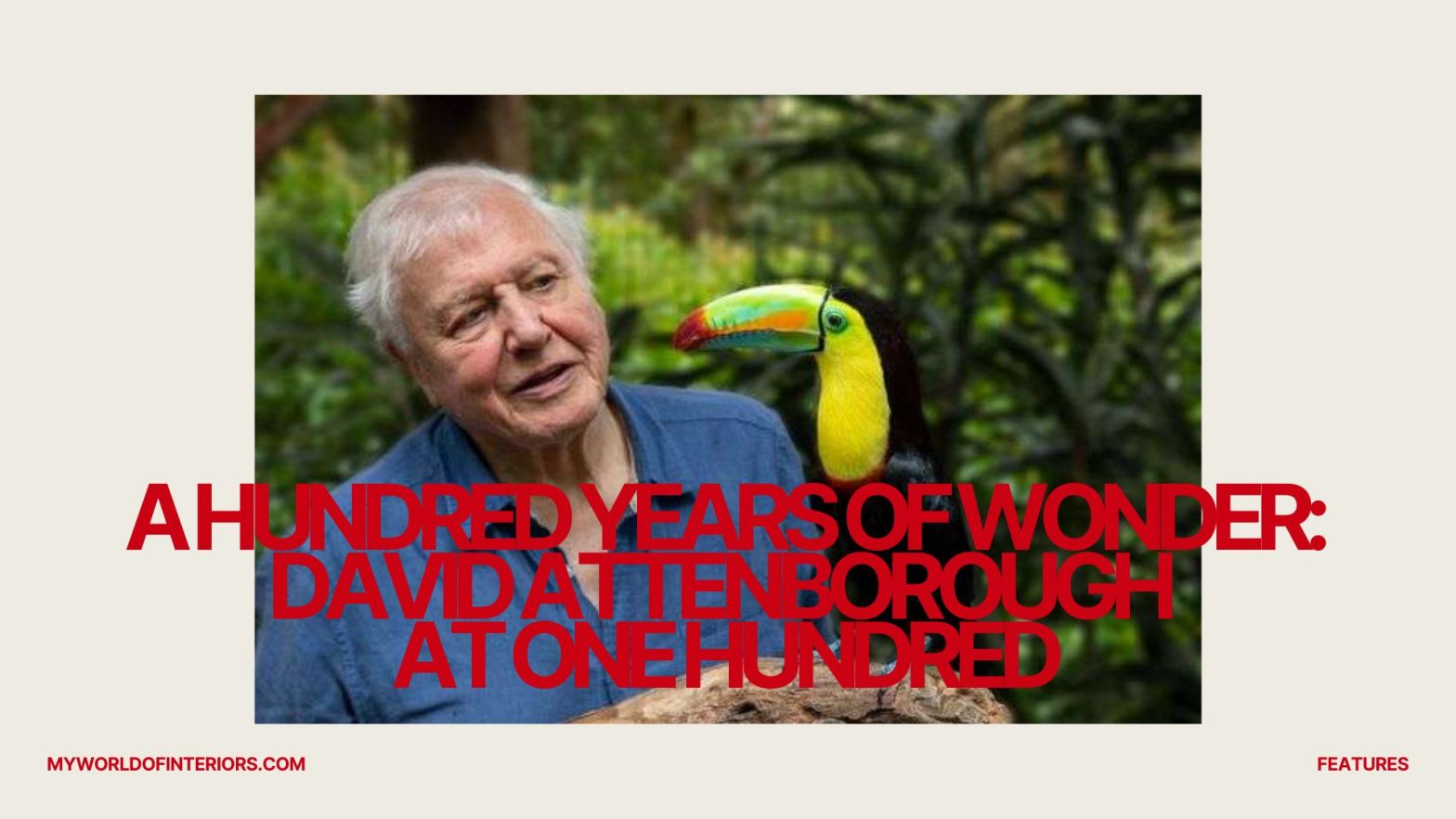
He gave three generations of human beings their understanding of the natural world. He did it with patience, with rigour, and with a quality of attention so rare it functions, in an age of noise, almost like a form of grace.
By Bergotte
On the eighth of May 1926, in Isleworth, Middlesex, a child was born who would spend the next century doing something that sounds, in the abstract, straightforward and proves, in practice, to be among the most difficult things a human being can attempt: paying attention. Paying attention not to the self, not to the drama of human affairs, not to the markets or the politics or the cultural fashions that consume the energies of most lives, but to the extraordinary, inexhaustible, perpetually astonishing fact of the natural world — the world that existed before us, that will exist after us, and that we are only now, after so much damage, beginning to understand we cannot afford to lose.
David Attenborough turns one hundred years old today. The number is almost too large to hold. He was born seven years after the end of the First World War, in the same decade as the first commercial radio broadcasts, in a Britain that still had an empire and had not yet had television. He will spend his centenary in a world where a clip of him narrating the behaviour of a mantis shrimp can be watched by forty million people in forty-eight hours, where his voice is among the most recognisable sounds on earth, where children in Lagos and Osaka and Lima grow up with his cadences as the soundtrack to their understanding of what the planet contains. The distance between Isleworth in 1926 and this morning is not merely a century. It is a transformation of human consciousness, and Attenborough has been, for the second half of it, one of its principal architects.
The life divides, roughly, into three movements, each of which would constitute a remarkable career on its own. There is the television pioneer of the 1950s and 1960s — the young man who joined the BBC in 1952 as a trainee and within two years was presenting Zoo Quest, travelling to Sierra Leone, British Guiana, and Paraguay to film animals in their natural habitats for an audience that had never seen anything of the kind. There is the administrator and institution-builder of the late 1960s and 1970s — controller of BBC Two, the man responsible for bringing colour television to Britain, the commissioning force behind Civilisation, America, and The Ascent of Man, cultural landmarks of the era. And there is the naturalist and narrator, from Life on Earth in 1979 onward — the voice and presence that would redefine the natural history documentary as an art form and establish itself, over the following four decades, as one of the great sustained creative achievements in the history of broadcasting.
What is extraordinary about this three-part life is not merely its length but its coherence. The thread running through all of it — through the Zoo Quest expeditions and the BBC boardrooms and the Attenborough of the extraordinary Netflix confession A Life on Our Planet — is a quality of attention that has never wavered, a conviction that the natural world deserves to be looked at, and looked at with rigour and with love, and then shown to people who might not otherwise look. He has never been an ivory tower naturalist. He has always been, at bottom, a communicator — someone for whom the point of knowledge is its transmission, for whom the greatest waste imaginable is a world full of astonishing things that nobody has been told about.
Life on Earth, broadcast in 1979, is where the modern Attenborough begins, and it remains one of the most ambitious single acts of television ever committed. Thirteen episodes. 650 million viewers in its first run worldwide. A narrative spanning four thousand million years of evolutionary history, from the first single-celled organisms in the primordial seas to the emergence of Homo sapiens and the ambiguous prospects that followed. The BBC Natural History Unit, which Attenborough had championed and nurtured from its Bristol base, deployed everything it had: years of location filming across six continents, specialist camera techniques that had never been used for television, and a presenter whose combination of scientific literacy and narrative instinct proved, as it turned out, to be precisely what the form required.
The series established a grammar for the natural history documentary that is still in use today. The immersive location photography, the specific scientific observation elevated into dramatic narrative, the presenter as guide rather than lecturer, the music as emotional infrastructure, the sense — always, in Attenborough’s work — that the animal behaviour being observed matters, that it has stakes, that the individual creature whose life is being documented is not a specimen but a protagonist. These are now such standard elements of the genre that it can be difficult to remember they were, in 1979, essentially inventions. Before Life on Earth, natural history documentaries were earnest and informative and frequently dull. After it, they were something else: a form capable of producing genuine awe.
The gorilla sequence near the end of Life on Earth — in which Attenborough, sitting among a group of mountain gorillas in Rwanda, is approached, examined, and briefly treated as an interesting but non-threatening piece of furniture by a young animal — has been watched more times than can be meaningfully calculated and has not, in any of those viewings, lost its power. What strikes you, watching it now, is not the drama of human and ape in close proximity, though that is extraordinary. It is Attenborough’s face. He is not performing wonder. He is experiencing it, and the experience is so transparently genuine — so unmediated by the self-consciousness that television usually produces in even its most seasoned performers — that the wonder is directly transmitted. You are not watching a man watch a gorilla. You are watching a man in a state of communion with the natural world, and you are briefly, entirely, in that state with him.
The series that followed over the next four decades — The Living Planet, The Trials of Life, The Private Life of Plants, The Life of Birds, Blue Planet, Life in the Undergrowth, Planet Earth, Frozen Planet, Blue Planet II, Our Planet, A Perfect Planet — constitute a body of work without parallel in the history of natural history communication. Each series pushed the technology further — the development of the gyroscopically stabilised helicopter camera that made Planet Earth‘s aerial sequences possible, the specialised deep-water equipment that allowed Blue Planet II to film at depths and in conditions previously inaccessible to cameras, the ultra-high-speed photography that made Life capable of showing what the eye alone cannot see. Each series also pushed Attenborough further into the role he had come, over the decades, to occupy: not merely a presenter but a conscience, a witness, a figure whose accumulated credibility allowed him to say things about the state of the natural world that politicians and scientists had been saying to considerably less effect.
The shift in register — from wonder to warning — happened gradually and then, in the final chapters of his career, with considerable speed. The early series are essentially celebratory; they document a natural world that is imperilled without quite making the peril their central subject. By Frozen Planet in 2011, the melting Arctic was impossible to ignore. By Blue Planet II in 2017, the plastic in the ocean had become as central to the series as the animals swimming through it. By A Life on Our Planet in 2020 — the most personal thing Attenborough had made, a ninety-three-year-old man’s account of what he had watched disappear over the course of his lifetime — the warning had become something closer to a reckoning.
A Life on Our Planet is, among Attenborough’s many achievements, perhaps the most important, because it represents the fullest deployment of his earned authority. He begins it at Chernobyl, in the dead zone where nature has reclaimed the ruins of human catastrophe, and he speaks directly to camera — no wildlife footage, no theatrical music, just a face that has been looking at the world honestly for ninety years — about what he has witnessed. The decline of wilderness. The death of species. The warming of the seas. The statistics are devastating; the delivery is quiet. It is not the quietness of resignation but of someone who has decided that panic is a form of dishonesty and that the truth, clearly told, is more useful than any amount of theatrical alarm. The film ends not in despair but in prescription: specific, science-based, grounded in the understanding that the natural world, given the chance, is astonishingly resilient. It is, finally, a film about hope — but hope of the rigorous kind, the kind that has looked at the evidence and decided that it still applies.
To understand what Attenborough has done for the culture, it helps to try to imagine the culture without him — to imagine what three generations of television viewers would know and feel about the natural world in the absence of his work. The thought experiment is vertiginous. He has not merely provided information; he has provided a framework for emotional relationship with the non-human world, a vocabulary of wonder and responsibility that has become so thoroughly embedded in the culture that we can no longer clearly distinguish between what we know because of him and what we feel because of him. He has shaped, as surely as any novelist or philosopher, the moral imagination of his audience — their sense of what matters, what is at stake, what the appropriate response to the magnificence and fragility of the natural world might be.
This is an unusual thing for a television presenter to have done. It is an unusual thing for almost anyone to have done. The comparison that suggests itself is not to other broadcasters but to figures of a different kind — to John Muir, whose writing helped create the American national park system by making the wilderness legible to people who had never entered it; to Rachel Carson, whose Silent Spring translated the science of pesticide damage into a form that produced political action; to figures who understood that the problem of conservation was, at bottom, a problem of imagination, and that what people cannot picture they will not protect. Attenborough understood this before almost anyone else in the medium of television, and he spent fifty years acting on the understanding.
He has also, in a way that is easy to overlook because it has become so familiar, done something formally remarkable. He has narrated the natural world — imposed a human storytelling intelligence on the behaviour of creatures that have no interest in being narrated — without falsifying it. The animals in Attenborough’s films are not anthropomorphised; they are not given human emotions or human motivations. But they are given dramatic shape, narrative context, the sense of their lives as something that unfolds over time and has, at each of its moments, something at stake. This is an act of storytelling that requires, simultaneously, the scientist’s fidelity to fact and the novelist’s instinct for the significant detail, the right moment, the image that carries more weight than information alone could sustain. Attenborough does both things at once, in every sequence, and makes it look like breathing.
The BBC is the other protagonist of this story, the institution without which the work would have been impossible and which was itself shaped, in crucial respects, by the man who served it. Attenborough joined the corporation when it was seven years old as a television broadcaster and left his administrative role as Controller of BBC Two having commissioned some of the most significant cultural programming in its history. His relationship with the institution is one of the great partnerships between an individual and an organisation in British cultural life — a partnership of mutual formation in which each made the other more fully what it could be.
The BBC’s commitment to natural history programming, the investment in the Natural History Unit in Bristol that has made it the world’s pre-eminent producer of wildlife documentaries for half a century, the willingness to give major series the production budgets and the broadcast prominence they require — all of this is Attenborough’s legacy as much as the series themselves. He built the infrastructure, and the infrastructure has continued to produce remarkable work in the hands of the producers and directors and camera operators and scientists he inspired. The lineage runs from Life on Earth to Planet Earth III and beyond, and if the work of those later series is sometimes compared unfavourably to Attenborough’s own, the comparison itself is testimony to the standard he set.
He has received, in the course of his century, more or less every honour a British life can accumulate. The knighthood. The Order of Merit. The fellowship of the Royal Society — one of very few people to have received it for services to science who are not themselves practising scientists, an acknowledgement of the unusual category his work occupies, somewhere between art and education and advocacy. He has been the subject of documentaries and biographies and academic studies. His face is among the most recognisable in the world, his voice among the most trusted. Opinion polls, conducted with a regularity that has itself become a form of cultural commentary, consistently place him at or near the top of lists of the most admired people in Britain — lists on which he tends to be the only person present who is not either a scientist, a sporting hero, or a fictional character.
None of this, one suspects, is what he would want to be remembered for. He has never been comfortable with the apparatus of celebrity, has always deflected biographical attention toward the animals and the science and the people who made the work alongside him. He is, by all accounts, genuinely and comprehensively modest in the way that only people who are truly confident of their own purpose can afford to be — secure enough in what he is doing not to need the world’s reassurance about whether it is worth doing.
On this May morning, a hundred years after his birth in a country that still had gaslight in its streets and a view of the natural world as essentially inexhaustible, David Attenborough is something that no system of honours can quite capture. He is a witness — the great witness of our age, the man who was there when the blue whale surfaced and when the bird of paradise danced and when the reef was still coral and when the ice was still thick, and who brought us there with him, and who has spent the last decades of his working life trying to ensure that there is something left for the next witness to see.
The blue whale still surfaces. The birds of paradise still dance on the forest floor in their astonishing, apparently pointless splendour. The reefs are damaged and the ice is diminished, but the natural world is still there, still extraordinary, still capable of producing in the human being who encounters it — on a screen in a living room or in person in a forest or on a mountain — the sensation that Attenborough has spent a century curating and transmitting: the sensation of wonder, which is also, at bottom, the sensation of gratitude for being alive on a planet extraordinary enough to contain these things.
He taught us to feel it. On this particular morning, one hundred years into a life that has been, in the most literal sense, one of the great gifts to human understanding, the least we can do is feel it completely.
Happy birthday, Sir David. The world is better for the looking you have done.
Sir David Frederick Attenborough was born on 8 May 1926 in Isleworth, Middlesex. He joined the BBC in 1952 and has been associated with the corporation for over seventy years. His most recent series, Planet Earth III*, was broadcast in 2023. His memoir,* A Life on Our Planet*, was published in 2020.*
Discover more from My World of Interiors
Subscribe to get the latest posts sent to your email.

