
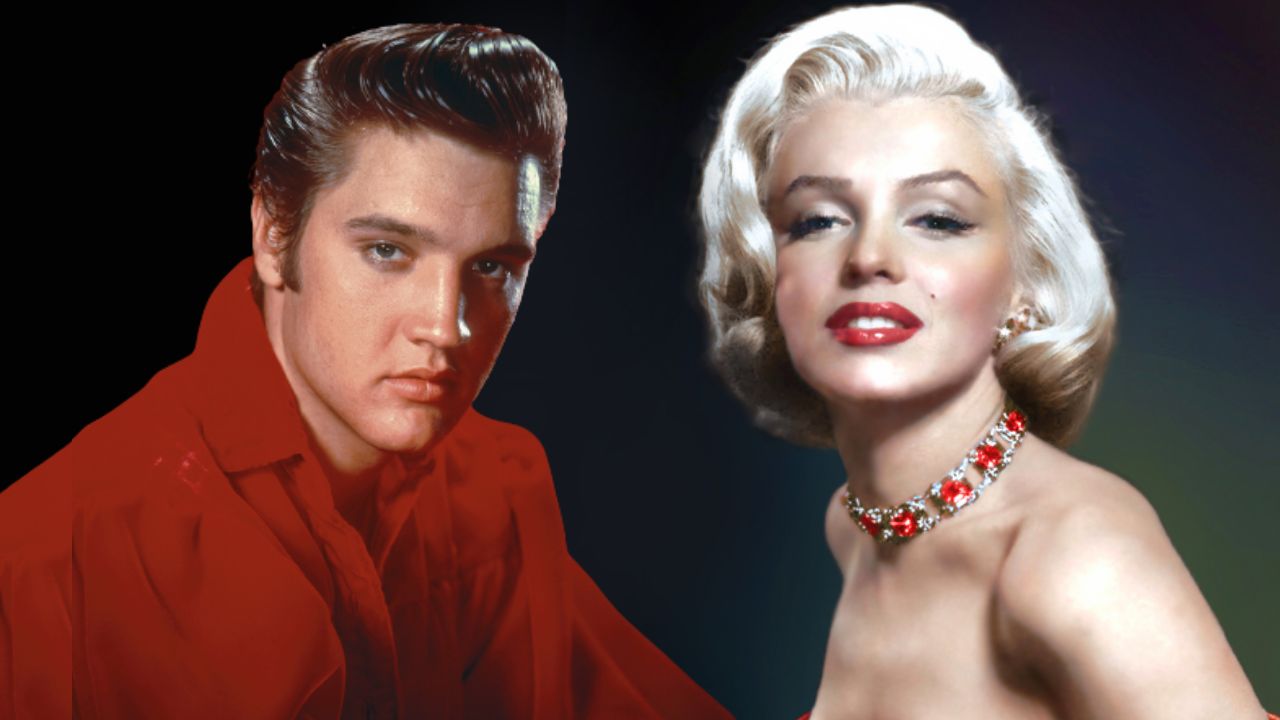
In the mythology of the twentieth century, two figures stand as the defining icons of modern celebrity: Elvis Presley and Marilyn Monroe. They are not simply stars, nor even merely “legends.” They became something more elusive and enduring: cultural deities, objects of near-religious devotion whose fame transcends their work, their lives, and even their deaths.
To speak of Elvis and Marilyn is to speak of a new category of human recognition: the superstar, a figure whose magnetism fuses sex, charisma, and vulnerability, and whose memory continues to glow decades after their deaths. If Hollywood in its golden age manufactured glamour, and if the recording industry produced stars, Elvis and Marilyn embodied something altogether different — they were the first to become god-like famous.
The Genesis of Superstardom
Both rose in the postwar moment, when mass media — film, television, radio, magazines — reached unprecedented reach. Fame was no longer local or even national; it was planetary.
- Marilyn Monroe, born Norma Jeane Mortenson in 1926, emerged from a difficult childhood to become Hollywood’s most photographed starlet of the 1950s. Her screen presence — breathy, luminous, paradoxically innocent and erotic — redefined female sexuality for the mass imagination.
- Elvis Presley, born in Tupelo, Mississippi in 1935, broke through in the mid-1950s as rock and roll’s first king. His fusion of Black rhythm and blues with white country stylings, delivered with gyrating hips and smoldering eyes, scandalized and enthralled America.
They embodied different poles of the same archetype: Elvis as the working-class boy remade into royalty, Marilyn as the factory girl transfigured into goddess.
The Magnetism: What Was the “X Factor”?
Psychologists often describe charisma as a blend of warmth, presence, and power. Elvis and Marilyn each possessed these in uncanny measure, but with one crucial addition: vulnerability.
- Elvis’s X factor: He projected masculine sexuality with unprecedented force, but always softened by a sweetness — the polite Southern boy, the mama’s son, the shy smile behind the swagger. He could command a stage like a demigod yet blush in an interview. This tension between raw erotic power and boyish vulnerability created a magnetism audiences could not look away from.
- Marilyn’s X factor: She radiated sexual allure, but her allure was never hard or aggressive. Instead, it was tinged with softness, even sadness. She seemed simultaneously aware of her effect and innocent of it. That paradox — eroticism and fragility — created an aura that made her not merely a sex symbol but an object of protective adoration.
Both figures embodied contradiction visibly: strong yet vulnerable, public yet private, hypersexualized yet childlike. This is the essence of the superstar magnetism: the paradox that makes the figure endlessly interpretable, a blank screen for projection.
The Psychological Dimension: Projection and Identification
Why can’t people get enough of Elvis and Marilyn? Because they invite projection. They are archetypes that function psychologically like myths.
- Elvis became the American dream made flesh: a poor boy from Tupelo who achieved impossible stardom. Fans identified with him as proof that greatness could be born from nowhere. But they also saw him as a tragic cautionary tale of excess, addiction, and the destructive machine of fame. He embodies both aspiration and warning.
- Marilyn became the archetype of female desire and vulnerability: the orphaned girl who became the world’s goddess yet remained fragile, insecure, yearning for love. Audiences projected their fantasies onto her, but also their own sense of loneliness.
In Jungian terms, both function as archetypes: Marilyn as the anima (feminine ideal/vulnerable muse), Elvis as the puer aeternus (eternal youth/erotic boy-god). Their magnetism is rooted not only in charisma but in their capacity to embody deep collective symbols.
The Media Machine and the Birth of Global Fame
Elvis and Marilyn also mark the point when technology amplified personality into myth.
- The camera loved them in a new way: both had faces that could register in close-up as luminous beyond ordinary beauty. Marilyn’s skin seemed to glow; Elvis’s features caught light in a way that turned movement into erotic spectacle.
- Television, photography, film, and later video replay ensured their presence was not ephemeral. They could be replayed, rewatched, frozen in iconic poses.
- Their deaths — Marilyn in 1962, Elvis in 1977 — sealed the mythology. Early death preserves beauty, halts decline, and crystallizes the star into eternal archetype.
In this sense, they are remembered less as historical figures than as cultural eternities.
God-Like Fame
Elvis and Marilyn were not worshipped simply as celebrities. They became objects of quasi-religious devotion. Graceland became a shrine; Marilyn’s image adorns candles, murals, and tattoos. Their names function like symbols detached from biography: Elvis as “The King,” Marilyn as “The Goddess.”
The fascination persists because they embody ideals that remain unresolved: beauty, desire, fame, excess, tragedy. Their stories dramatize the paradox of modern celebrity: adored by millions, yet consumed and destroyed by the very adoration.
The Legacy: Why They Endure
- Cultural Archetypes: They embody enduring human myths — the erotic goddess, the boy king, the star destroyed by light.
- Visual Permanence: Photographs and recordings have frozen them at the peak of beauty and charisma.
- Narrative Tragedy: Their lives ended prematurely, creating the unfinished story that culture compulsively revisits.
- Projection Surface: They invite endless reinterpretation — feminist icon, queer symbol, working-class hero, tragic saint.
No later star, however famous — not Madonna, not Michael Jackson, not Beyoncé — has achieved quite the same archetypal resonance. Others are idols; Elvis and Marilyn are myths.
Conclusion: The First Superstars
Elvis Presley and Marilyn Monroe were the first to embody superstardom in its fullest sense: not simply entertainers, but mythological beings produced by and for the mass imagination. Their fame was not proportional to their artistry alone, though both were extraordinary performers. It was the product of charisma amplified by media, vulnerability transmuted into archetype, and death sealed into legend.
We cannot get enough of them because they are not finished. They remain symbols, eternally revisited, perpetually reinterpreted. They are not only remembered — they are worshipped. In the pantheon of 20th-century culture, Elvis and Marilyn are not merely icons. They are its gods.
Elvis vs. Marilyn: A Comparative Archetypal Chart
| Category | Elvis Presley | Marilyn Monroe |
|---|---|---|
| Origins | Born 1935, Tupelo, Mississippi. Working-class Southern boy, twin brother died at birth. Raised in poverty, deeply tied to mother. | Born 1926, Los Angeles (as Norma Jeane). Childhood marked by foster homes, instability, absent father. Became a model before film stardom. |
| Breakthrough | 1954: Sun Records, blending Black rhythm & blues with white country. 1956 TV appearances (Ed Sullivan Show) catapulted him into scandalous fame. | 1950s: Bit parts in films → breakout in Niagara (1953), Gentlemen Prefer Blondes (1953). Posed for Playboy; became Hollywood’s ultimate blonde bombshell. |
| Archetype | The Boy King — working-class kid remade into royalty. A mix of sexual danger and shy Southern vulnerability. | The Eternal Goddess — innocent and erotic, luminous yet fragile. A paradox of childlike softness and adult allure. |
| X Factor | Physicality: hips, voice, and presence radiated sexuality but balanced by politeness and boyishness. Fans saw both god and neighbor’s son. | Physicality: curves, voice, and glow radiated sexuality but softened by vulnerability and a hint of sadness. Fans saw both goddess and orphan. |
| Media Image | Television + records amplified charisma. “Elvis the Pelvis” became both scandal and seduction. Later film career built the King myth. | Cinema + photography immortalized her. Studio publicity crafted the “blonde bombshell.” Later Playboy images sealed her as icon. |
| Vulnerability | Dependency on fame, isolation, addiction, and weight fluctuations became public spectacle. Vulnerability beneath swagger. | Struggled with insecurity, loneliness, fragile mental health. Vulnerability beneath allure. |
| Death | 1977, age 42. Collapsed at Graceland. Mythologized as “The King” — fans still visit his home like a shrine. | 1962, age 36. Overdose (probable suicide). Mythologized as “The Goddess” — eternally young, frozen in luminous images. |
| Legacy | Archetype of the modern male superstar. Rock and roll’s first King; model for every male pop idol that followed. | Archetype of the female superstar. Hollywood’s eternal sex symbol; model for every blonde starlet, endlessly imitated. |
| Cultural Function | Embodies aspiration and excess: the American Dream fulfilled, then destroyed. A symbol of both triumph and caution. | Embodies beauty and fragility: the fantasy of desire, the tragedy of loneliness. A symbol of longing and loss. |
| Afterlife | Graceland as pilgrimage site, impersonators worldwide, songs still canonical. Elvis as secular saint of popular music. | Marilyn’s image on posters, art (Warhol), tattoos, fashion. Her face is global shorthand for glamour, desire, and tragedy. |
Synthesis
- Parallels: Both rose from hardship, embodied paradox (strength + fragility), and were consumed by fame. Both died young, preserving eternal allure.
- Differences: Elvis symbolized transformation of class and masculinity into fame; Marilyn symbolized transformation of femininity and vulnerability into desire.
- Shared Legacy: They remain the first true superstars — not just remembered, but worshipped as modern myths.
Elvis & Marilyn as Jungian Archetypes
Archetypal Map
- Hero / King → Elvis Presley
Embodies the “boy becomes king” myth: working-class Southern youth transformed into royalty, the archetype of modern masculine fame. - Puer Aeternus (Eternal Youth) → Elvis Presley
His image is bound to youth and vitality — even in later years, the myth remembers him as the eternally young rebel in 1956. - Anima (Feminine Ideal) → Marilyn Monroe
Marilyn functions as the anima figure: an archetype of femininity projected by the collective male imagination — desire and vulnerability merged. - Goddess / Muse → Marilyn Monroe
She embodies divine feminine archetypes: Aphrodite-like sexuality fused with Persephone-like fragility, worshipped as eternal muse. - Trickster / Performer → Both
Both played with performance masks: Elvis’s playful stage banter and swiveling hips, Marilyn’s “dumb blonde” persona. Each knew how to transform vulnerability into performance. - Victim / Martyr → Both
Consumed by fame, undone by excess or fragility, their deaths enshrined them as sacrificial figures in the mythology of modern celebrity.
Psychological Synthesis
Elvis and Marilyn endure because they do not occupy a single archetype but oscillate across them: hero and victim, goddess and orphan, trickster and martyr. Their contradictions create endless interpretability, the hallmark of archetypal resonance.
Discover more from My World of Interiors
Subscribe to get the latest posts sent to your email.

