
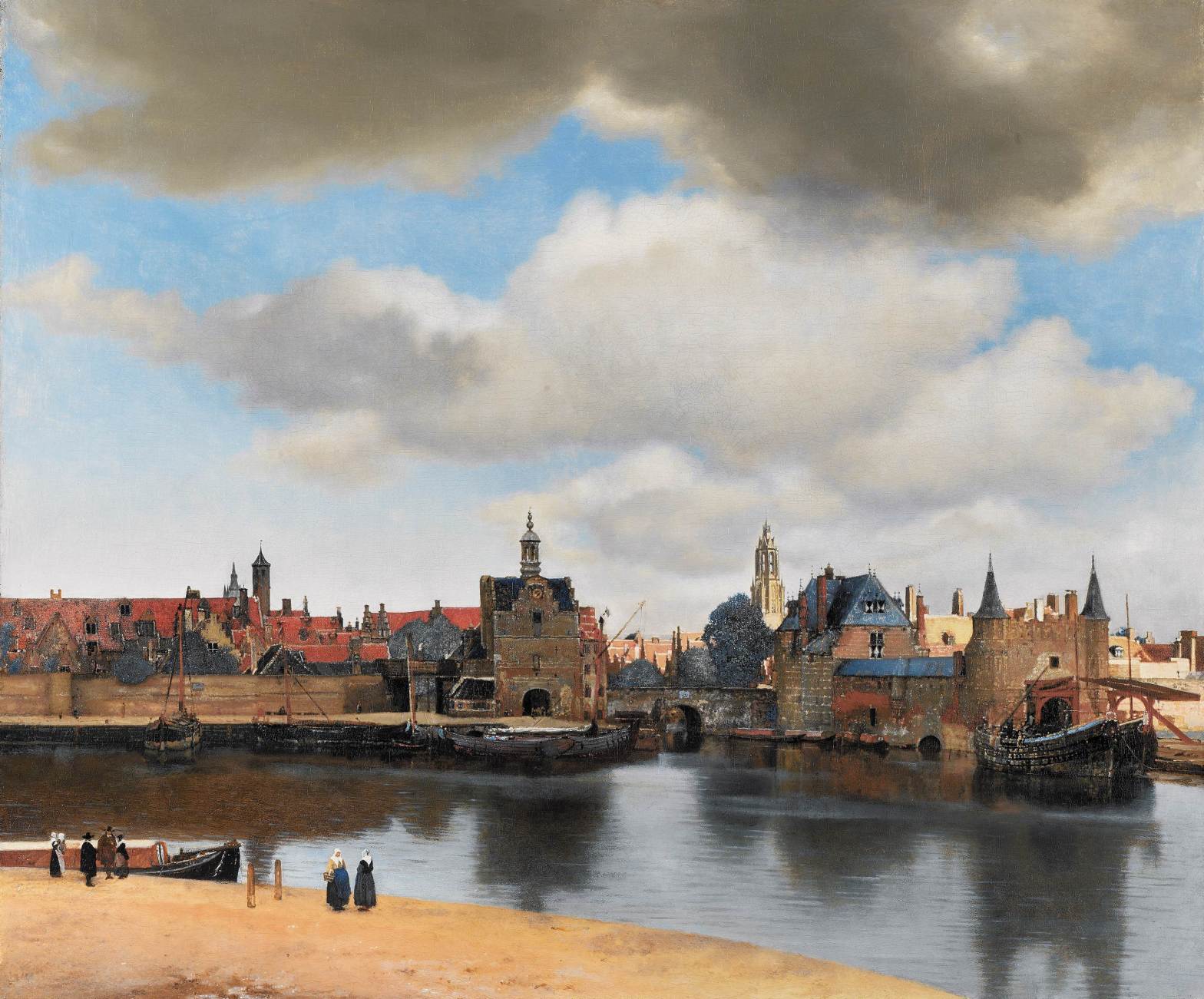
Marcel Proust on the Death of the Writer Bergotte
The circumstances of his death were as follows. A fairly mild attack of uraemia had led to his being ordered to rest. But, an art critic having written somewhere that in Vermeer’s View of Delft (lent by the Gallery at The Hague for an exhibition of Dutch painting), a picture which he adored and imagined that he knew by heart, a little patch of yellow wall (which he could not remember) was so well painted that it was, if one looked at it by itself, like some priceless specimen of Chinese art, of a beauty that was sufficient in itself, Bergotte ate a few potatoes, left the house, and went to the exhibition. At the first few steps he had to climb, he was overcome by an attack of dizziness. He walked past several pictures and was struck by the aridity and pointlessness of such an artificial kind of art, which was greatly inferior to the sunshine of a windswept Venetian palazzo, or of an ordinary house by the sea. At last he came to the Vermeer which he remembered as more striking, more different from anything else he knew, but in which, thanks to the critic’s article, he noticed for the first time some small figures in blue, that the sand was pink, and, finally, the precious substance of the tiny patch of yellow wall. His dizziness increased; he fixed his gaze, like a child upon a yellow butterfly that it wants to catch, on the precious patch of wall. “That’s how I ought to have written,” he said. “My last books are too dry, I ought to have gone over them with a few layers of colour, made my language precious in itself, like this little patch of yellow wall.” Meanwhile he was not unconscious of the gravity of his condition. In a celestial pair of scales there appeared to him, weighing down one of the pans, his own life, while the other contained the little patch of wall so beautifully painted in yellow. He felt that he had rashly sacrificed the former for the latter. “All the same,” he said to himself, “I shouldn’t like to be the headline news of this exhibition for the evening papers.”
He repeated to himself: “Little patch of yellow wall, with a sloping roof, little patch of yellow wall.” Meanwhile he sank down on to a circular settee whereupon he suddenly ceased to think that his life was in jeopardy and, reverting to his natural optimism, told himself: “It’s nothing, merely a touch of indigestion from those potatoes, which were undercooked.” A fresh attack struck him down; he rolled from the settee to the floor, as visitors and attendants came hurrying to his assistance. He was dead. Dead for ever? Who can say? Certainly, experiments in spiritualism offer us no more proof than the dogmas of religion that the soul survives death. All that we can say is that everything is arranged in this life as though we entered it carrying a burden of obligations contracted in a former life; there is no reason inherent in the conditions of life on this earth that can make us consider ourselves obliged to do good, to be kind and thoughtful, even to be polite, nor for an atheist artist [or scientist, RdW] to consider himself obliged to begin over again a score of times a piece of work the admiration aroused by which will matter little to his worm-eaten body, like the patch of yellow wall painted with so much skill and refinement by the artist destined to be for ever unknown and barely identified under the name Vermeer. All these obligations, which have no sanction in our present life, seem to belong to a different world, a world based on kindness, scrupulousness, self-sacrifice, a world entirely different from this one and which we leave in order to be born on this earth, before perhaps returning there to live once again beneath the sway of those unknown laws which we obeyed because we bore their precepts in our hearts, not knowing whose hand had traced them there – those laws to which every profound work of the intellect brings us nearer and which are invisible only – if then! – to fools. So that the idea that Bergotte was not dead for ever is by no means improbable.
They buried him, but all through that night of mourning, in the lighted shop-windows, his books, arranged three by three, kept vigil like angels with outspread wings and seemed, for him who was no more, the symbol of his resurrection.
From Marcel Proust’s The Captive (Part of In Search of Lost Time)
Bergotte: Proust’s Fragile Saint of Style
In Marcel Proust’s In Search of Lost Time, the figure of Bergotte hovers like a delicate watermark — faint, elusive, yet unmistakably present in every page where the narrator tries to understand what it means to be an artist. Among the many characters who populate Proust’s vast social and psychological world, Bergotte occupies a unique position. He is not simply a writer within a novel; he is a reflection, an echo, a shimmering hypothesis of what literature can aspire to be.
Where others in the book represent society, desire, jealousy, habit, or memory, Bergotte represents a way of writing — and more importantly, a way of being.
A Fictional Writer Who Feels More Real Than Many Real Ones
Bergotte is introduced to us through the Young Narrator’s intense admiration. Before we meet him in person, we meet his style: those crystalline pages he writes “in little blocks of ivory,” prose that the Narrator clings to as if it were scripture.
Proust subtly constructs Bergotte as a composite of several real writers — Anatole France, Pierre Loti, maybe even a misted-over self-portrait — but he emerges as wholly himself: whimsical, refined, taut with melancholy, perpetually seeking beauty.
The magic of Bergotte is that he feels entirely real to the reader, not because he is modeled on real people, but because Proust allows us to know him as we know great writers in life:
through their sentences, their myths, their failings, their frailty.
The Child’s Idol and the Adult’s Mirror
For the Narrator, Bergotte begins as a kind of literary hero, the writer whose work first opens the world to aesthetic feeling. His books form a grammar of taste. They become a private language.
When the Narrator eventually meets him, he encounters not a marble genius but a nervous, somewhat shabby man, wrapped in unpaid debts, chronic ill health, and domestic disarray. And yet this gap — between the immaculate style and the imperfect man — is precisely what fascinates Proust.
The Narrator learns that art and life are not symmetrical. A writer can be weak, vain, anxious, inconsistent, and still create something enduring, luminous, and true.
Bergotte’s imperfections become part of his charm. The Narrator’s disillusionment is not a collapse of belief but a maturing of it. He comes to understand the complexity of the artistic temperament, the loneliness of labor, the vulnerability behind carefully polished pages.
The Dutch Interior and the Price of Beauty
Bergotte’s most unforgettable moment — and one of the most famous scenes in all of Proust — is his death in front of Vermeer’s View of Delft. Drawn to the museum despite his worsening illness, he stares at the little “patch of yellow wall” that Proust elevates into a talisman of pure aesthetic perfection.
“That is how I ought to have written,” he thinks.
“My last books are too dry… one should have made the language precious in itself.”
It is a moment of ecstatic clarity — and fatal self-critique. Bergotte collapses in the museum, spending his final thoughts on a piece of art that embodies the precision and colour he believes he never fully achieved.
This scene crystallises Proust’s belief that artists are forever chasing something just out of reach: a luminous exactitude, a purity of form, a perfect correspondence between perception and expression. Bergotte dies, in a sense, of beauty — or of the desire for it.
His death is not tragic so much as mythic, almost holy. He becomes a martyr of style:
a saint who dies before a painting.
Bergotte as Proust’s “Other Self”
Many critics read Bergotte as Proust’s alter ego — the writer Proust both was and was not. Where Proust’s own prose is labyrinthine, Bergotte’s is crystalline. Where Proust is reclusive, Bergotte is socially entangled. Where Proust writes an enormous cathedral of memory, Bergotte fashions small, perfect objects.
If Proust is the architect, Bergotte is the jeweller.
Their differences matter less than their shared fate: the devotion to art, the sense of fragility, the awareness that illness and mortality shadow every page.
Proust gives Bergotte the death he himself feared and understood intimately — a death suffused with aesthetic revelation.
Why Bergotte Matters Today
In a world saturated with fast content, Bergotte feels like a reminder — almost a rebuke. He embodies the idea that style is not decorative but ethical, an attempt to grasp truth with precision and tenderness. His wavering voice, his anxieties, his meticulous sentences: they all insist on the dignity of taking beauty seriously.
He also reminds us that the artist need not be heroic to create something heroic.
Fragility can coexist with brilliance.
Confusion can coexist with insight.
Illness can coexist with vision.
In Bergotte, Proust gives us the writer not as a monument, but as a person: trembling, ambitious, and endlessly striving for that elusive “patch of yellow wall.”
 My World of Interiors