
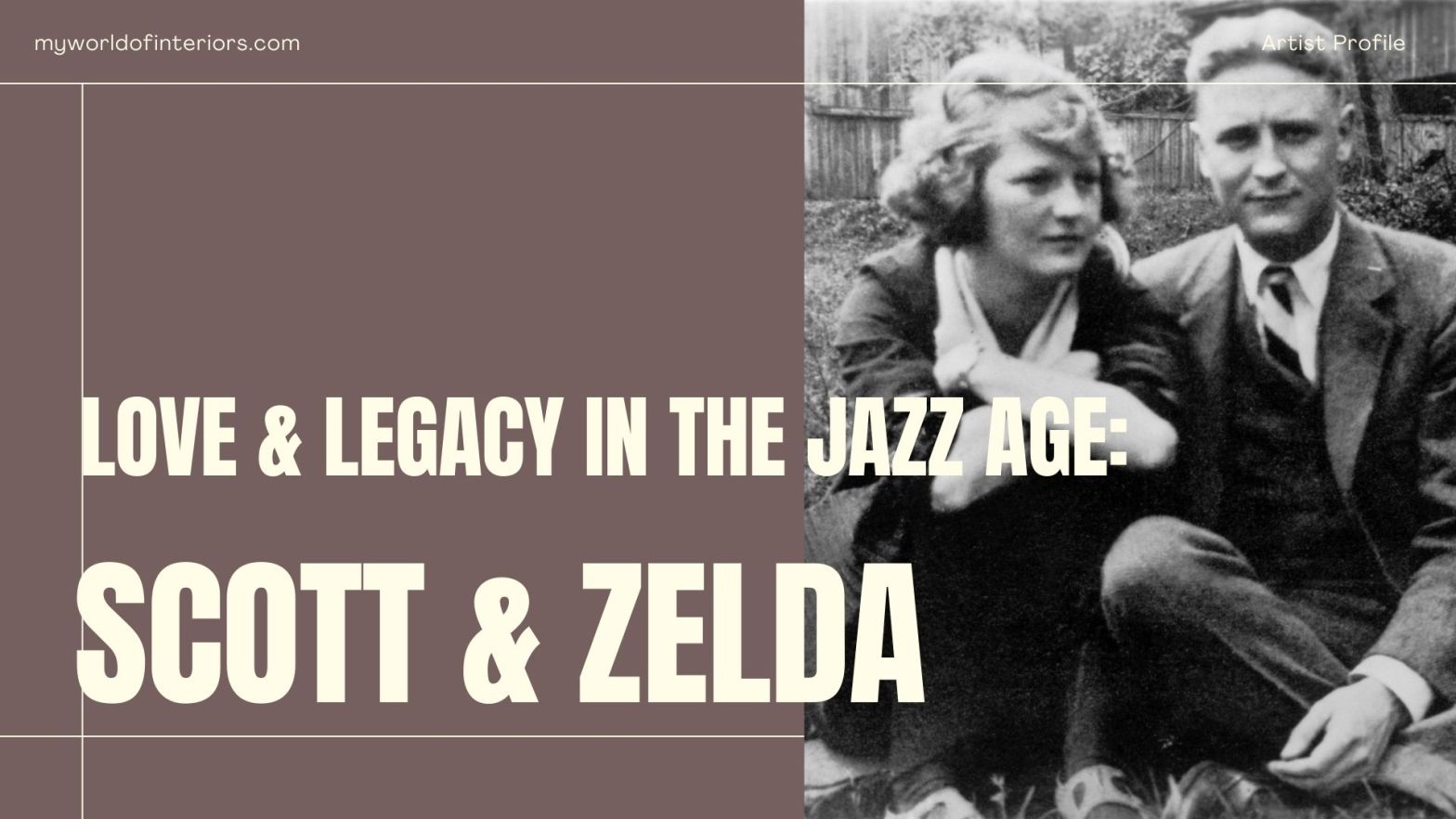
Few couples loom as mythically over the 20th century as F. Scott and Zelda Fitzgerald. They were beautiful, brilliant, and reckless — the gilded children of the Jazz Age, as dazzling as the parties they haunted, and as doomed as the decade they defined. To speak of them is to speak of literature, glamour, and tragedy woven into one incandescent thread.
Literary Legacy
Scott’s novels — This Side of Paradise, The Beautiful and Damned, Tender Is the Night, and above all The Great Gatsby — remain touchstones of American literature. They distilled the rhythms of jazz, the intoxication of youth, and the quiet ache of lost illusions. His sentences shimmer with precision, crystalline and heartbreaking, offering both the intoxication of success and the hollowness beneath.
Zelda, often cast as Scott’s muse, was far more than that. Her own novel, Save Me the Waltz (1932), is a modernist portrait of marriage and identity, its candor shocking for the time. In her paintings and essays, she offered an alternate lens on the very stories Scott claimed as his own — making her not only the “first flapper,” but also a voice wrestling for agency in a world eager to mythologize her rather than listen.
Together, their combined body of work tells not just the story of the Jazz Age but of a marriage that was both creative partnership and battlefield.
A Relationship of Brilliance and Ruin
Their romance was born in Montgomery, Alabama, in 1918, when Scott was a young lieutenant and Zelda Sayre a bold Southern belle. They married in 1920, launching themselves into notoriety as the glamorous couple of the Roaring Twenties. Their life together was an intoxicating mix of champagne-soaked nights, hotel lobbies, and reckless stunts — Zelda diving fully clothed into fountains, Scott drinking himself into infamy.
Yet behind the glitter lay turbulence. Scott borrowed from Zelda’s diaries and letters for his fiction, while Zelda felt her life was appropriated. Her descent into mental illness, and his into alcoholism, mirrored one another. Their bond remained intense but destructive, both sustaining and corroding the art that defined them.
A Geography of Restlessness
The Fitzgeralds’ life was one of restless movement — always searching for reinvention.
- New York – Their first playground, where they became the toast of the Plaza Hotel and the Jazz Age literati.
- Paris – In the 1920s, they joined the Lost Generation circle of Hemingway, Gertrude Stein, and Ezra Pound. The cafés of Montparnasse and the Left Bank were their haunts.
- The Riviera – Summers in Antibes, Juan-les-Pins, and Cap d’Antibes brought them into the orbit of Gerald and Sara Murphy, Picasso, and the glittering European set. These landscapes seeped into Tender Is the Night.
- Montgomery, Alabama – Zelda’s hometown, where she later returned during her hospitalizations.
- Baltimore and Asheville – Later chapters of their lives unfolded here, Scott writing Tender Is the Night in Baltimore, Zelda living much of her final decade at Highland Hospital in Asheville, North Carolina.
Their travels were both escape and pursuit — attempts to find happiness, stability, or inspiration, often undone by their own excesses.
In Their Footsteps: Hotels & Restaurants Still Standing
The Plaza Hotel, New York
Their New York playground — the grand ballroom and oak-paneled suites where the Fitzgeralds partied and wrote themselves into legend.
- Address: Fifth Avenue at Central Park South, New York, NY
- Website: theplazany.com
Hôtel Le Meurice, Paris
One of the Fitzgeralds’ Paris bases, still a temple of Belle Époque opulence where gilded mirrors and chandeliers echo their era.
- Address: 228 Rue de Rivoli, 75001 Paris
- Website: dorchestercollection.com
Les Deux Magots, Paris
A Montparnasse café where they mingled with the literary set — still bustling with writers and artists.
- Address: 6 Place Saint-Germain-des-Prés, 75006 Paris
- Website: lesdeuxmagots.fr
Hôtel Belles Rives, Juan-les-Pins
The Riviera hotel where the Fitzgeralds stayed, perched on the sea at Cap d’Antibes. Its Art Deco elegance remains intact.
- Address: 33 Boulevard Edouard Baudoin, 06160 Juan-les-Pins
- Website: bellesrives.com
Hôtel du Cap-Eden-Roc, Antibes
Perhaps the most famous Riviera retreat of them all, frequented by the Fitzgeralds and their circle. Still the epitome of Riviera luxury.
- Address: Boulevard J. F. Kennedy, 06601 Antibes
- Website: oetkercollection.com
Harry’s New York Bar, Paris
The legendary cocktail bar where expats gathered — Scott was a fixture here, notebook in hand, martini close by.
- Address: 5 Rue Daunou, 75002 Paris
- Website: harrysbar.fr
What to Read: The Fitzgeralds & Their Kindred Spirits
By F. Scott Fitzgerald
- This Side of Paradise (1920) — His debut novel, capturing the voice of a generation awakening to modernity.
- The Beautiful and Damned (1922) — A portrait of love, wealth, and ruin, echoing his own marriage.
- The Great Gatsby (1925) — The Jazz Age masterpiece, an elegy to illusion and longing.
- Tender Is the Night (1934) — A haunting Riviera-set novel about love, psychiatry, and collapse, thinly veiled autobiography.
- The Crack-Up (1945) — Posthumously published essays exposing his self-doubt and disintegration.
By Zelda Fitzgerald
- Save Me the Waltz (1932) — Zelda’s only novel, raw and luminous, written during her hospitalization.
- Collected Writings — Essays, short fiction, and letters that reveal her sharp wit and artistic vision.
Kindred Spirits & Spiritual Relatives
- Ernest Hemingway — Fellow chronicler of the Lost Generation; rival and sometimes friend, whose terse prose counterpointed Scott’s lyricism.
- Gertrude Stein — Matriarch of the Paris literary scene, coining the term “Lost Generation.”
- T. S. Eliot — His The Waste Land (1922) mirrors Scott’s sense of modern disillusionment.
- Virginia Woolf — Zelda’s modernist peer, equally invested in inner consciousness and female subjectivity.
- Sylvia Plath & Ted Hughes — Later echoes of the Fitzgeralds’ creative/intimate entanglements and destructiveness.
- Paul Bowles — An American expatriate whose Moroccan exile and outsider’s gaze reflect Scott and Zelda’s restless search for elsewhere.
 My World of Interiors
One thought on “Scott & Zelda: Legacy, Love, and the Geography of a Jazz Age”