
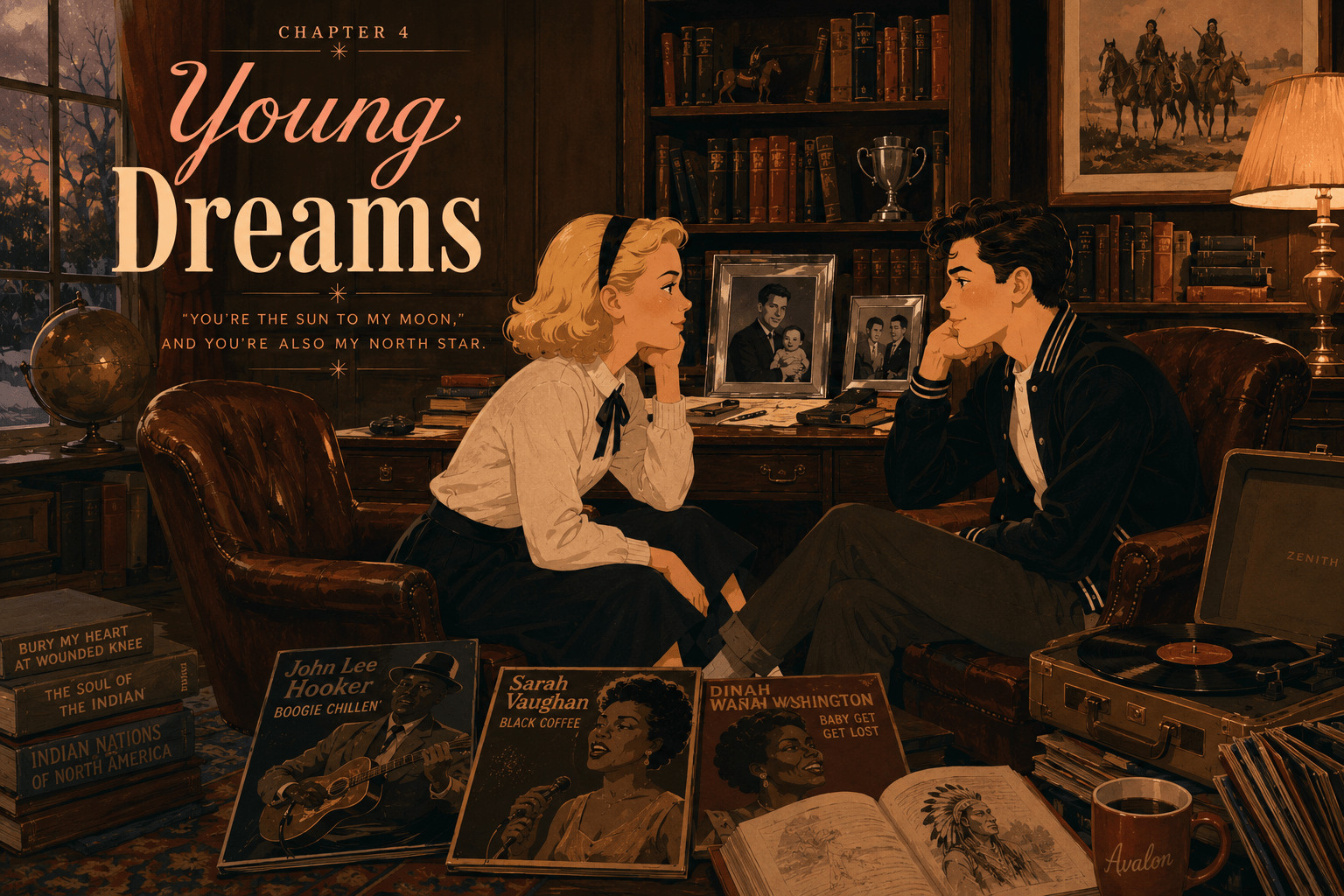
It’s January in 1949, and the boy is celebrating his fourteenth birthday.
He turns up at my house mid-afternoon, carrying a book of cartoons, a gift from his parents he’s eager to show me. I am sitting behind the big desk in the downstairs office, the one adjacent to the library. It used to be Grandpa George’s den, but now it’s mine. I am reading a book on Red Indians. They’re my favourite Americans.
The boy says they’re not actually called Red Indians, but American Indians, because they’re not red.
“That’s just something the pilgrims made up,” he says, “to make them seem like devils.” I ask him why.
“So it was easier to kill them, and not view them as real people.” He tells me.
“They are the only real Americans, and we stole their land.” He sounds sad.
The boy is passionate about this. He says it’s because some of his ancestors were Indians on his mother’s side, and because he is always on the side of the underdog, and what is moral and good.
“I understand,” I say, and put my hand on his shoulder, and look him in the eye. I like him extra much when he is like this.
“This is cool,” I say as he hands me his new book.
“Yeah,” he smiles. “Ain’t it, though?”
The boy takes a look around the room. It’s the first time he has been here. “It’s cozy,” he says, then chuckles, “and very masculine.”
He turns to face Grandpa George’s line of silver-framed photographs on the desk.
“I had forgotten about those,” I say and move closer.
He picks one up and studies it. It’s of Tom when he was our age and I was a baby. He is proudly cradling me in his lap and grinning. It’s from my christening and Tom is looking very smart in his pressed suit, his shiny brown hair falling across his brow. He was such a handsome boy. I am suddenly close to tears.
“Who is this?” the boy asks, “your…your…your boyfriend?” He’s trying to sound casual, but is failing.
“No.” I say. I grab the picture and place it back on the desk. Then I take a deep breath. “He’s my brother Tom. The baby is me.”
“You have a brother?” The boy is surprised. “You never told me.”
A tear slips out and I quickly wipe it away. “He died in the war,” is all I tell him.
He hugs me, tells me he is sorry and says he knows how I feel. Then he tells me he had a brother too once, a twin, who died at birth.
We plonk down in the two leather chairs on the other side of the desk and talk about our grief in a way I never have with anyone before, not even Miss Mary or Grandpa George. It’s easier than I thought it would be with him. He listens to my stories about Tom and knows I’m telling the truth when I say how wonderful and special he was.
The boy tells me he sometimes talks to his brother, or sees him in dreams, and that it can feel as if he’s still with him. I understand exactly what he means. It seems as though we can sense each other’s pain, and help soothe it, just by sitting here together, listening.
After a while, the room grows quiet, and it’s time to break the spell.
“Want to watch a movie downstairs? I’ve got a whole stack of new films but you decide, it’s your birthday.”
“Really?”
“Yes, baby.”
He grins. “Well, what do y’all have?”
The Red Shoes? It’s new! I launch into the plot.
“Alright then.” He chirps.
“Alright then.” I echo. “Cake now or later?”
“Now, of course!”
***
We’re upstairs in my room, doing homework after school has started up again following the Christmas break. We are together all the time these days. The local radio is on.
“You know somethin’, Buzzy Bee-Bop?” he looks up.
“Yes,” I reply with mock authority. “I know a lot, but tell me anyway.”
He laughs.
“Be serious now.”
“I am.” I give him my most earnest look. “What’s up?”
“You… you’re pretty wonderful,” he says, eyes dropping to his homework.
“I totally know,” I reply. “I so know it. I’m relieved you’ve noticed too.”
He looks back at me, clearly holding something in. I wait, letting him build up courage. His face goes red.
“You’re the sun to my moon,” he says, his voice cracking. Then, with finality: “And you’re also my North Star.”
I am taken aback. I am so flattered that I don’t know which way to turn, I just sit and smile at my homework until my face starts to hurt. I look up at him with a gawky smirk and say, “Wow. That’s a lot.”
He’s flushed, serious, and brave. I can see the relief in him just to have said it.
And before I can think, the words blurt out of my mouth:
“I love you.”
Now I’m the one who is brave. I wait a little too long before I try to make light of it.
I cough, breaking the silence, desperate to push time on from here. “I don’t think I’ve ever had so much fun with anyone as I have with you.”
He looks up, pleased. “Honest?”
“Yes, honestly. It’s like you have the best sense of humour I’ve ever encountered, and it matches mine exactly. How grateful do you think I am for that?”
“Fancy putting our books down for a minute and having a play-wrestle?” he asks.
“Abso-bloody-lutely.” I grin.
We play-wrestle, all above board, then lie on the floor listening to our latest finds from downtown: Boogie Chillen’ by John Lee Hooker, Black Coffee by Sarah Vaughan and Baby Get Lost by Dinah Washington. We study the covers, and talk about why we love the records.
Music is one of the things we share, a deep love of it, along with movies… and recently, a bit of roughhousing. Before I came here, I knew I loved Billie Holiday above all, but the boy has opened my ears to the bluesmen, to gospel, country and the Memphis sound that’s rising up like a stirring fever dream around us. He has widened my tastes from jazz and crooners to raw and soulful blues. I didn’t know who Robert Johnson was before I met the boy, but I sure do now. “The Mississippi Delta will do that to you.” the boy grins.
We sit quietly as the last record spins out.
“I don’t understand all this race segregation,” I blurt. “Look at these records.” I gesture at the sleeves on the floor. “They’re mostly by coloured people.”
The boy gestures earnestly. “I don’t get it either. When we lived in Tupelo, we lived in a colored neighbourhood for a while. Folks were just folks. Ain’t no difference.”
“Apart from being better at music,” I say. “And dancing. And sports.”
He laughs, thinking I am thinking of something else that I know nothing about yet.
“How do you deal with it?” I ask. We didn’t have segregation or any Jim Crow Laws in England.
He pauses to think.
“I pretend we live in a post-segregated world,” he says seriously. “I talk to anyone I want to, no matter their color or creed, and pretend I’m free of these stupid laws.”
I feel the pull toward him a little stronger. I sometimes feel like I want to crawl over and live inside of him. It’s like I can’t get close enough.
“I don’t understand how a coloured man can fight the same war as the rest of us, then have to sit at the back of the bus when he comes home,” I say.
“It’s entirely unchristian,” the boy agrees.
“I hope we live to see a day when we can all mix.”
“Me too.”
We smile at each other.
“I’m glad we agree on the things that matter,” he says.
“We do,” I nod. “I’m glad too. After what happened to the Jews during the war, I don’t think I could be friends with you if we didn’t.” I add solemnly.
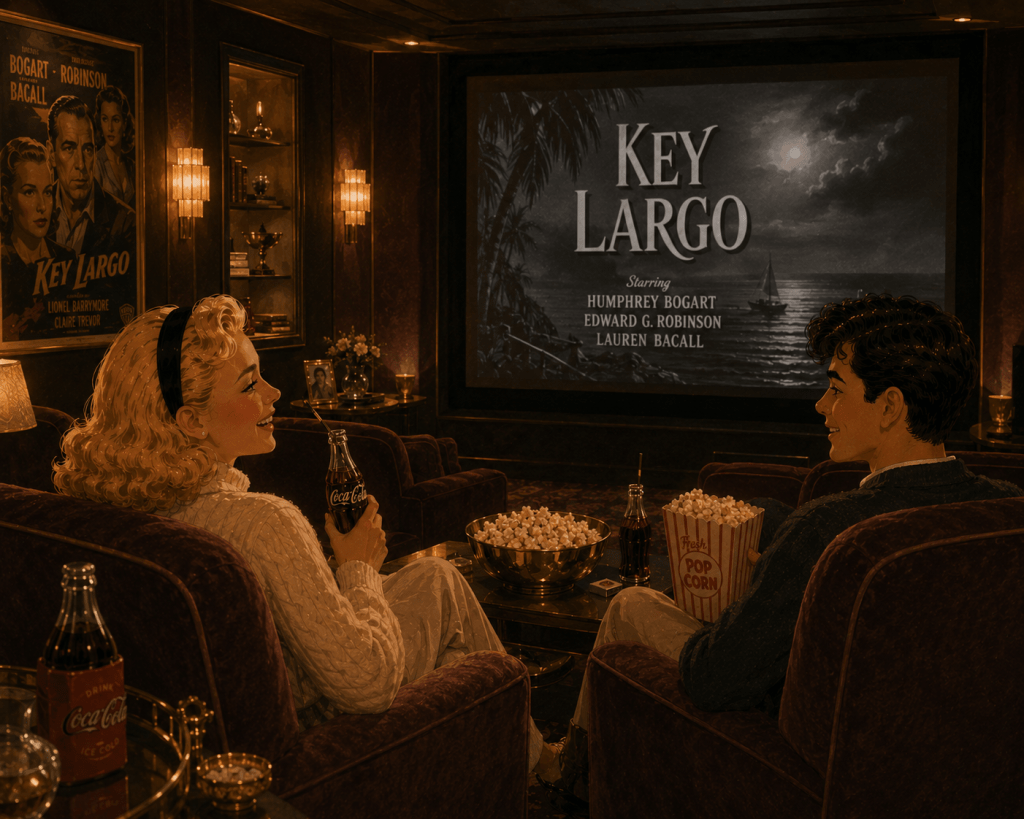
“Wanna watch Key Largo?” I ask, remembering the parcel that came this morning.
“Is the Pope Catholic?” he grins, and we run downstairs.
I let him put the first roll of film on, I’ve shown him how, just as he’s shown me how to make my body more aerodynamic when we race home from school on our push bikes. It makes him feel like he is contributing something. I have told him a million times that he already is, “more than you will ever know.”
My novel GREAT ARE THE MYTHS will be serialised (one chapter each day) over the summer of 2026. If you would rather listen to the audiobook, the full story is available for free on all the usual platforms. Info and links HERE
Discover more from My World of Interiors
Subscribe to get the latest posts sent to your email.

