

Mark Twain was not merely a writer; he was a voice so distinct, so irreverent, that it seemed to belong to America itself. Born Samuel Langhorne Clemens in 1835 on the banks of the Mississippi River, Twain became the first truly national humorist, a man who captured the cadences of ordinary speech, the hypocrisies of polite society, and the contradictions of a nation still struggling with its conscience. His genius lay in making Americans laugh while also forcing them to look in the mirror.
Today, Twain is often remembered for a handful of aphorisms — “The reports of my death are greatly exaggerated” or “Clothes make the man. Naked people have little or no influence on society.” But to treat him as merely a dispenser of one-liners is to diminish the breadth of his achievement. His wit was inseparable from his artistry, his satire from his storytelling, and his humor from his moral seriousness.
From the Mississippi to the World
Samuel Clemens was born in Florida, Missouri, and grew up in Hannibal, a small Mississippi River town that became the model for St. Petersburg in The Adventures of Tom Sawyer and Adventures of Huckleberry Finn. His early years were marked by loss — his father died when Clemens was eleven — but also by the river, that vast artery of commerce and folklore that defined his imagination.
As a young man he worked as a printer’s apprentice, a steamboat pilot, and a prospector out West, before discovering his calling in journalism and storytelling. He adopted the pen name “Mark Twain” — a riverboat term meaning safe water — in 1863. By the 1870s he had become America’s most famous humorist, celebrated for his lectures as much as his books.
Humor as Social Critique
Twain’s humor was always more than entertainment. He used satire as a scalpel, cutting through pretension, hypocrisy, and injustice. He lampooned the Gilded Age’s obsession with money in The Gilded Age: A Tale of Today (1873, co-written with Charles Dudley Warner), skewered imperialism in Following the Equator (1897), and turned a skeptical eye on organized religion in works like Letters from the Earth.
His great novels embody this balance of humor and critique. Tom Sawyer is a mischievous portrait of boyhood freedom, but Huckleberry Finn goes deeper, exposing the moral rot of slavery through Huck’s friendship with the runaway slave Jim. Hemingway once declared that “all modern American literature comes from one book by Mark Twain called Huckleberry Finn.” The novel’s colloquial voice and unflinching moral questions still reverberate — and still provoke controversy.
The Public Performer
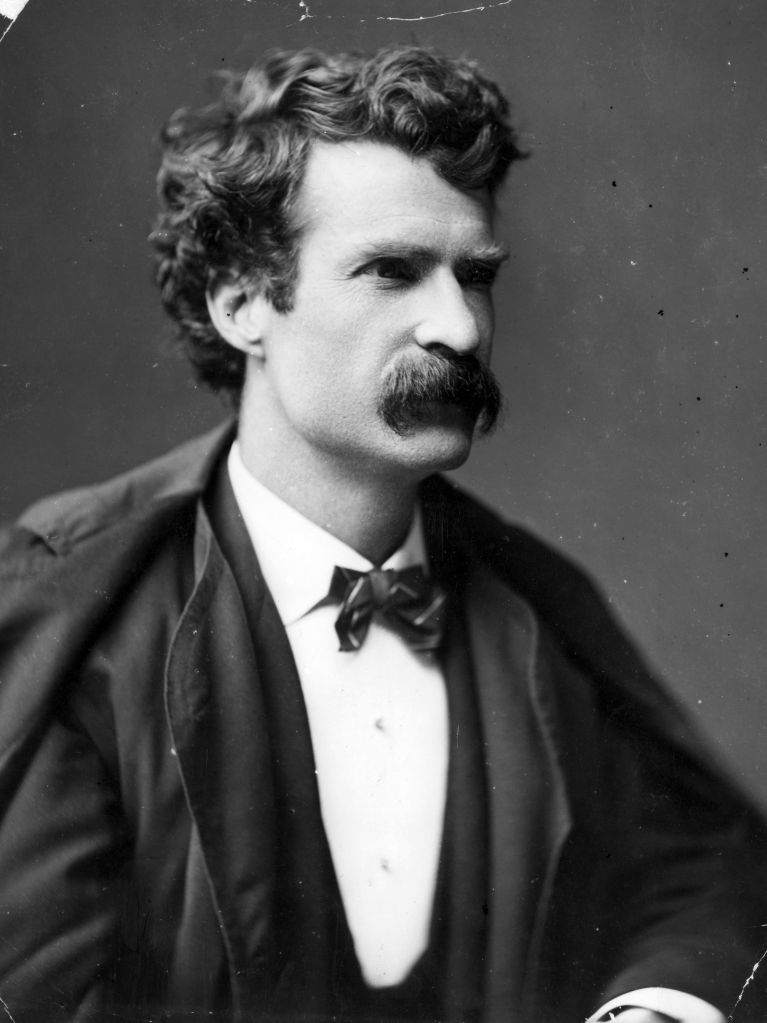
Twain was also a performer in the most modern sense. He toured America and Europe as a lecturer, spinning yarns with impeccable comic timing. His bushy mustache, white suits, and drawling delivery made him instantly recognizable.
Unlike many humorists, Twain thrived on the stage. He understood that storytelling was as much performance as prose, and his lectures often blurred the line between stand-up comedy and literary recitation. He was among the first writers to become a celebrity in the modern sense — quoted, caricatured, adored, and scrutinized.
The Darker Undercurrent
Beneath Twain’s humor ran a current of melancholy. He endured financial ruin after disastrous investments, particularly in new printing technologies. He declared bankruptcy in the 1890s and spent years lecturing around the world to pay off debts, which he eventually did in full.
His personal life was shadowed by tragedy: he lost three of his four children and his beloved wife, Olivia Langdon Clemens. These losses deepened his skepticism and gave his later writings a darker, more biting edge. Works such as The Mysterious Stranger reveal a man grappling with the cruelty and absurdity of existence, even as he continued to cloak despair in satire.
Sidebar: Five of Twain’s Sharpest Quips
1. On Reports of His Death
“The reports of my death are greatly exaggerated.” — A masterstroke of self-parody, delivered to a journalist in 1897.
2. On Government
“Suppose you were an idiot. And suppose you were a member of Congress. But I repeat myself.” — Twain’s enduring lampoon of American politics.
3. On Travel
“Travel is fatal to prejudice, bigotry, and narrow-mindedness.” — A line from The Innocents Abroad, revealing Twain’s belief in travel as education.
4. On Clothes
“Clothes make the man. Naked people have little or no influence on society.” — Satire distilled to its wry essence.
5. On Education
“I have never let my schooling interfere with my education.” — A playful jab at formal learning, elevating experience and curiosity above rote.
Legacy: The American Voice
Mark Twain died in 1910, fittingly as Halley’s Comet returned — he had predicted he would “go out with it.” In death as in life, he seemed bound to cosmic timing.
His legacy is vast. He gave America a literary vernacular rooted in its own rhythms, not borrowed from Europe. He made humor an instrument of critique, proving that laughter could expose injustice more effectively than sermons. And he left behind works that remain foundational: Huckleberry Finn, Tom Sawyer, Life on the Mississippi, The Innocents Abroad.
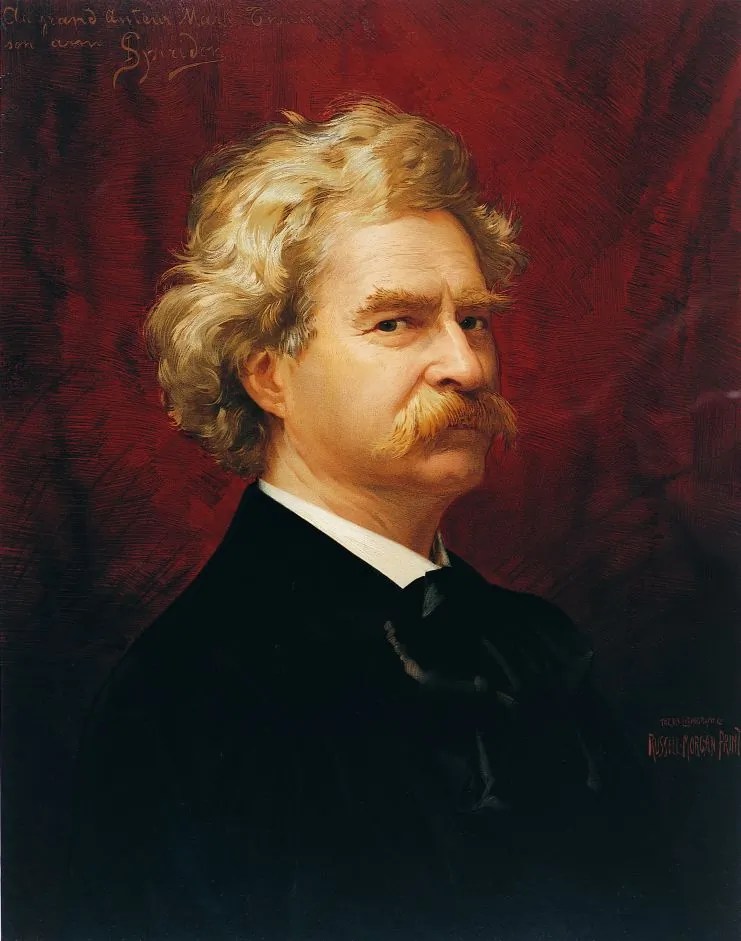
More than a century later, Twain’s voice still feels alive — ironic, humane, restless, amused and appalled in equal measure. He reminds us that wit is not mere ornament but a way of thinking, a mode of truth-telling, a mirror held up to society.
The Seriousness of Twain’s Humor
To read Twain is to hear America speaking to itself — brash, funny, self-critical, and contradictory. His wit continues to resonate not because it is clever but because it is tethered to moral vision. He laughed at the absurdities of the world not to dismiss them but to expose them.
Mark Twain was, in the end, both America’s jester and its conscience. His humor was a form of clarity, his satire a form of justice. The man from the Mississippi remains, more than a century later, the wit who invented America.
 My World of Interiors