
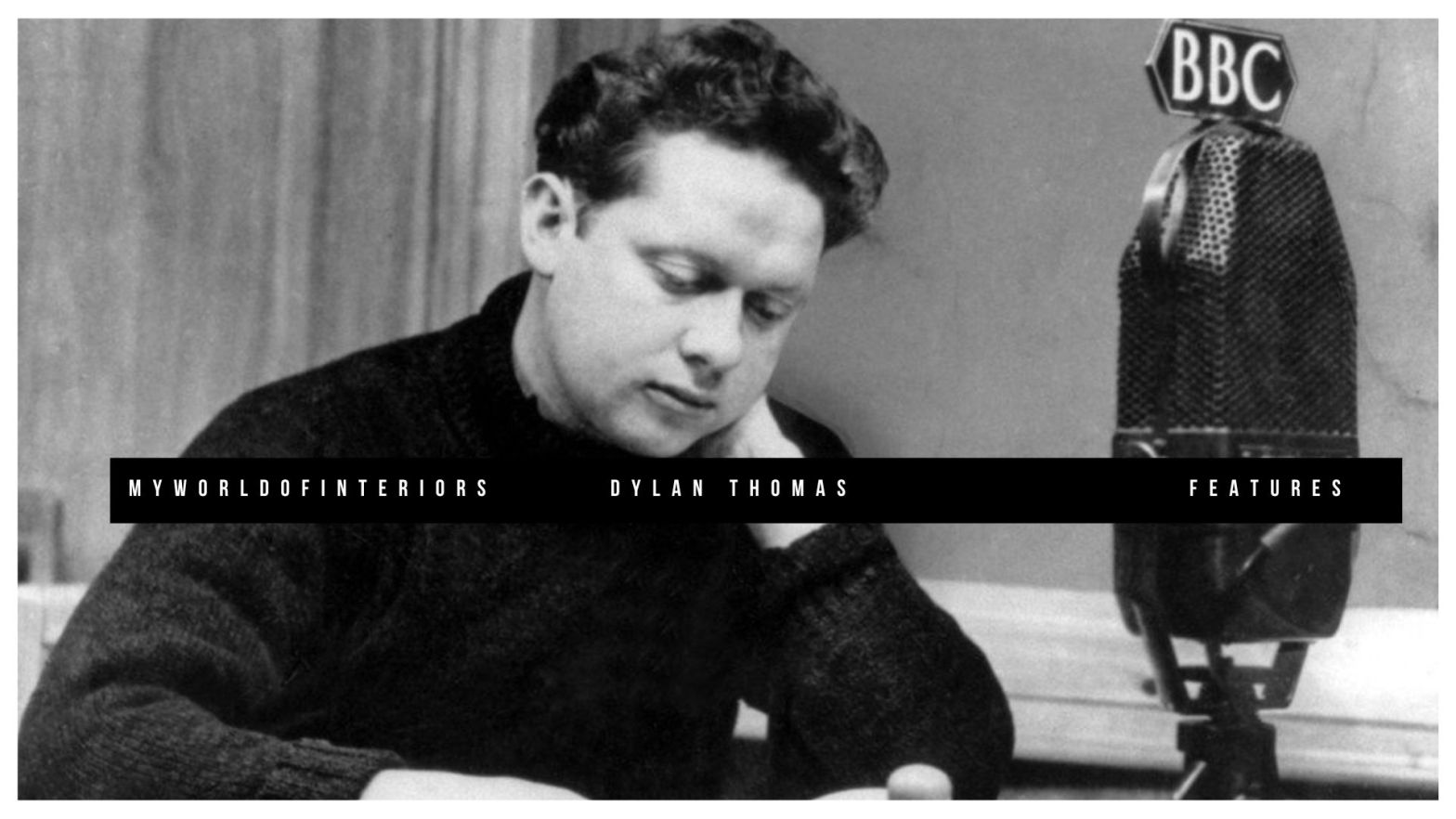
Dylan Thomas occupies a singular corner of twentieth-century poetry: a writer for whom sound was not ornament but ontology. He is, perhaps above all else, a poet of voice—of syllables struck like bells, of syntax uncoiling into chant, of images that are felt in the mouth before they settle in the mind. He is my favourite and I never tired of him. To read him silently is already to hear him. To hear him read—those famous recordings, that sonorous baritone—is to realize how completely his art collapses the distance between text and performance. In an era that prized irony and cool, Thomas insisted on rapture.
And yet the legend has often eclipsed the labor. The bohemian myths—the Chelsea Hotel, the Manhattan tours, the whisky, the “18 straight whiskies” line—threaten to reduce him to a poster of doomed Romanticism. What endures, when the fog burns off, is the work: fiercely made, technically exacting, rooted in Welsh speech-music and the Bible’s rolling cadences, alive to birth and sex and death with an almost liturgical urgency. Thomas is not simply a poet who sounds good; he is a poet whose meanings are braided into sound itself.
Origins: A Welsh Grammar of Wonder
Born in Swansea in 1914 to a schoolmaster father and a mother from farming stock, Thomas grew up between the grammar of books and the grammar of fields. The Welsh landscape—its estuaries and hedgerows, its sea-light and chapel tones—became his imaginative birthright. Even writing in English, he absorbs a Welsh prosodic inheritance: the cynghanedd’s intricate chimes, internal rhymes that knit the line from within, a taste for parallelisms and antiphonal balance.
As a teenager he filled notebooks with drafts—intense, embryonic poems already bent toward metamorphosis, fertility, and the cyclic dramas of nature. He leaves school early, writes and revises obsessively, and by twenty releases 18 Poems (1934): dense, hermetic lyrics whose biological imagery (seeds, cells, marrow, sap) fuses the erotic and the cosmic. The influence of Blake’s visionary symbolism and Hopkins’s sprung energies is audible, but the voice is unmistakably his—incantatory, corporeal, and strange.
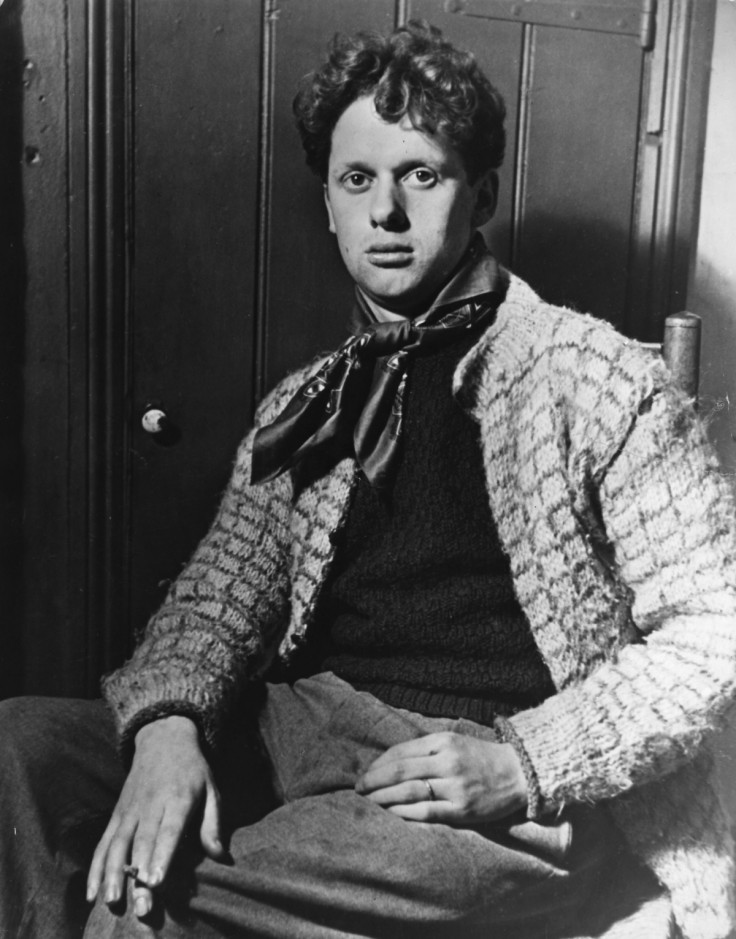
Craft: Sound as Structure
Thomas’s reputation for “difficulty” has less to do with obscurity than with amplitude. The poetry overflows—rhyme upon rhyme, images blooming and overblooming. Underneath the wildness is craft: villanelles and sonnets discreetly skeleton the lyric swell; stanzaic architectures hold the surf. He uses internal rhyme not merely to decorate but to generate thought—sound leads the imagination through quick turns and associative leaps.
Biblical diction—oak-heavy nouns, verbs with muscle—gives the work its oracular weight. But Thomas is not sermonizing; his biblical voice is earthly, flesh-forward, interleaving chapel and carnal knowledge. The key technique is apposition: images stacked rather than subordinated, the line accruing meaning through accretion rather than exposition.
The Early Volumes: Flesh, Seed, and Star
18 Poems and Twenty-Five Poems (1936) are ablaze with generative force. Birth and sex are cosmologies; the body is landscape; nature is anatomy. A typical Thomas line refuses to choose between metaphor and fact—it is both at once. The poems are private—at times hermetically so—but they pulse with a confidence rare in youth: an insistence that language, pushed hard enough, can return us to first principles.
If Yeats sought to systematize the soul, Thomas seeks to hymn its energies. Where Auden’s early work diagrams crises, Thomas baptizes them. Even war, when it arrives, is felt viscerally rather than polemically.
War and After: Elegy with Fire
In Deaths and Entrances (1946), written amid and after the Second World War, the ecstatic registers darken into elegy. The see-saw of his sensibility—delight counterweighted by mortality—clarifies into mature music. “A Refusal to Mourn the Death, by Fire, of a Child in London” is exemplary: grief and grandeur yoked without sentimentality, a lyric that refuses cheap consolation while insisting on sanctity.
“Fern Hill” sings of childhood as a green world spent like a coin; “Poem in October” returns to Swansea as to a font, weaving pilgrimage and birthday into one rite. The voice has broadened—less cryptic, more lucid without losing density, confident enough to let air into the stanza.
“Do not go gentle into that good night”: Form as Command
Thomas’s most famous poem is a villanelle, a notoriously constricting French form whose obsessions—refrain, return, repetition—are perfect for the poem’s subject: raging against diminishment. The technical paradox is the point. The villanelle’s iron bars force a controlled fury; the refrains mutate not by argument but by pressure, the way grief revisits a fact until it reveals another face. What is often quoted as sentimental uplift is, on the page, a hard lyric of filial desperation, faithless to piety and faithful to insistence.
The Play for Voices: Under Milk Wood
If the poems make music on the page, Under Milk Wood (1954) makes it explicitly in the ear. Subtitled “a play for voices,” it assembles the village of Llareggub (read it backwards) into a choral portrait: bawdy, tender, comic, elegiac. Thomas’s gift for naming—the Dickensian, sea-salted coinages—and his ear for idiom create a whole social soundscape. It is Joyce miniaturized and made singable; it is also a summation of Thomas’s democratic instinct: all registers admitted, from chapel to pub. The piece demonstrates how thoroughly his art belongs to orality, and why his readings became events rather than mere recitals.
America: The Stage and the Pressure
Thomas’s American lecture tours in the early 1950s turned the poet into a performer and the performer into a myth. The New York audience wanted incantation; he delivered it. The fees paid bills; the pace and the nightlife exacted costs. Accounts of the last tour are a tangle of romance and ruin—Chelsea Hotel, deadlines, debts, drink. What matters for the work is not the tabloid arc but the fact that the public readings permanently altered how the poems live in culture: on the record, in the voice, with the poet’s own emphases fossilized into interpretation.
His death in 1953, at thirty-nine, has been endlessly sensationalized; responsible biographies emphasize a complex of factors (illness, exhaustion, medical mismanagement) rather than a single melodramatic cause. What remains incontestable is the work’s unfinishedness—projects in embryo, poems sketched, a career cut off at its most capacious moment.
Style and Charge: Why He Lasts
Thomas’s detractors have often accused him of rhetoric at the expense of sense, of gorgeous surfaces that hide vacuity. The charge misunderstands where his meanings live. In Thomas, sound is not a veil but a vehicle: the consonantal crunch, the vowel-rich swell, the chime of internal rhyme—these are how the poem thinks. He writes toward elemental experiences that precede paraphrase: birth, lust, fear, wonder, mourning. If a poem resists summary, it is not because it lacks substance but because it has condensed too many vectors of feeling into a single verbal event.
He also endures because he is unabashedly hospitable to delight. Even in elegy his work keeps a pagan joy—a pleasure in the body, the weather, the fact of being here. In a century of anxiety, he permits exultation without naiveté.
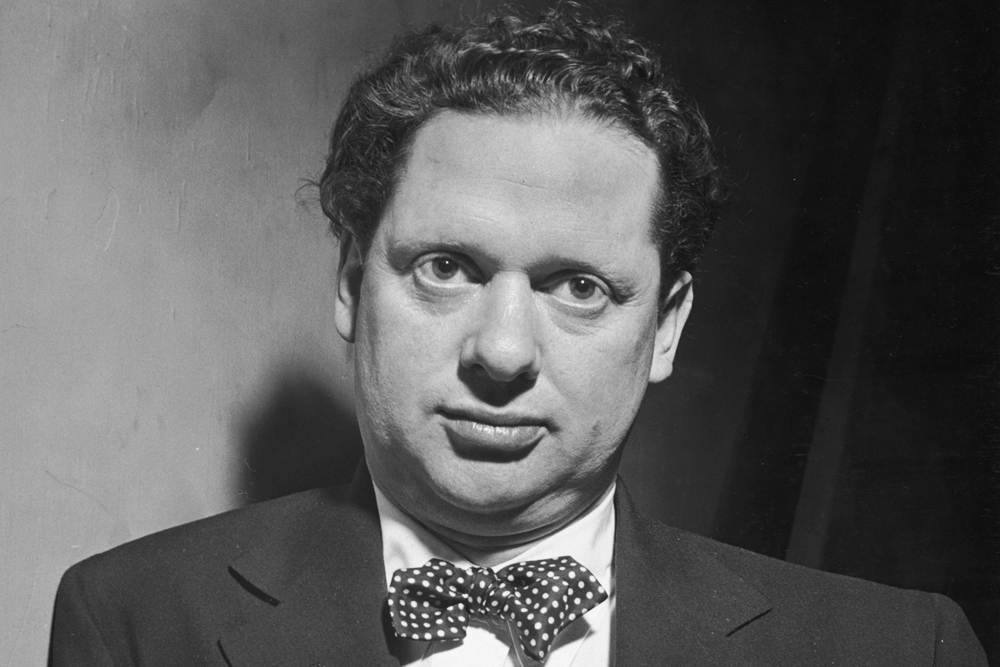
Influence: From Page to Microphone
Thomas helps inaugurate the modern poet as performer—an artist whose recorded voice is as canonical as the printed text. The “poetry reading” becomes, in part through him, a genre. His sonic priorities travel forward into poets of cadence and chant; his compression and image-stacking point sideways to the lyric intensities of contemporary performance poetry. In prose, Portrait of the Artist as a Young Dog shows he knew how to modulate—comic, clear, companionable—proving he could write in many keys.
Welsh writers, unsurprisingly, read him as both ancestor and problem: a giant whose shadow both shelters and distorts. English-language poets more broadly have raided his toolbox—the villanelle’s modern authority owes much to his version; internal rhyme and chiming syntax find new homes in poets as different as Sylvia Plath and Seamus Heaney. Musicians and actors borrow him outright: recordings of “A Child’s Christmas in Wales” and Under Milk Wood continue to define a certain winter warmth on radio and stage.
The Life with Caitlin: Intimacy and Combustion
Any honest portrait must admit the marriage: Dylan and Caitlin—volatile, passionate, mutually wounding, mutually necessary. Their letters and memoirs are documents of love as siege and sanctuary. The poems are not confessionals in the modern sense, but you can feel the pressure of that life in the work’s oscillations—the feast-day ecstasies and the hangover despairs, the home as ark and as storm. If the legend tempts melodrama, the poems transmute it into ritual, giving form to chaos without prettifying it.
Where to Begin (and How to Continue)
- For the ear: The Caedmon Recordings—Thomas reading his own poems and Under Milk Wood. Hear the lineation become breath.
- For the lyric arc: Deaths and Entrances, then Collected Poems—to feel the shift from dense early rapture to lucid late mastery.
- For narrative warmth: Portrait of the Artist as a Young Dog—prose that shows the humor and human sympathy under the thunder.
- For winter ritual: “A Child’s Christmas in Wales”—proof that Thomas could speak plainly and still enchant.
Read him aloud. Even alone in a room, sound the lines. Thomas’s meanings flare in the mouth.
The Work Against the Myth
It is tempting to end with the romance of the doomed poet. Resist it. Thomas’s achievement is not his wreckage; it is his workmanship. The poems are labored into being, revised into shape, their brilliances engineered. The voice that sounds spontaneous is sustained by technique—the villanelle’s cage, the sonnet’s hinge, the stanza’s hidden scaffolds.
Dylan Thomas’s gift was to make the elemental feel newly elemental, to braid awe and anguish until they sang. His poems argue—by seduction rather than thesis—that language can still bless the world, and that to name it beautifully is not evasion but praise. In a culture that often mistrusts intensity, his work remains a reminder that lyric excess, rightly handled, is a mode of truth.
 My World of Interiors