
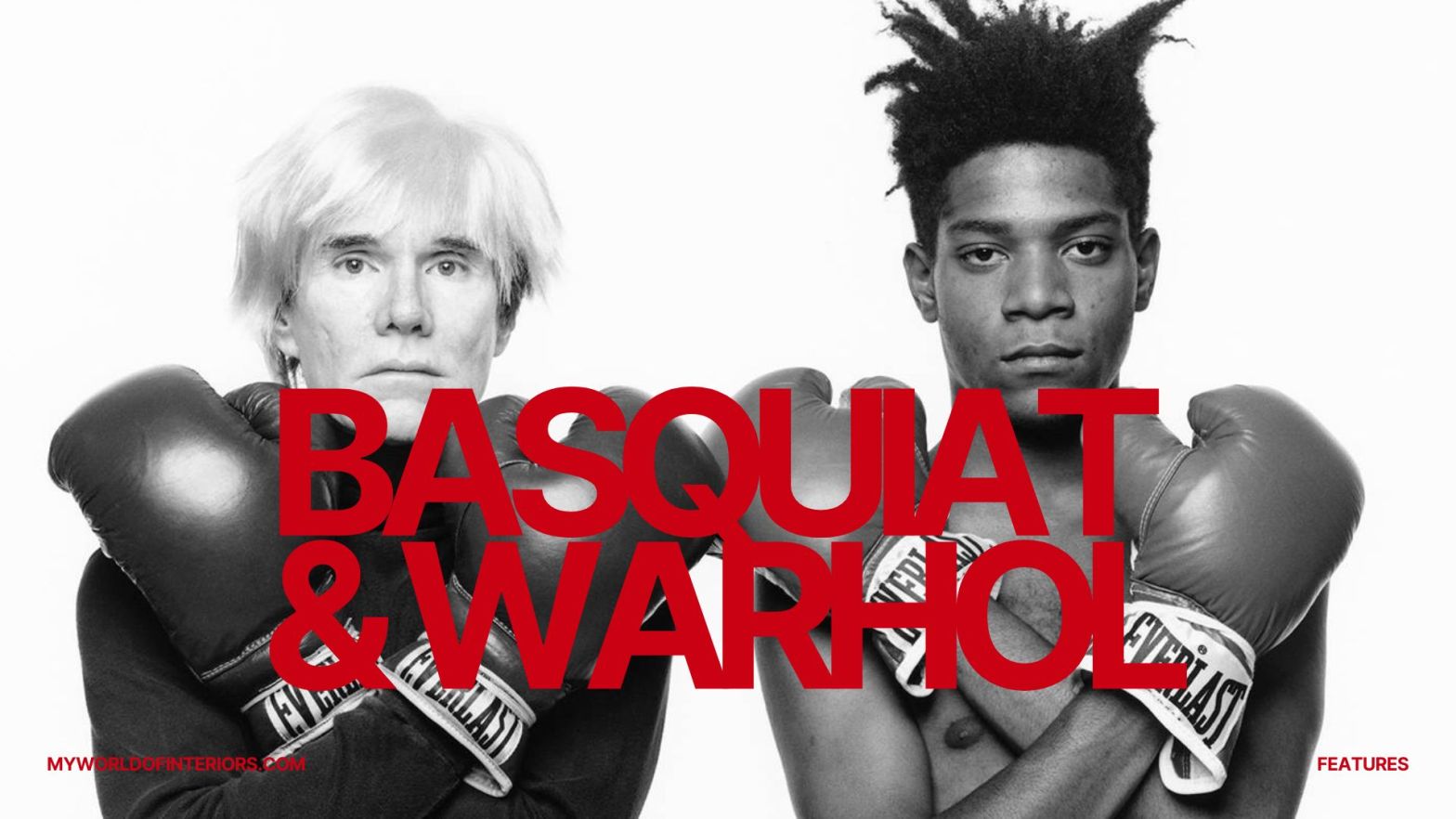
Art history is rich with encounters between generations, but few have provoked as much fascination, controversy, and enduring debate as the working friendship between Andy Warhol and Jean-Michel Basquiat. On one side stood Warhol, the established oracle of Pop, a man whose silkscreens of soup cans, celebrities, and consumer logos had redefined art’s relationship to mass culture. On the other was Basquiat, the young prodigy from Brooklyn whose canvases roared with text, symbols, anatomy, and crowns — a new visual language born from the street and the jazz record.
When they met in the early 1980s, each represented a different pole of the art world: Warhol, the cool observer of surfaces, and Basquiat, the fiery conduit of expression. Their subsequent collaborations were not harmonious mergers but volatile dialogues, layered canvases where logos collided with graffiti, and detachment met urgency. What they produced together was as divisive as it was daring. To understand their partnership is to glimpse not only two artists in tension but also the culture of 1980s New York — an art world saturated with commerce, celebrity, and the politics of identity.
Warhol Before Basquiat
By the time Basquiat burst onto the scene, Andy Warhol was already both legend and institution. The enfant terrible of the 1960s — the man who had blurred the line between art and advertising, who had transformed celebrity into commodity — was, by the late 1970s, accused of stagnation. His society portraits paid well but left critics cold. The Factory, once a crucible of avant-garde creativity, had become more brand than workshop.
Yet Warhol remained a cultural barometer. He sensed shifts before others did. He knew how to absorb the new. His diaries, his endless Polaroids, his relentless socializing at Studio 54 — all reflected his conviction that art was no longer confined to the canvas but lived in the churn of media and celebrity.
It was this antenna for the new that drew him toward Basquiat.
Basquiat Before Warhol
Jean-Michel Basquiat’s rise was meteoric, mythic, and in many ways tragic. Born in Brooklyn in 1960 to a Haitian father and Puerto Rican mother, he first gained attention as SAMO, spraying gnomic phrases — “SAMO as an end to mindwash religion” — across Lower Manhattan. By 1981, he had moved onto canvas, transferring the raw urgency of graffiti into oilstick and acrylic. His works pulsed with contradictions: anatomical sketches alongside crowns, fragments of jazz lyrics, symbols of Black history refracted through the vocabulary of Western art.
Basquiat’s paintings were not merely expressive but analytical. They dissected power, race, and commerce in an art world that fetishized him as its “Black prodigy.” Critics hailed him as the great new painter of his generation, though often with undertones of exoticism. By 1982, he was exhibiting internationally, his canvases commanding attention and high prices. Fame arrived swiftly, but so did the pressures that would accompany it.
Meeting of Minds
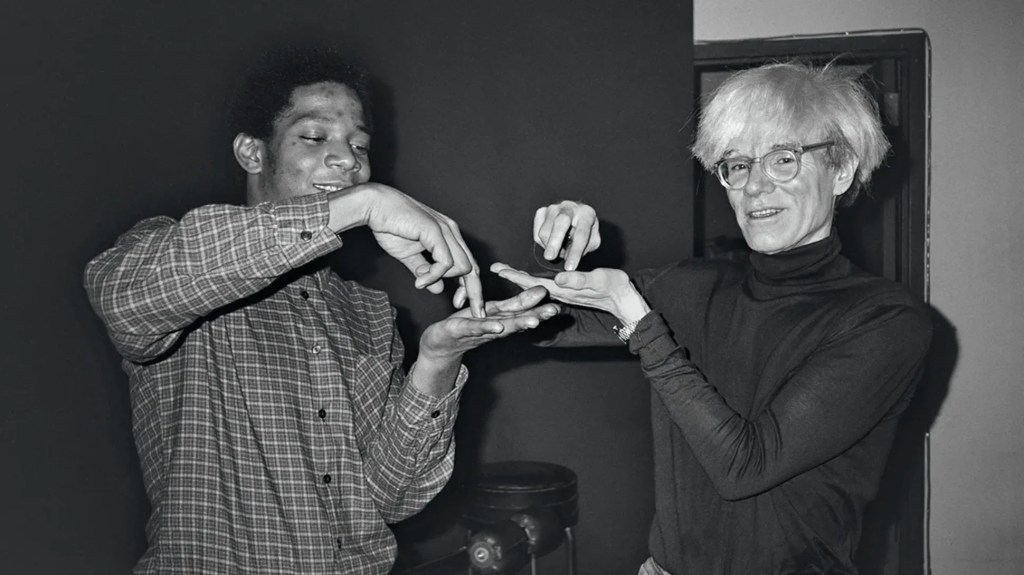
The encounter between the two artists was engineered by Swiss dealer Bruno Bischofberger in 1982. Recognizing the potential in their contrast, he arranged for Warhol and Basquiat to meet. The story is legend: Basquiat, just twenty-two, painted a portrait of himself and Warhol immediately after their lunch, delivered it still wet, and dazzled Warhol with his speed and energy.
From there, a friendship took shape. Warhol assumed a paternal role, offering discipline and a degree of protection within a volatile art market. Basquiat, for his part, electrified Warhol, reawakening his appetite for risk. They exercised together, dined, and painted side by side. Each, in some way, needed the other: Warhol sought vitality; Basquiat sought validation.
The Collaborative Works
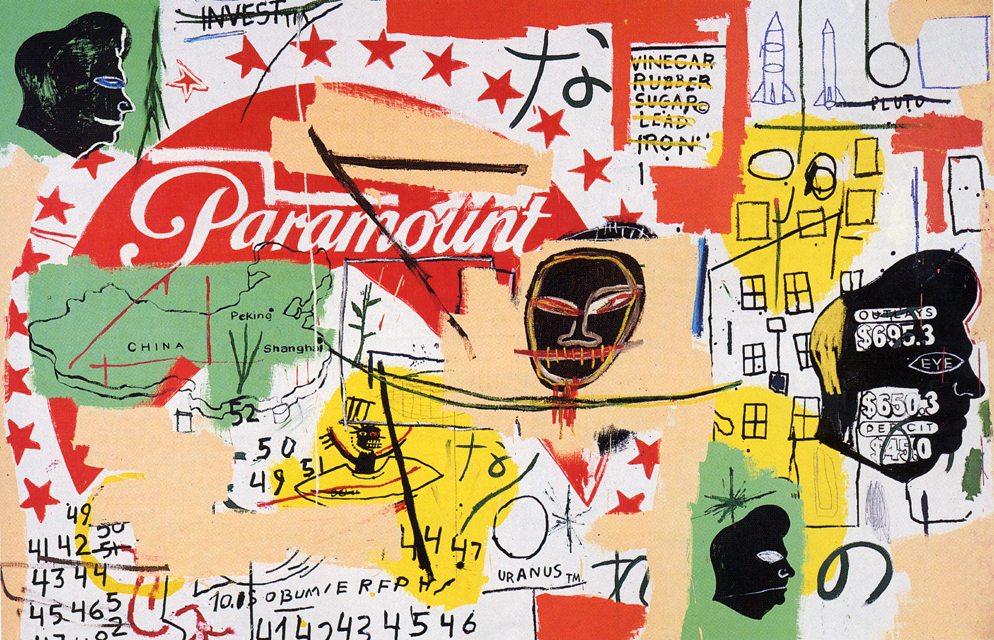
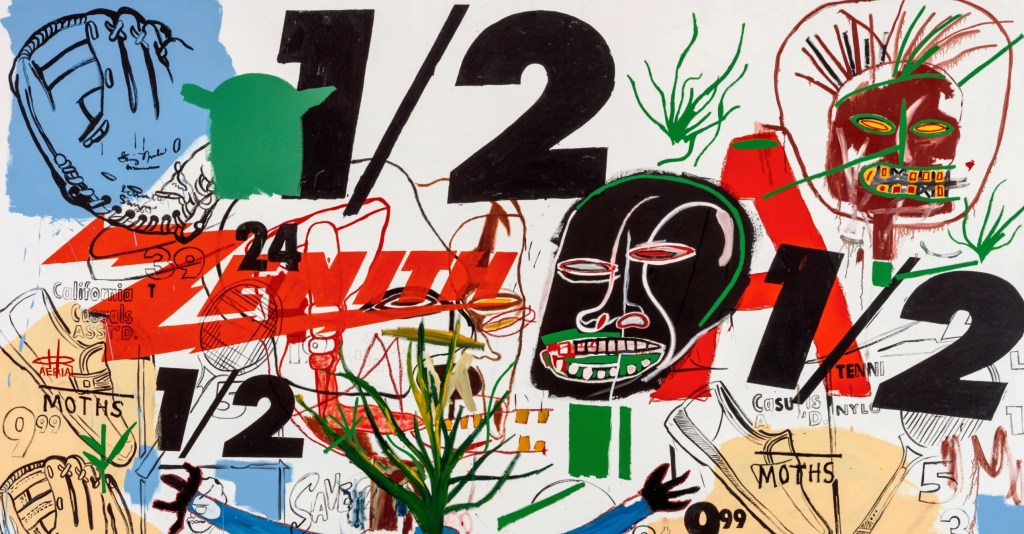
Between 1984 and 1985, the pair produced more than one hundred collaborative canvases. The method was improvisational: Warhol would lay down silkscreened emblems — corporate logos, the Olympic rings, the General Electric insignia — and Basquiat would paint over, around, and against them with frenetic energy, layering skeletal figures, words, and crowns.
The results were deliberately unstable. These works resisted polish; they were confrontations staged in paint. Where Warhol’s contribution was mechanical, Basquiat’s was visceral. The canvases became arenas where Pop’s coolness and Neo-Expressionism’s heat battled for dominance.
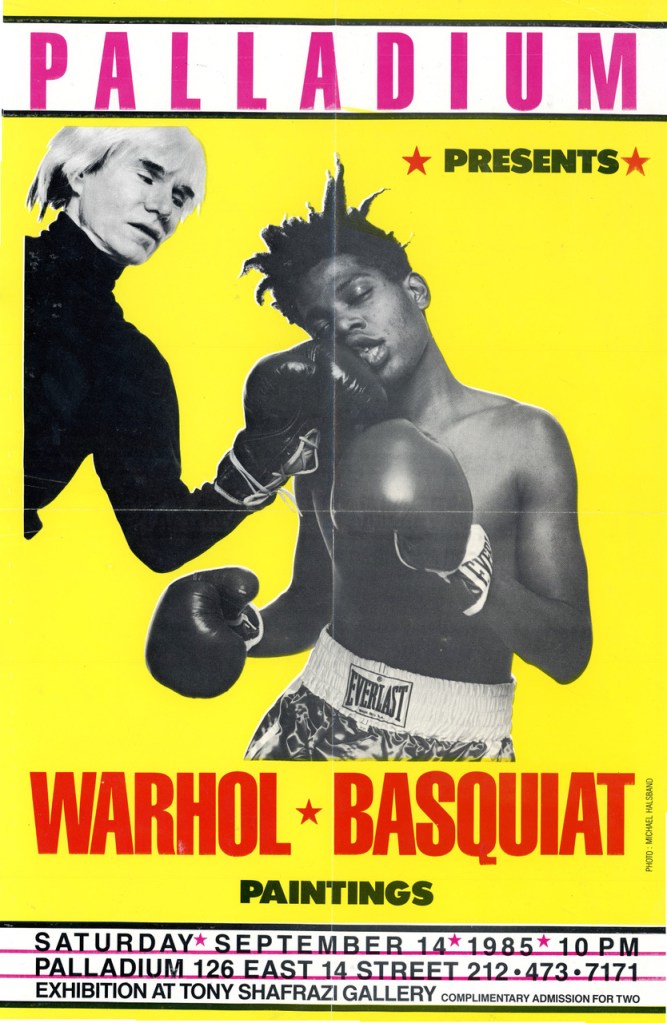
Critical reception was harsh. The 1985 Tony Shafrazi Gallery show, billed with the infamous poster of the two artists in boxing gloves, was derided by many. The New York Times dismissed the works as “awkward and sometimes maddening.” Some critics accused Warhol of vampirizing Basquiat’s energy; others accused Basquiat of relying too heavily on Warhol’s imprimatur. Yet to reduce the works to failure is to miss their ambition. They were never meant to resolve; they were meant to expose the act of collaboration itself, with all its tensions, hierarchies, and frictions.
Mutual Impact
Despite critical scorn, the partnership left its mark. Warhol, who had been increasingly distanced from painting by hand, returned to it with new vigor. His late works, more gestural and experimental, owe something to Basquiat’s ferocity.
Basquiat, meanwhile, gained legitimacy in the eyes of collectors who had dismissed him as too raw, too young, too volatile. Warhol’s mentorship provided access, networks, and protection — though it also subjected him to accusations of being used by, or dependent on, Warhol. The truth was more complex: Basquiat admired Warhol as a cultural architect, while Warhol, in turn, recognized in Basquiat a brilliance that reconnected him to art’s urgency.
Their bond was not without strain. Basquiat bristled at being perceived as Warhol’s protégé; Warhol worried about Basquiat’s self-destructive habits. Yet at its heart, theirs was a genuine friendship, marked by mutual curiosity and respect.
Endings
Warhol’s sudden death in 1987, following routine gallbladder surgery, devastated Basquiat. Friends recalled him wandering New York in grief, unable to anchor himself without his mentor and collaborator. Within a year, he too was gone, dead of a heroin overdose at twenty-seven.
The proximity of their deaths sealed their partnership in myth. Warhol, the Pop icon who turned celebrity into commodity; Basquiat, the prodigy who burned too brightly, too fast. Together, they embody the twin poles of the 1980s art world: commodification and authenticity, spectacle and sincerity, fame and fragility.
Legacy
Today, the Warhol-Basquiat collaborations are reassessed with fresh eyes. No longer dismissed as failures, they are understood as experimental dialogues — visual debates in which two radically different sensibilities negotiated space. They are imperfect, provocative, and alive, embodying the contradictions of collaboration itself.
As solo artists, their legacies remain distinct yet intertwined. Warhol, the cool mirror of mass culture, whose repetitions revealed the emptiness of consumer desire. Basquiat, the fiery critic of race, history, and power, whose work brought new vocabularies and identities into the canon. Together, they remind us that influence is not unidirectional but dialogic.
Their canvases are not resolutions but records: of a conversation between generations, between whiteness and Blackness, between Pop’s surfaces and Expressionism’s depths. They are archives of a friendship that was both fraught and fertile.
To shop our curated selection on Amazon
Collision as Creation
The friendship of Andy Warhol and Jean-Michel Basquiat resists simplification. It was mentorship and rivalry, collaboration and confrontation, affection and exploitation — all at once. What endures is the art itself: paintings that stage their differences rather than disguise them, works that embody the creative potential of friction.
In the end, Warhol gave Basquiat access and discipline; Basquiat gave Warhol urgency and risk. Their dialogue, cut short by death, remains unfinished. Yet in its incompleteness lies its power: a reminder that art does not always emerge from harmony, but from collision.
Warhol & Basquiat — A Timeline of Two Careers
Andy Warhol
- 1962 – Exhibits Campbell’s Soup Cans, establishing Pop Art as a movement.
- 1964 – Opens the Factory, his silver-walled studio and social hub.
- 1968 – Survives an assassination attempt by Valerie Solanas.
- 1970s – Produces society portraits and films, consolidating fame but facing critical skepticism.
- 1980 – Returns to painting in new ways, increasingly open to collaborations.
Jean-Michel Basquiat
- 1977–79 – Graffiti work as SAMO appears across downtown Manhattan: enigmatic phrases and symbols.
- 1980 – Included in the Times Square Show, marking his entry into the gallery world.
- 1981 – Solo shows in New York and Europe; hailed as part of the Neo-Expressionist wave.
- 1982 – Rapid ascent: joins Annina Nosei Gallery, sells to collectors, becomes international star.
- 1983 – Moves into a loft on Great Jones Street (owned by Warhol).
The Collaboration
- 1982 – Introduced by dealer Bruno Bischofberger. Basquiat paints a double portrait of himself and Warhol after their first lunch together.
- 1983–84 – Begin working in tandem, exchanging canvases in a call-and-response process.
- 1985 – Warhol/Basquiat Paintings exhibition at Tony Shafrazi Gallery; critics dismiss it, but the show captures the spirit of the 1980s art world.
- 1986 – Collaboration slows as both artists pursue solo projects.
Aftermath
- 1987 – Warhol dies unexpectedly after gallbladder surgery.
- 1988 – Basquiat dies of a heroin overdose at 27.
- 1990s–2000s – Their collaborations are reevaluated, first as curiosities, later as crucial documents of art in the Reagan era.
- Today – Joint works fetch millions at auction; their relationship is seen as one of modern art’s most fascinating collisions.
 My World of Interiors