
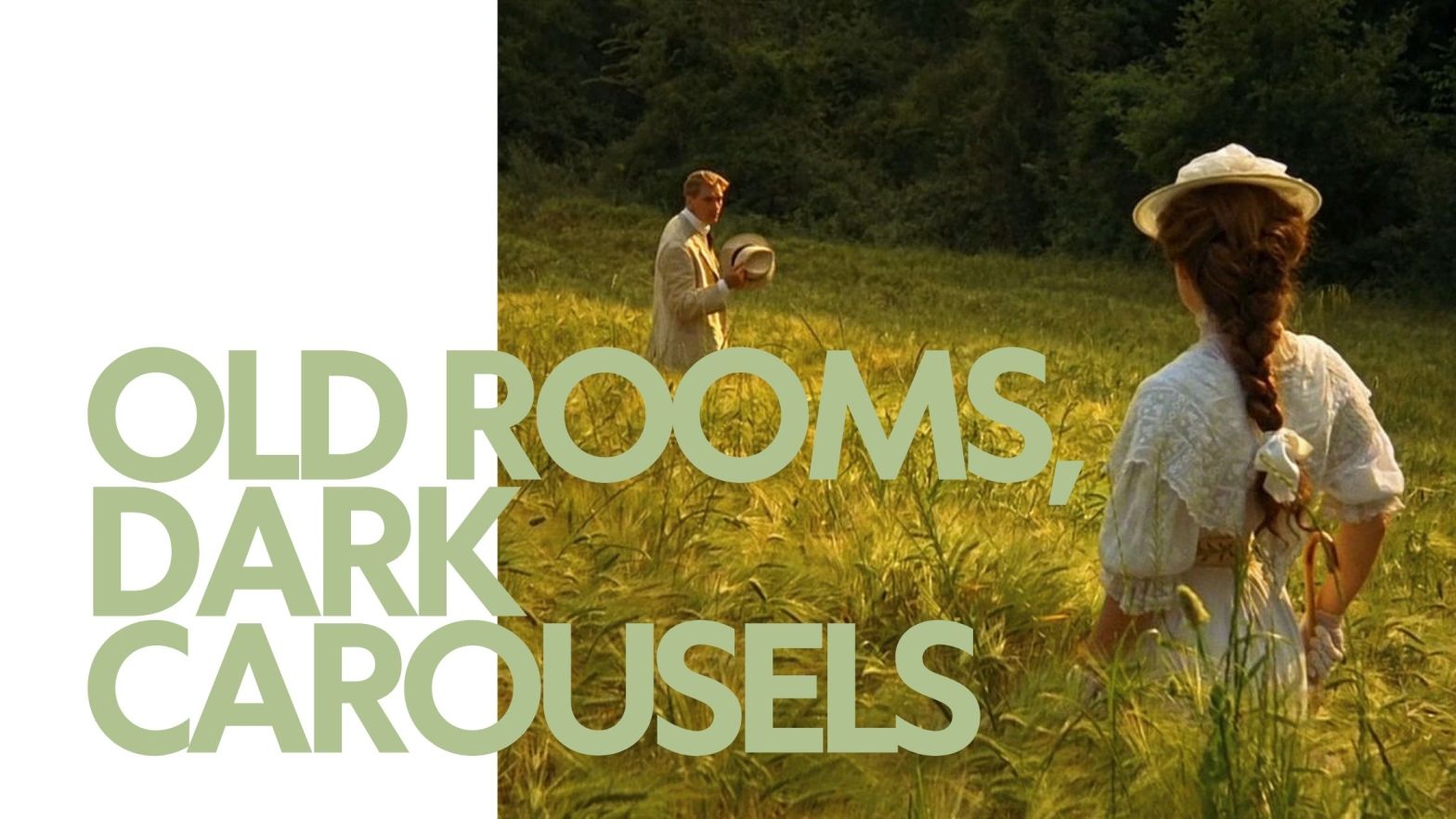
On returning to E.M. Forster’s A Room with a View and Ray Bradbury’s Something Wicked This Way Comes — two novels about the terrible and liberating cost of desire.
There is a particular kind of reading that only happens the second time around. The first encounter with a great novel is, of necessity, an act of navigation — you are finding your footing, orienting yourself among the characters, learning the landscape. It is only on the return that you can afford to slow down, to notice the architecture beneath the story, to ask not merely what happens but why it matters. This month I found myself returning to two very different books, separated by more than fifty years and an ocean, and yet — as the weeks passed — increasingly in conversation with each other. E.M. Forster’s A Room with a View (1908) and Ray Bradbury’s Something Wicked This Way Comes (1962) are not obvious companions. One is an Edwardian comedy of manners set among the churches and piazzas of Florence; the other is a Gothic American nightmare involving a sinister travelling carnival and a magical carousel that ages you backwards. And yet both are, at their core, novels about the same thing: the seductive, terrifying danger of wanting what you cannot have — and the even greater danger of getting it.
To re-read them back to back, in a single February felt unexpectedly right.
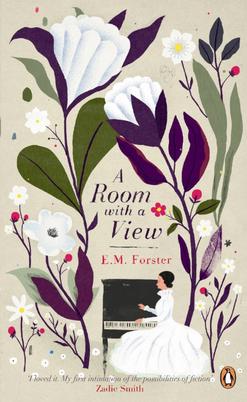
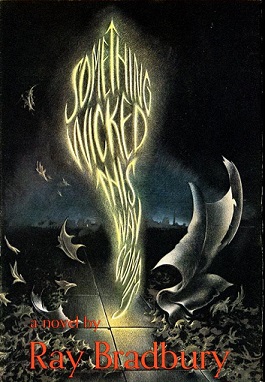
I. A Room with a View — The Geography of Freedom
Forster began writing A Room with a View in 1901, during a trip to Italy with his mother, and spent seven years wrestling it into its final form. The delay matters. The novel has the feeling of something long thought-about, long felt — not a young man’s impulsive declaration but a careful argument conducted under the cover of wit. It is, on the surface, a social comedy in the Austenian tradition: Lucy Honeychurch, a well-bred young Englishwoman, travels to Florence with her fussy older cousin Charlotte as chaperone, meets the unconventional Emersons — father and son — has a kiss stolen from her on a hillside covered in violets, and then spends the second half of the novel trying to convince herself she doesn’t want what she has already admitted she wants.
But Forster, as he acknowledged, was trying to “hitch” the domestic comedy “on to other things” — specifically, to the question of how we might live more honestly inside ourselves. The novel’s real subject is not romance; it is vision. The title’s central metaphor — a room, a view — runs through every scene. Characters who are confined, cautious, and self-deceived are associated with interiors and shade. Charlotte Bartlett closes the shutters. The prissy aesthete Cecil Vyse is, as Forster puts it, a man who belongs to a room. George Emerson, by contrast, exists most fully in the naked sunlight. When Lucy finally admits her love for George, she does it by flinging open a window.
Re-reading the novel, what strikes you most is not the romance — which, for a 21st-century reader, comes freighted with some awkwardness around consent — but the precision of Forster’s psychological observation. He is extraordinarily good at capturing the way we lie to ourselves: the small internal negotiations, the careful misrememberings, the elaborate constructions we build to avoid knowing what we already know. Lucy tells herself she is content with Cecil; she tells herself George means nothing; she tells herself she is not the kind of person who bolts to Florence and marries beneath her class. Forster watches her do all of this with an irony so tender it barely registers as irony at all.
This is what separates A Room with a View from mere romantic comedy. Forster was himself living a version of Lucy’s predicament — a gay man in Edwardian England, unable to live openly, acutely aware of the gap between the self one presents to the world and the self one nurses in private. George Emerson, we now know, was modelled on Hugh Meredith, Forster’s first love. The novel is, among other things, a coded argument for authenticity that Forster himself could never fully make in his own life. That poignancy is everywhere in the text once you know to look for it — in the slightly desperate brightness of the ending, in Forster’s later remark that he allowed George and Lucy their happiness “against his own instincts.”
What does the novel say to us today? More than it perhaps should. The particular tension Forster diagnoses — between what we are told we ought to want and what we actually, urgently, carnally desire — has not gone away. It has merely migrated. We are no longer constrained by quite the same apparatus of class and chaperonage, but we have developed our own sophisticated mechanisms for self-censorship: the career we pursue because it seems responsible, the relationship we stay in because disruption feels dangerous, the life we half-live because the other life — the one with the view — seems too presumptuous to claim. Forster’s Lucy is not a period piece. She is a diagnosis.
There is also, on this re-reading, something newly interesting about the character of Mr. Emerson, the father — a man who has thought his way to a kind of homespun humanism and who delivers his philosophy in great ungainly bursts that embarrass everyone around him. He is, in some ways, the novel’s most important character: the only one who says what he means without apology, who sees through Lucy’s evasions not with cruelty but with a kind of bewildered compassion. His scene with Lucy near the end of the novel — where he simply refuses to let her leave without facing the truth of her feelings — is as quietly devastating now as it must have been in 1908.
“You love George,” he tells her. And she knows he is right. The view was there all along. She just needed someone to make her look at it.
II. Something Wicked This Way Comes — The Carousel of Regret
If Forster’s novel is about the cost of repressing desire, Bradbury’s is about the even greater cost of surrendering to it. Something Wicked This Way Comes arrived in 1962, the year of the Cuban Missile Crisis, and it carries that era’s particular anxiety about the fragility of ordinary goodness — the sense that something dark and perfectly calibrated to human weakness might, at any moment, come rolling into town.
The premise is brilliantly simple. Two thirteen-year-old boys — Will Halloway and Jim Nightshade, whose very names telegraph their moral positions — witness the midnight arrival of Cooger and Dark’s Pandemonium Shadow Show, a carnival that appears just before Halloween and offers its visitors the fulfilment of their deepest wishes. The catch, naturally, is that the wishes destroy you. The carnival’s central attraction is a carousel that, depending on which direction it spins, either ages its rider forward or reverses them toward youth — a machine that literalises the two great temptations Bradbury identifies as the engines of human misery: the desire to be older than you are, and the desire to be young again.
Bradbury, writing from his own childhood in a small Illinois town, understood that these are not trivial hungers. Will’s father, Charles Halloway, is a fifty-four-year-old library janitor who moves through his days weighted by the sense that he is too old, too slow, too ordinary — that life has happened to him rather than through him. His relationship with his son is tender but awkward, crossed with a diffidence born of his own self-disappointment. He is the novel’s most fully realised character, and it is through him that Bradbury does his most serious philosophical work. The carnival can take Charles because the carnival knows what Charles wants: to be young enough to be his son’s equal, his son’s friend, his son’s contemporary.
The names in Something Wicked This Way Comes repay attention. Nightshade is a poison. Halloway contains the word “hollow” — a man defined by what he lacks. Mr. Dark, the carnival’s tattooed proprietor, is literally illustrated with the faces of his victims; he wears the people he has consumed. The Dust Witch navigates the world with her eyes sewn shut. These are not subtle signals, but Bradbury’s allegorical ambitions are worn openly, even proudly. The novel operates, as one critic noted, in the manner of a medieval morality play — but it puts flesh on the abstractions in a way that medieval morality plays rarely managed.
Bradbury’s prose is the novel’s most divisive feature. It is lush, incantatory, drunk on metaphor — occasionally to the point where the narrative pace slackens under the weight of its own imagery. Some readers find this maddening. On re-reading, I find it hypnotic. The opening pages, in which autumn arrives in Green Town like an invasion, have the quality of poetry more than fiction: a sustained effort to render not just a season but a mood, a temperature of the soul. Bradbury understood that horror — real horror — is not about monsters. It is about the parts of yourself that the monsters know how to find.
What redeems Will and his father, in the end, is not courage in any conventional sense. It is laughter. Specifically, it is the realisation that the carnival’s power depends entirely on the power you grant it — that fear and longing are the fuel it runs on, and that joy, by contrast, is the one thing it cannot metabolise. Charles Halloway defeats the Witch not with strength but with amusement, with a refusal to take his own terror seriously, with an acceptance of his age and his limitations and his deeply ordinary life. It is an unexpectedly generous resolution to a very dark novel.
Something Wicked This Way Comes went on to become one of the foundational texts of American dark fantasy. Stephen King credits it as a direct influence on It — itself a novel about two boys confronting the monster that knows how to find you — and Neil Gaiman has spoken of it repeatedly as a shaping work. Erin Morgenstern’s The Night Circus owes it an obvious debt. The book’s influence persists because its insight persists: that the thing we most desire is almost always the thing most likely to undo us, and that the only protection against it is not denial but acceptance. Not suppression of the wanting, but a clear-eyed understanding of what the wanting is actually for.
III. What They Share, What They Ask
Re-reading these two novels together, in the same month, produced an unexpected resonance. Both are, at heart, about the relationship between desire and the self — about what it means to want something badly enough that the wanting changes you. Both understand that the objects of desire are, to a significant degree, beside the point: what matters is the internal struggle between the part of us that reaches for life and the part of us that flinches from it.
Forster frames this as a social and psychological drama: the enemy of desire, in A Room with a View, is convention — the accumulated pressure of class and propriety and the fear of what other people will think. Bradbury frames it as something more metaphysical: the enemy of wholeness, in Something Wicked This Way Comes, is not society but the self’s own restlessness, its inability to be satisfied with the life it actually has. In Forster, the answer is to claim the life you want. In Bradbury, the answer is to love the life you’ve been given. They are not contradictory positions. They are, rather, the two sides of the same difficult truth: that desire requires both courage and acceptance, that freedom demands you reach for things and also know when to stop.
Both novels are also, in their different registers, profoundly concerned with fathers. Mr. Emerson is Lucy’s surrogate father in the novel’s climactic scene — the man who refuses to let her lie to herself. Charles Halloway is the novel’s moral centre, the one who must learn, in the carnival’s shadow, to stop measuring himself against what he might have been and start inhabiting what he is. In both cases, the older generation is not, as in so many coming-of-age narratives, an obstacle to be overcome — it is a source of wisdom, awkward and imperfect but real. Forster and Bradbury both believed in the possibility of honest connection across the gulf of age, which is itself a kind of hope.
There is one more thing the two books share: both reward re-reading in a way that few novels do. The first time through, you read for event. The second time, you read for meaning. A Room with a View opens up on re-reading because you already know what Lucy will choose, and so you can watch all the small moments where she almost admits it — the hesitations, the deflections, the tiny betrayals of feeling. Something Wicked This Way Comes opens up because you already know what the carnival is, and so you can see how precisely Bradbury has calibrated its temptations to the exact shape of each character’s grief.
Both books are, in the end, about the same thing re-reading is about: the difference between experiencing something and understanding it. Between passing through and arriving.
A Room with a View by E.M. Forster (1908) and Something Wicked This Way Comes by Ray Bradbury (1962) are both widely available in paperback and as ebooks.
 My World of Interiors