
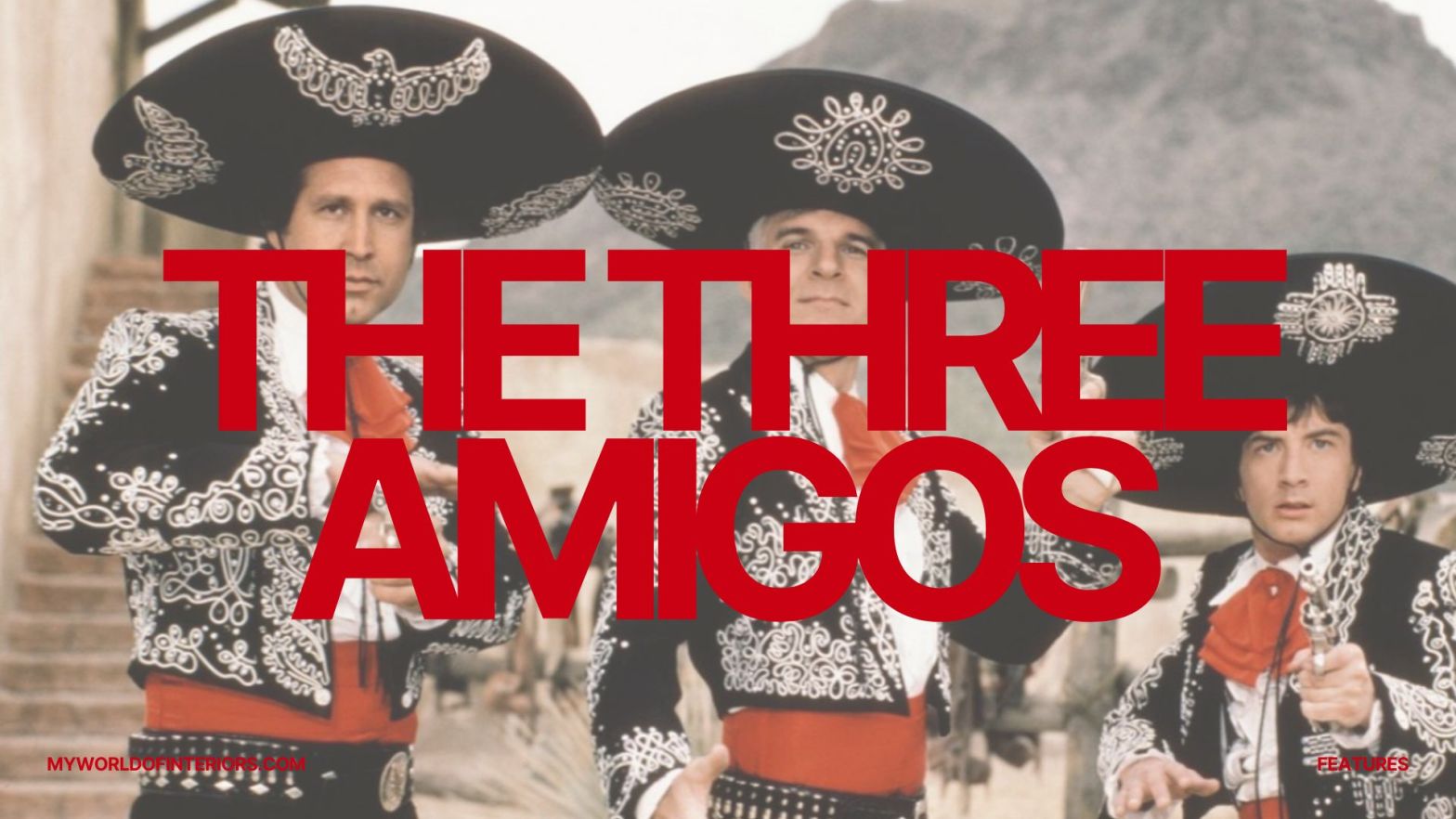
There are comedies that chase the gag, and there are comedies that build a world so ridiculous that the gags feel inevitable. John Landis’s ¡Three Amigos! (1986), starring Steve Martin, Chevy Chase, and Martin Short, belongs squarely in the second camp. Part parody, part homage, it takes the bones of a Hollywood Western and dresses them in sequins, sombreros, and slapstick, creating a film that is both utterly silly and strangely revealing of the culture that produced it.
Hollywood Satirizes Itself
The conceit is as simple as it is sharp: three out-of-work silent film stars, mistaken for real gunfighters, are summoned to a Mexican village to battle the bandit El Guapo. They arrive in full costume, armed not with bullets but with pratfalls and bravado. What unfolds is a film about the porous line between performance and reality, between cinematic myth and lived experience.
In this way, ¡Three Amigos! is less a Western spoof than a Hollywood satire. It lampoons the pomposity of actors, the absurdity of cinematic heroics, and the dissonance between what the screen promises and what reality demands. Martin, Chase, and Short play not only characters but caricatures of their own star personae: the cerebral wit, the smug charmer, the neurotic ingénu.
Comedy as Cultural Collage
The film’s comedy is broad — pratfalls, mistaken identities, musical numbers — yet beneath the slapstick lies a curious cultural collage. The Western, Hollywood’s great mythmaking genre, is here refracted through 1980s irony. Where John Ford built solemn landscapes of American destiny, Landis fills his desert with dancing horses, synchronized singing, and a villain whose name literally means “The Handsome One.”
There is also the film’s uneasy cultural positioning. Made in the mid-1980s, ¡Three Amigos! traffics in stereotypes even as it winks at them. The villagers are noble and earnest, the bandits cartoonishly cruel. It is a Hollywood vision of Mexico filtered through parody, raising questions — particularly today — about who gets to tell whose stories, and in what registers.
The Musical Interludes
One of the film’s oddest charms is its use of song. Randy Newman co-wrote the screenplay and provided original music, including the absurdly heartfelt “Blue Shadows on the Trail” and the Amigos’ own theme song. These numbers, performed with straight-faced sincerity, amplify the film’s commitment to its own ridiculousness. A lullaby to a desert night, sung in harmony by three washed-up actors in matching suits, is both parody and strangely beautiful.
Legacy of a Flop Turned Cult Classic
Upon release, ¡Three Amigos! was met with lukewarm reviews and middling box office returns. Critics dismissed it as uneven, audiences found it too odd, and it seemed destined to be a footnote in the careers of its stars. And yet, over the decades, the film has acquired cult status. Its quotable lines (“Would you say I have a plethora of pinatas?”), its surreal musical interludes, and its exuberant silliness have earned it a devoted afterlife.
Part of its endurance lies in nostalgia. The trio of Martin, Chase, and Short, all at their comedic peak, embody a style of ensemble comedy rarely seen today. But it also endures because of what it reveals: that Hollywood’s myths are always ripe for parody, and that comedy, at its best, exposes the absurd scaffolding on which our cultural fantasies rest.
The Amigos as Archetypes
Viewed today, ¡Three Amigos! feels less like a dated comedy than a fable about performance itself. Actors mistaken for heroes become, in the end, actual heroes — not because they are competent but because they believe in the role they’re playing. It is a sly comment on the power of cinema: sometimes performance shapes reality, sometimes reality succumbs to performance.
In this sense, ¡Three Amigos! is both parody and parable. It mocks the very idea of the heroic Western, yet it also affirms that storytelling — even in its most ridiculous forms — can inspire. The villagers, and perhaps the audience, do not care that the Amigos are frauds. What matters is the courage the performance sparks.
A Comedy of Menace and Delight
Nearly forty years after its release, ¡Three Amigos! remains a curious object: too strange for mainstream comedy, too broad for cinephiles, but perfectly pitched for the cult audience it has found. It is a reminder that comedy, like jazz, thrives on improvisation, dissonance, and risk.
Landis’s desert fantasia, stitched together with songs, slapstick, and satire, is less about Mexico or Hollywood than about the universal absurdity of pretending to be something you are not — and, in the pretending, becoming it.
 My World of Interiors