
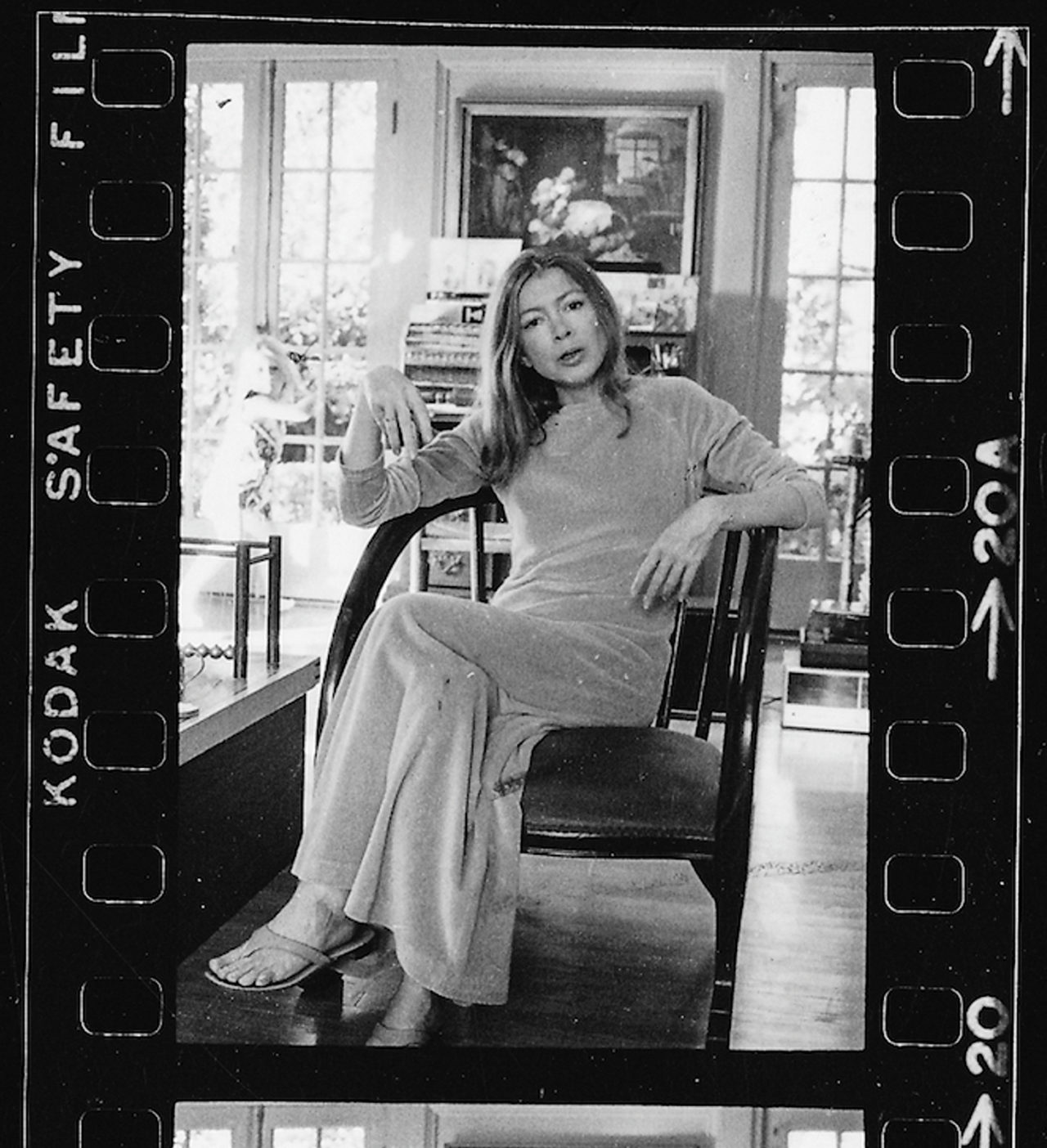
Joan Didion was one of the defining writers of the 20th century, a figure whose cool prose, sharp eye, and unsparing self-examination reshaped the possibilities of nonfiction. From her portraits of California in the 1960s to her searing meditations on grief in the 2000s, Didion’s work remains a model of style, clarity, and depth. Her voice — detached yet intimate, analytical yet vulnerable — continues to reverberate as both cultural document and literary art.
California Beginnings
Born in Sacramento in 1934, Didion grew up amid the mythology of the American West. After studying at Berkeley, she began her career at Vogue in New York, where she honed the precise, spare style that would become her hallmark. But it was her return to California in the 1960s that gave her the material — and the cultural moment — that would define her.
The 1960s and the New Journalism
Didion became associated with the “New Journalism” movement, alongside Tom Wolfe and Hunter S. Thompson, but her voice was singular: cool where others were flamboyant, meticulous where others leaned into spectacle. Her 1968 essay collection Slouching Towards Bethlehem chronicled the turbulence of California life with an eye that was both detached and deeply personal. The title essay, set in Haight-Ashbury at the height of the counterculture, captured the fragmentation of American life with a precision that still resonates.
The White Album (1979) continued this exploration, blending reportage with memoir in essays that moved from the Manson murders to shopping malls, from the Black Panthers to the personal rhythms of depression and dislocation.
Fiction with a Reporter’s Eye
Though best known for nonfiction, Didion also wrote fiction throughout her career. Novels such as Play It As It Lays (1970) and A Book of Common Prayer (1977) carried the same clipped, observational tone, portraying women caught in the dislocations of modern life. These works confirmed that her style — elliptical, exacting, cinematic — could inhabit both reportage and narrative fiction.
The Later Years: Grief and Reflection
Didion’s late career brought her most intimate and devastating works. The Year of Magical Thinking (2005), written after the sudden death of her husband John Gregory Dunne, became an instant classic of grief literature, winning the National Book Award. In its unsparing honesty and meticulous detail, it transformed private loss into universal recognition.
This was followed by Blue Nights (2011), an elegiac reflection on aging, fragility, and the death of her daughter Quintana Roo Dunne. Together, these books form one of the most poignant literary meditations on mortality in recent memory.
Joan Didion: Notable Works
- Slouching Towards Bethlehem (1968) – Essays capturing California in the 1960s, blending personal voice with cultural critique.
- Play It As It Lays (1970) – A novel set in Hollywood, spare and haunting, reflecting the emptiness of modern celebrity culture.
- The White Album (1979) – Essays chronicling the unraveling of American society in the late 1960s and 1970s.
- A Book of Common Prayer (1977) – A novel set in Central America, reflecting Didion’s global political concerns.
- Miami (1987) – Nonfiction exploring Cuban exile politics in Florida, a model of her ability to fuse narrative and political analysis.
- The Year of Magical Thinking (2005) – A memoir of grief, awarded the National Book Award, and later adapted into a stage play.
- Blue Nights (2011) – A meditation on aging, memory, and the loss of her daughter.
How to Begin Reading Didion
- The Essayist: Slouching Towards Bethlehem
The essential entry point. This 1968 collection distills Didion’s eye for detail and her ability to capture a cultural moment.
Buy via Penguin Random House - The Novelist: Play It As It Lays
A taut, cinematic novel about Hollywood ennui and female disillusionment, it reveals Didion’s gift for narrative fiction.
Buy via Penguin Random House - The Memoirist: The Year of Magical Thinking
Her most personal and widely read book, a devastating yet crystalline meditation on grief and survival.
Buy via Penguin Random House
For readers new to Didion, these three works — an essay collection, a novel, and a memoir — offer a balanced entry into her range and brilliance.
Joan Didion on Screen
- The Panic in Needle Park (1971) – Didion, with her husband John Gregory Dunne, co-wrote the screenplay for this stark portrait of heroin addiction in New York.
IMDb - Play It As It Lays (1972) – Her novel was adapted into a film starring Tuesday Weld and Anthony Perkins, capturing the novel’s spare, devastating mood.
IMDb - True Confessions (1981) – Another Didion-Dunne screenplay, adapted from John Gregory Dunne’s novel, starring Robert De Niro and Robert Duvall.
IMDb - Up Close & Personal (1996) – Didion and Dunne co-wrote this romantic drama, loosely inspired by news anchor Jessica Savitch.
IMDb - The Center Will Not Hold (2017) – A Netflix documentary directed by Griffin Dunne, Didion’s nephew, offering an intimate portrait of her life and career.
Netflix
Legacy and Influence
Joan Didion’s legacy is inseparable from her style. Her prose is lean, crystalline, and relentless in its clarity. She combined the eye of a reporter with the sensibility of a novelist, crafting sentences that still serve as models of precision. Beyond her words, she became an icon of cultural cool — her Céline sunglasses and frail frame as much a symbol of elegance as her books were of rigor.
Today, Didion remains a touchstone for writers seeking to balance detachment with intimacy, and for readers seeking a voice that names the instability of the world without surrendering to it.
TL;DR
Joan Didion’s career spanned six decades, but its through-line was consistency: the belief that writing is not about certainty, but about looking directly at the chaos of the world and rendering it with exacting style. From California freeways to personal loss, she chronicled the fractures of modern life in prose that still feels timeless.
Her legacy is not only in the subjects she covered, but in the way she covered them: with restraint, beauty, and an unwavering sense that to write is to bear witness.
 My World of Interiors