

When Gattaca premiered in 1997, it seemed almost too sleek, too elegant, for the dystopian genre it occupied. Directed by Andrew Niccol, the film offered a future not of neon overload or cyberpunk chaos, but of restrained architecture, immaculate tailoring, and quiet menace. It was science fiction disguised as modernist design — a cautionary tale told in Bauhaus lines and muted color palettes.
Nearly three decades later, its vision remains eerily prescient. In an age of genetic testing, designer babies, and algorithmic bias, Gattaca continues to speak to how technology, class, and aesthetics intersect in shaping human destiny.
A World Written in DNA
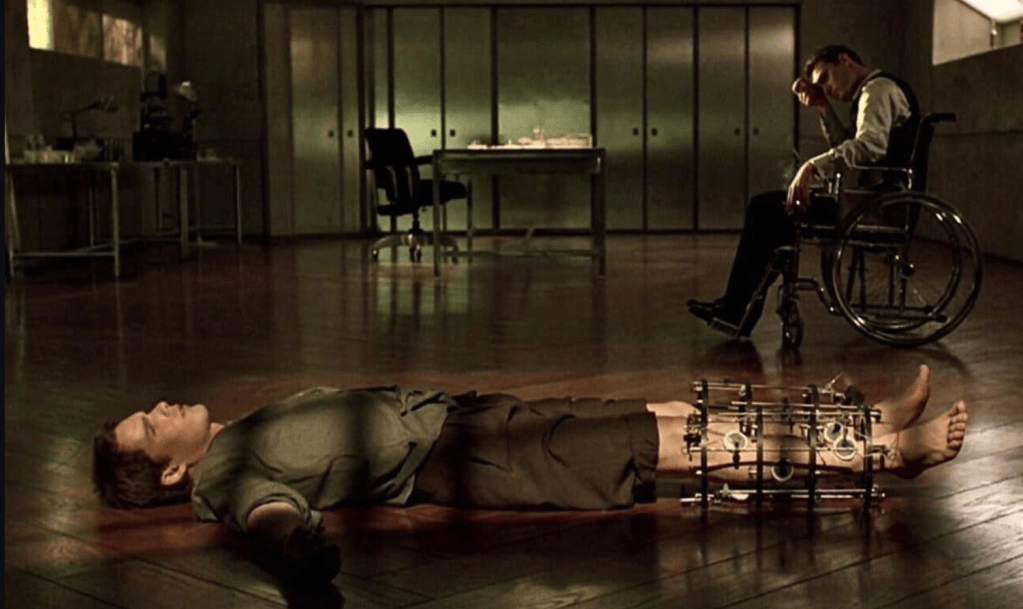
The premise of Gattaca is chilling in its simplicity. In a near future, society has perfected genetic engineering: embryos are screened for disease, intelligence, and physical fitness, producing a hierarchy of “valids” and “in-valids.” Ethan Hawke plays Vincent Freeman, born naturally and thus condemned to a life of menial labor despite his brilliance and ambition. Jude Law plays Jerome Morrow, a genetically “perfect” man who, after an accident, sells his genetic identity to Vincent. Their pact allows Vincent to infiltrate Gattaca Aerospace Corporation, pursuing his dream of space travel.
The film’s genius lies in its restraint. Rather than dystopian collapse, Gattaca shows a society that functions smoothly, almost beautifully. Its menace is in its orderliness.
Style as Substance
Much of Gattaca’s power comes from its design. Filmed largely in Los Angeles landmarks such as the Marin County Civic Center (by Frank Lloyd Wright) and the CLA Building at Cal Poly Pomona, the movie’s architecture evokes a future that is both familiar and uncanny: sleek, symmetrical, and suffocating.
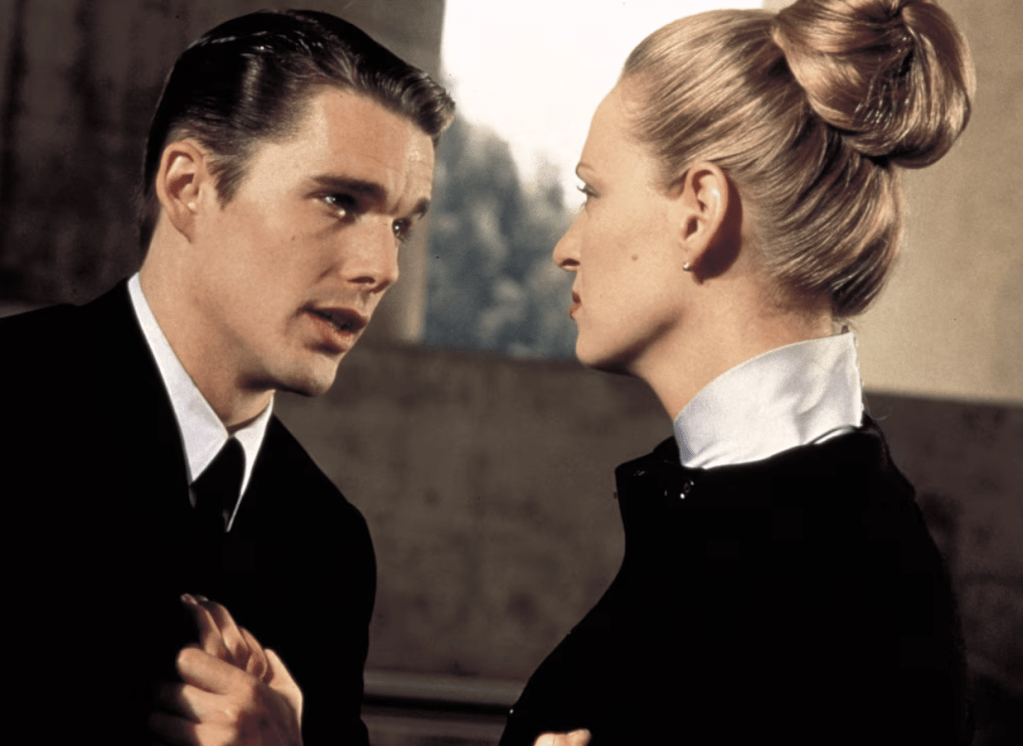
Costumes, designed by Colleen Atwood, extend this aesthetic. Men wear perfectly cut suits in gray and navy; women, minimalist dresses in subdued tones. The effect is timeless — evoking the 1950s as much as the 2050s. Unlike the garish futurism of its cinematic contemporaries, Gattaca’s style is stripped to essentials, making its world feel not only believable but inevitable.
Cinematographer Slawomir Idziak bathes the film in hues of green, gold, and steel, a palette that feels at once sterile and sumptuous. Every frame looks like it belongs in an architectural journal as much as a film reel.
Themes of Aspiration and Control
At its heart, Gattaca is a story about aspiration — about the human desire to exceed one’s limits. Vincent’s quest to reach the stars is both literal and metaphorical, standing against a society that reduces him to his genetic code. The film interrogates the dangers of determinism: whether scientific, social, or aesthetic.
It also touches on class and eugenics. The language of perfection masks old prejudices: who is allowed to dream, who is denied opportunity. In this, Gattaca anticipates debates about genetic editing technologies like CRISPR, as well as broader concerns about inequality in a data-driven world.
A Film of Its Time — and Ahead of It
Released in the late 1990s, Gattaca shared screens with flashier blockbusters (Men in Black, The Fifth Element) but chose an entirely different vocabulary. Its vision of the future was not loud but hushed, not chaotic but chillingly orderly. Critics at the time praised its intelligence but noted its coolness; audiences were divided.
Yet over time, its reputation has only grown. Today, it is seen as one of the great speculative films of the late 20th century, admired for its foresight and its artistry.
Gattaca’s Design Legacy
- Architecture – Filming locations included Frank Lloyd Wright’s Marin County Civic Center, the CLA Building at Cal Poly Pomona, and the Sepulveda Dam. Their clean lines and monumental scale embodied a future both modern and oppressive.
- Costume Design – Colleen Atwood’s wardrobe choices — tailored suits, structured dresses, muted palettes — fused mid-century classicism with futuristic minimalism.
- Cinematography – Slawomir Idziak’s palette of green, steel, and amber created a sense of sterile beauty, contrasting the organic unpredictability of Vincent’s human struggle.
- Influence – Later films such as Her (2013) and Ex Machina (2014) borrowed heavily from Gattaca’s minimalist design ethos, envisioning futures of quiet menace rather than apocalyptic spectacle.
- Cultural Resonance – The film’s aesthetic continues to influence fashion, architecture, and advertising, where “Gattaca-esque” has become shorthand for clean-lined futurism tinged with unease.
TL;DR
Gattaca is not merely a science fiction film; it is a meditation on human worth, told through the language of design. Its clean lines, subdued colors, and immaculate compositions are not just style, but ideology — a future where perfection suffocates individuality.
In an era where technology once again promises to “improve” humanity, Gattaca reminds us of what we risk losing: the unpredictable, the imperfect, the human. Its world is beautiful to look at, and terrifying for precisely that reason.
 My World of Interiors