
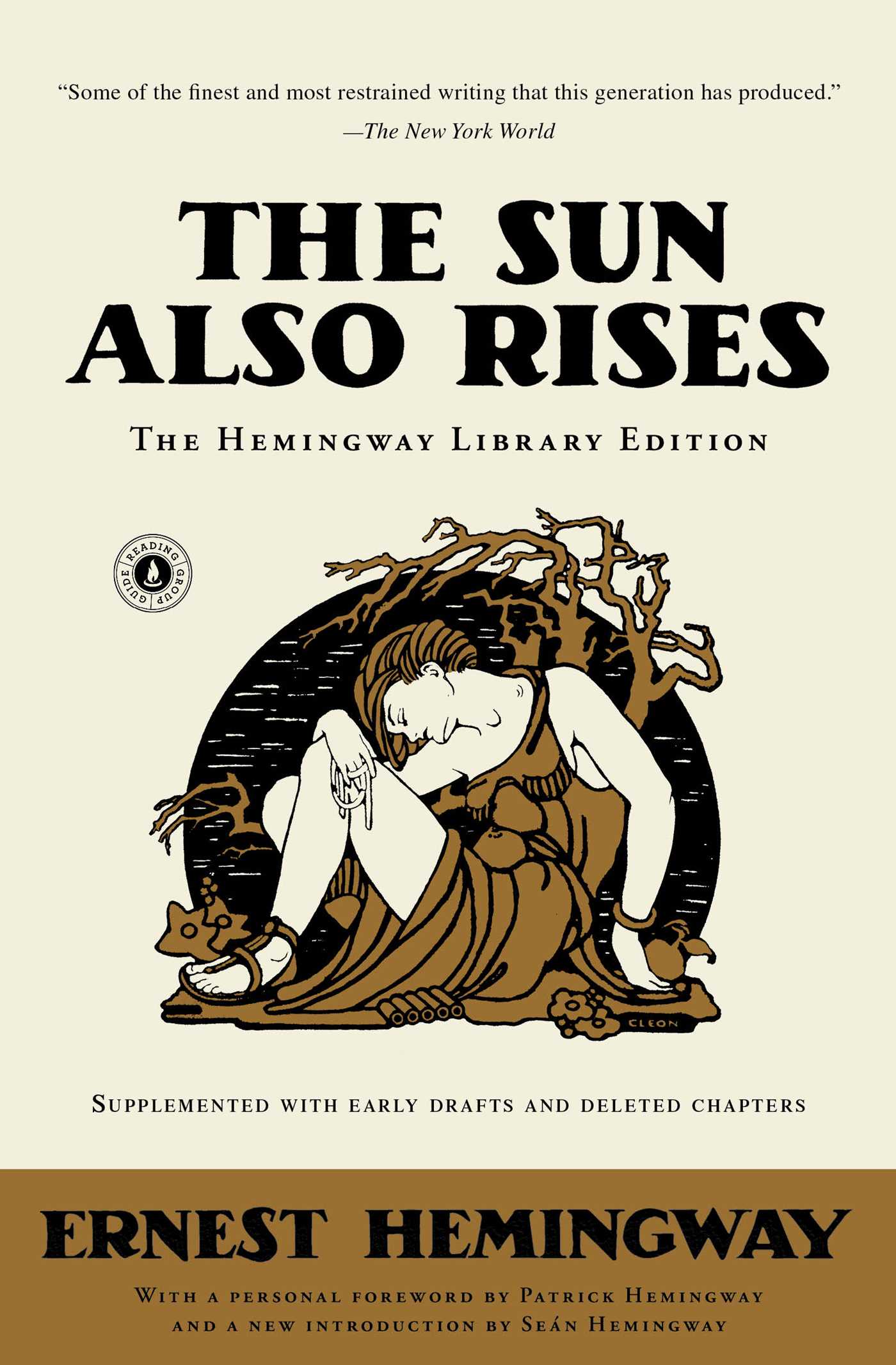
When Ernest Hemingway published The Sun Also Rises in 1926 — titled Fiesta in the United Kingdom — he gave modern literature one of its first portraits of what would come to be called the “Lost Generation.” The novel, loosely drawn from his own time in Paris and Pamplona with a circle of expatriate friends, is both an ode to youth and a record of its exhaustion. Nearly a century later, its voice still resonates: clipped, unsentimental, yet charged with an intensity that makes disillusion almost glamorous.
A Generation in Exile
The novel begins in Paris, a city swollen with expatriates in the aftermath of World War I. Hemingway’s characters — Jake Barnes, Lady Brett Ashley, Robert Cohn, Mike Campbell, Bill Gorton — drift between cafés, bars, and rented rooms. They drink heavily, talk endlessly, and struggle to fill the void left by a war that has dislocated not only bodies but meaning itself.
Jake, the novel’s narrator, is a wounded veteran, his injury leaving him impotent. Brett, dazzling and untethered, is both desired and unattainable, her restlessness a symptom of a generation caught between tradition and modernity. Their circle exemplifies what Gertrude Stein called the génération perdue: brilliant, unmoored, chasing intensity in order to avoid despair.
From Paris to Pamplona
The novel’s shift to Spain — to the bullfights of Pamplona and the fiesta of San Fermín — marks its most enduring imagery. Hemingway renders the rituals of the corrida with meticulous detail, elevating the matador Pedro Romero as a figure of authenticity amid the group’s drift. Where Jake and his friends perform identities in smoky cafés, Romero embodies a purity of action, grace under pressure, and a connection to tradition that feels uncorrupted.
The bullfights are not merely spectacle; they are Hemingway’s metaphor for art, courage, and a way of facing death without illusion. They stand in stark contrast to the drunken quarrels and romantic entanglements of his expatriates, whose emotional volatility masks a deeper emptiness.
Style as Substance
Much has been said about Hemingway’s prose: the short sentences, the clipped dialogue, the iceberg theory of omission. In The Sun Also Rises, this style becomes more than technique; it mirrors the psychic condition of his characters. Their talk is circular, their declarations rarely resolved. What is left unsaid — the weight of war, the pain of Jake’s injury, the melancholy of Brett’s independence — gives the novel its power.
The restraint of the language, like Romero’s control in the ring, becomes its own form of truth. Where other modernists experimented with stream of consciousness, Hemingway pared the sentence to its bone, producing a prose that felt both raw and new.
Gender, Desire, and Dislocation
At its heart, the novel is about desire: frustrated, misdirected, and often destructive. Jake’s love for Brett, doomed by his injury, is both the novel’s tragedy and its pathos. Brett’s independence — her refusal to be contained by convention — made her a scandalous figure for 1926 and still complicates readings today.
Critics have long debated whether Hemingway idealizes or punishes her. Perhaps he does both. Brett is at once the symbol of liberation and the object of male anxiety, embodying the contradictions of a society where gender roles had been shaken but not resolved.
A Novel of Its Moment — and Ours
Upon its release, The Sun Also Rises was controversial. Some readers saw it as immoral, a celebration of dissipation; others recognized its brilliance in capturing the disillusionment of a generation. Today, it reads less as a period piece than as an enduring meditation on how societies recover — or fail to recover — from trauma.
The expatriates’ rootlessness, their endless search for diversion, feels strikingly contemporary. In an age of displacement, digital distraction, and existential unease, Hemingway’s portrait of the lost still feels oddly familiar.
The Sun Also Rises: A Cultural Timeline
- 1914–1918 – World War I: Hemingway serves as an ambulance driver in Italy; his injury shapes the novel’s wounded narrator, Jake Barnes.
- 1920s – Paris: Hemingway joins a community of expatriate artists and writers, including Gertrude Stein, F. Scott Fitzgerald, and Ezra Pound. Stein famously coins the term “Lost Generation.”
- 1925 – Pamplona: Hemingway attends the San Fermín festival and the bullfights with friends, providing the direct inspiration for The Sun Also Rises.
- 1926 – Publication: The novel is released in the U.S. by Scribner’s and in the U.K. as Fiesta. Reception is polarized but the book becomes an instant cultural marker.
- 1957 – Film Adaptation: Henry King directs a Hollywood version starring Tyrone Power and Ava Gardner, which brings the story to a broader audience but loses much of its subtlety.
- Today: The novel remains a staple of modernist literature, read as both a historical portrait of the 1920s and a timeless meditation on loss, desire, and resilience.
TL;DR
The Sun Also Rises remains Hemingway’s most emblematic novel not because of its plot — which drifts as aimlessly as its characters — but because of its mood: elegiac, ironic, desperate, beautiful. It captures a generation that could not go back to the world before the war, and did not know how to go forward.
In the end, Jake’s final line to Brett — “Isn’t it pretty to think so?” — is less resignation than recognition: that desire and fulfillment, hope and reality, are rarely aligned. It is a sentence that defines not only Hemingway’s novel but modern life itself.

 My World of Interiors