
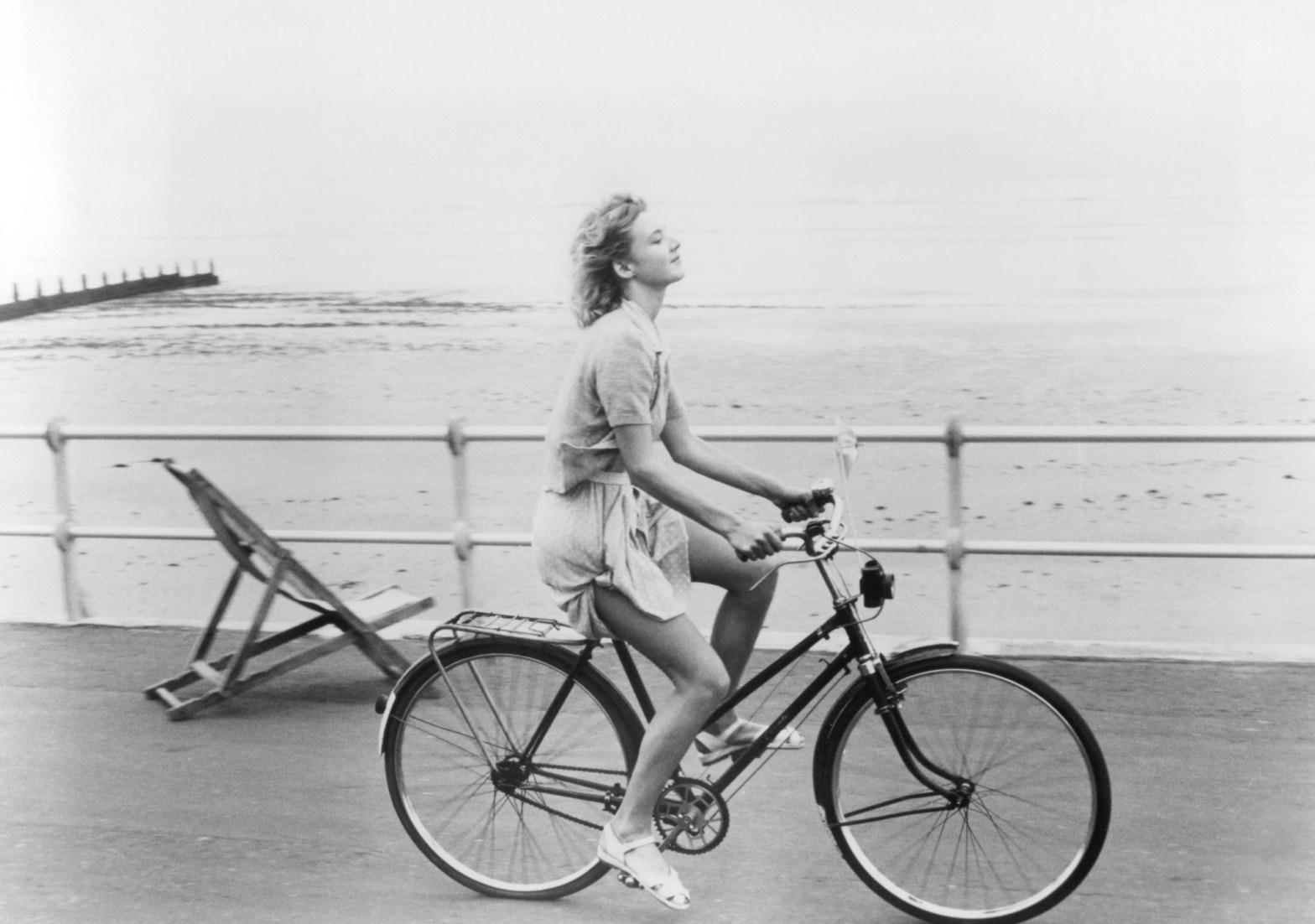
In the late 1980s and early 1990s, there was a moment when Emily Lloyd seemed destined to define a generation of cinema. With her wide, mischievous smile, her London-bred irreverence, and her startling ability to move between comedy and pathos, she felt like a new kind of screen presence: unvarnished, spontaneous, utterly alive. That she never quite became the star Hollywood imagined for her only deepens the fascination. Looking back, Emily Lloyd’s career is a reminder of the volatility of stardom — and of the fragile brilliance of those who burned most brightly in the ’90s.
A Breakout That Shook British Film
Lloyd’s career began in 1987 with Wish You Were Here, David Leland’s coming-of-age drama set in postwar England. At just sixteen, she gave a performance of startling naturalism: brash, defiant, comic, wounded. Her character, Lynda Mansell, announcing herself with the famous line “Up yer bum!”, became an emblem of teenage rebellion. Critics compared Lloyd to a young Shirley MacLaine or Julie Christie. The role won her international acclaim, a BAFTA nomination, and the promise of Hollywood.
Crossing the Atlantic
Hollywood did come calling. In the 1990s, Lloyd appeared in films that captured the moment’s blend of eccentricity and grit. In Country (1989), opposite Bruce Willis, positioned her as a dramatic actress capable of carrying the weight of America’s Vietnam legacy. A River Runs Through It (1992), directed by Robert Redford, gave her a place in one of the decade’s most elegiac portraits of American life.
Though not always the lead, Lloyd brought a mercurial quality that lifted every role. She was unpredictable — sometimes playful, sometimes haunted — and always compelling to watch.

A Face of the 1990s
Part of Lloyd’s allure was cultural. In the ’90s, the film industry oscillated between glossy Hollywood productions and the grittier realism of independent and British cinema. Lloyd embodied the latter. She felt closer to everyday life than to the airbrushed starlets of the era. With her sharp wit, wide-eyed charm, and refusal to soften her edges, she seemed like a new kind of heroine for a generation that valued authenticity.
Magazines loved her. Profiles painted her as precocious, slightly unruly, resistant to Hollywood polish. For young audiences — especially in Britain — she represented something fresh, even radical: a female star whose appeal was not in perfection but in immediacy.
The Roles That Might Have Been
The mythology around Lloyd is heightened by the roles she nearly played. She was originally cast as the lead in Tank Girl and as the star of Pretty Woman, before both roles went to others. Each missed opportunity contributed to a narrative of near-stardom, of a career full of almosts. Yet even in supporting roles, she maintained her vivid presence.
A Career Interrupted
Lloyd’s trajectory was complicated by personal struggles with mental health. Diagnosed with bipolar disorder, she stepped back from acting at moments when her career might have accelerated. In interviews, she later spoke candidly about these challenges, bringing a new dimension to her legacy: honesty about the costs of fame, and the fragility that often accompanies brilliance.
Why She Still Matters
Emily Lloyd may not have become a household name like Julia Roberts or Winona Ryder, but in many ways she represented something rarer. She was never packaged, never predictable. Her work in Wish You Were Here remains one of the great teenage performances in modern cinema. Her presence in the films of the 1990s captures a fleeting cultural moment: when cinema seemed to value individuality, eccentricity, and risk.
Emily Lloyd: Selected Filmography
- Wish You Were Here (1987, dir. David Leland) — As Lynda Mansell, Lloyd’s breakout role; won Best Actress at the Evening Standard British Film Awards.
- In Country (1989, dir. Norman Jewison) — Co-starring Bruce Willis, exploring the legacy of Vietnam.
- Chicago Joe and the Showgirl (1990, dir. Bernard Rose) — Wartime noir opposite Kiefer Sutherland.
- A River Runs Through It (1992, dir. Robert Redford) — Period drama based on Norman Maclean’s novella; Lloyd plays Jessie Burns, love interest to Craig Sheffer’s character.
- The Honeytrap (1994, TV) — A psychological thriller reflecting her versatility in smaller projects.
- Welcome to Sarajevo (1997, dir. Michael Winterbottom) — A gritty war drama, emblematic of ’90s British cinema’s social conscience.
- River Red (1998, dir. Eric Drilling) — Independent drama showcasing her raw screen presence.
TL;DR
To celebrate Emily Lloyd today is to recognize not only what she achieved but what she symbolized. She was a star who resisted polish, who gave performances alive with immediacy, who carried both lightness and melancholy in her gaze.
The 1990s were filled with icons of style and celebrity, but Emily Lloyd remains unforgettable precisely because she was never reducible to either. She was a brilliant spark — brief, mercurial, but impossible to ignore.
 My World of Interiors