
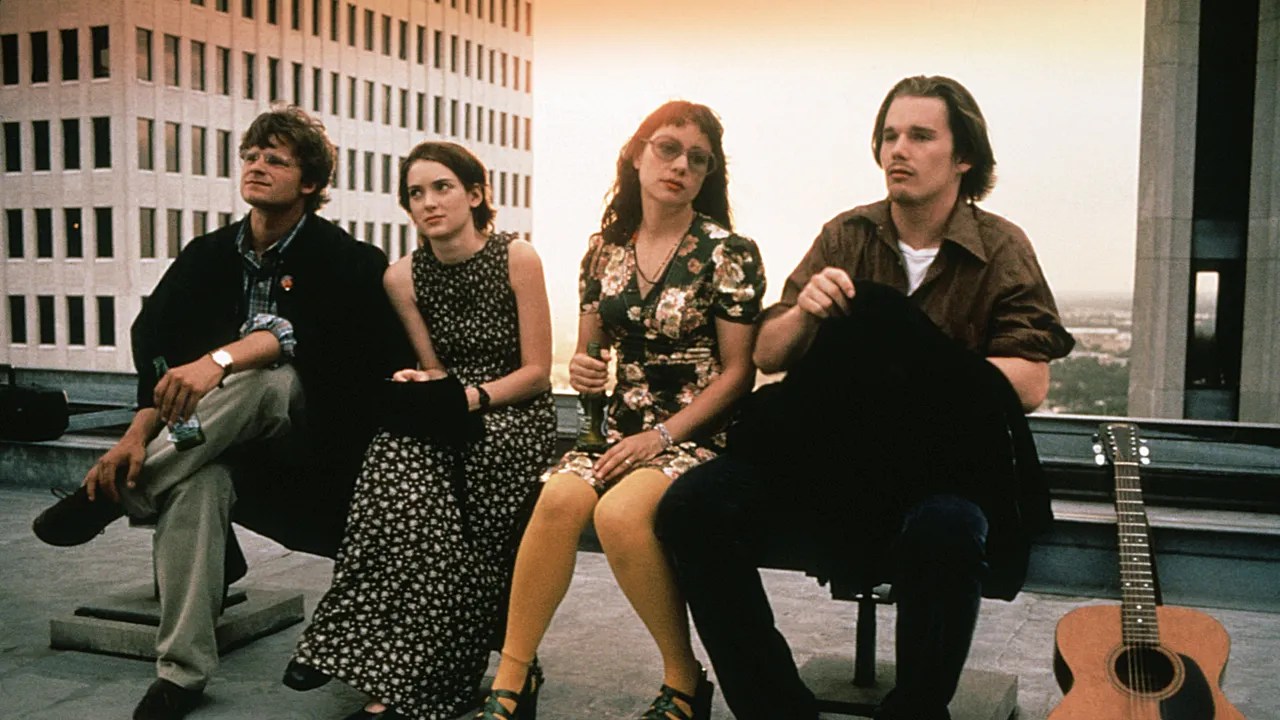
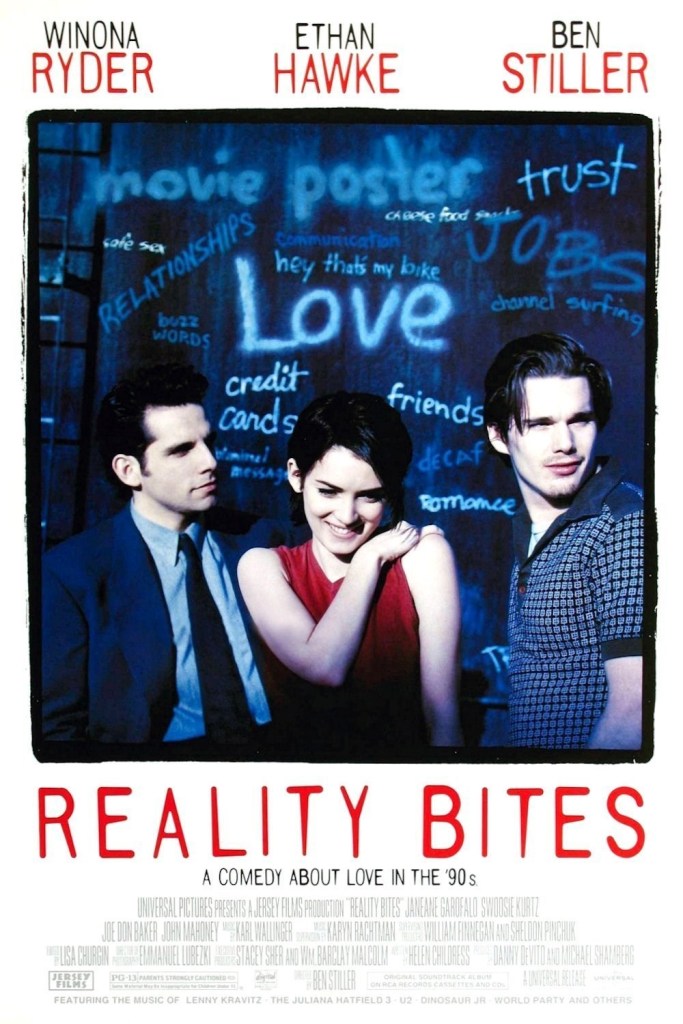
When Reality Bites premiered in 1994, it was marketed as a romantic comedy about recent college graduates stumbling into adulthood. But in hindsight, it was more than that: it was the first Hollywood film to hold a mirror to Generation X, capturing both its cynicism and its yearning, its distrust of institutions and its craving for authenticity. Today, the film looks less like a period piece than a time capsule of a generation suspended between analog childhood and digital adulthood.
Gen X Comes of Age
Directed by Ben Stiller and written by Helen Childress, Reality Bites follows Lelaina (Winona Ryder), an aspiring documentarian; Troy (Ethan Hawke), a slacker-philosopher with a garage band; Vickie (Janeane Garofalo), a Gap manager navigating sex and friendship with ironic detachment; and Sammy (Steve Zahn), a closeted young man negotiating identity in a less forgiving era. Together, they drift through Houston in the long shadow of student debt, entry-level jobs, and the fading promise of the American Dream.
For Gen X, born between the late 1960s and early 1980s, the film articulated a worldview shaped by divorce rates, corporate downsizing, AIDS, and the end of the Cold War. Its characters don’t trust politicians, corporations, or even their own résumés. They’re fluent in pop culture, skeptical of advertising, and allergic to sincerity — yet hungry for connection.
The Texture of the 1990s
The film is saturated with the textures of its moment: answering machines, Camel cigarettes, thrift-store wardrobes, MTV aesthetics. The soundtrack — Lisa Loeb’s “Stay (I Missed You),” U2, Crowded House, Lenny Kravitz — became an anthem for a generation that often defined itself through mixtapes and borrowed music. The presence of MTV Productions as co-financier is no accident: Reality Bites is edited and scored like a music video, its jump cuts and ironic juxtapositions echoing the way Gen X consumed culture.
Love, Work, and Selling Out
At its heart, Reality Bites stages a generational dilemma: should one pursue authenticity, embodied by Troy’s tortured integrity, or stability, embodied by Michael (Ben Stiller), a well-meaning yuppie who works at an MTV-style network? Lelaina’s choice between them became a cultural metaphor: between corporate assimilation and “keeping it real.” That she chooses Troy — with his unwashed hair, sharp wit, and existential aimlessness — was, at the time, read as romantic. Today, it feels like a defiant refusal of Gen X to be absorbed by the Baby Boomer system.
A Cult Text for a Cynical Generation
Critics were divided in 1994. Some dismissed the film as a collection of affectations; others praised its wit and accuracy. Over time, it has acquired cult status, in part because its characters articulated the contradictions of an in-between generation. Unlike the Boomers, they were not utopian; unlike Millennials, they were not digital natives. They were skeptical, ironic, self-aware, yet still capable of vulnerability.
Reality Bites offered Gen X a form of representation they rarely saw in mainstream cinema: not revolutionaries, not consumers, but ambivalent adults in formation. It is telling that Lelaina’s most honest work is her raw documentary footage of friends — shaky, unpolished, true.
Legacy and Relevance
The film’s impact extended beyond its box office. It helped shape the archetype of the 1990s “slacker” hero — a figure that appeared in music videos, independent cinema, and advertising that ironically co-opted the very ethos it parodied. Ryder and Hawke became icons of a generational mood: intellectual but disaffected, stylish but anti-fashion.
For later viewers, Reality Bites also foreshadows debates that would dominate the 2000s: about work-life balance, about authenticity versus branding, about the commodification of counterculture. If Lelaina were graduating today, she might be documenting her life on TikTok or YouTube, her footage monetized, her angst algorithmically packaged.
Generation X Timeline: Culture Around Reality Bites
- 1989 – Fall of the Berlin Wall signals the end of the Cold War, shaping the geopolitical backdrop for Gen X adulthood.
- 1991 – Nirvana releases Nevermind, bringing grunge into the mainstream and defining a sound of disaffection.
- 1992 – MTV’s The Real World premieres, blurring the line between documentary and entertainment — a precursor to Lelaina’s “reality bites” project.
- 1994 – Reality Bites is released, offering Hollywood’s first major portrayal of Gen X anxieties.
- 1995 – Douglas Coupland’s Generation X (1991) and Microserfs (1995) give literary voice to the same demographic.
- 1999 – The release of Fight Club reflects Gen X’s darker, more nihilistic edge at the turn of the millennium.
- 2000s – Gen X enters middle age as Millennials rise; the irony and skepticism of Reality Bites give way to new narratives about work and identity.
TL;DR
Seen thirty years on, Reality Bites is less a love story than a generational self-portrait. It captured the ambivalence of being young in the 1990s — too smart for the system, too broke to escape it, too ironic to hope, too earnest not to. Generation X may have resisted labels, but in this film it found one of its sharpest: a reminder that for a moment in the mid-1990s, to be young was to live in the tension between authenticity and compromise, between selling out and staying true.
 My World of Interiors