
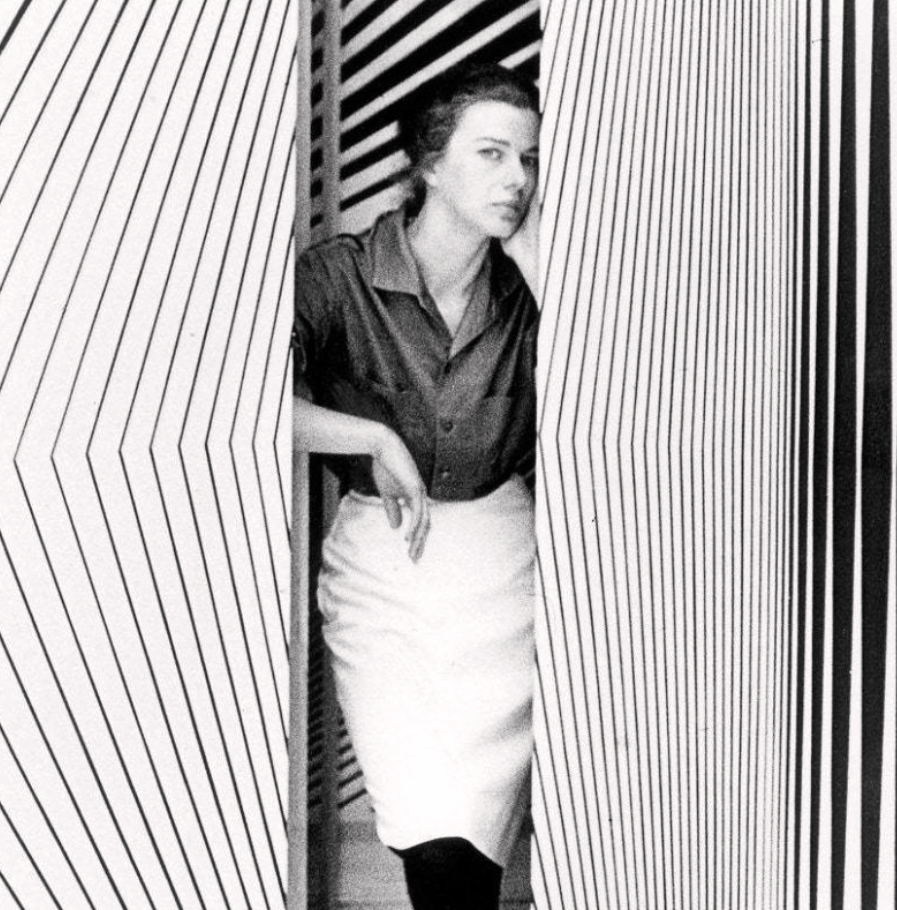
As an art student in the UK in the 1990s, Bridget Riley stood as the grande dame of abstraction to me. She has now spent six decades bending perception into form — distilling line, color, and rhythm until they transcend into something more elemental: pure visual sensation.
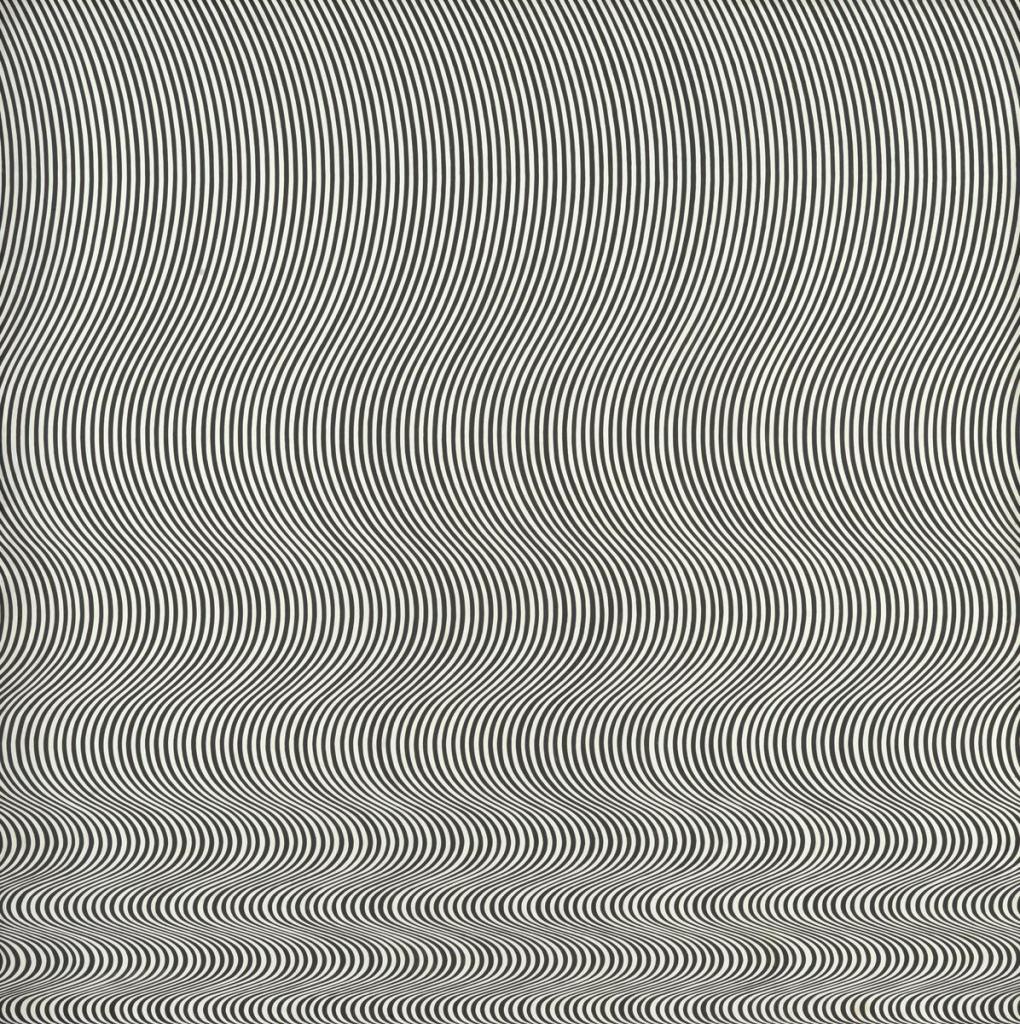
Born in 1931 in Norwood, London, Riley emerged in the 1960s at the crest of Op Art — a movement that blurred art, science, and design in dazzling ways. Her early black-and-white works, with their vibrating waves and pulsating geometries, jolted the viewer into a kind of perceptual vertigo. At the 1965 exhibition The Responsive Eye at MoMA, New York, Riley’s canvases stopped visitors in their tracks. They were not pictures in the traditional sense, but experiences — kinetic without ever moving.
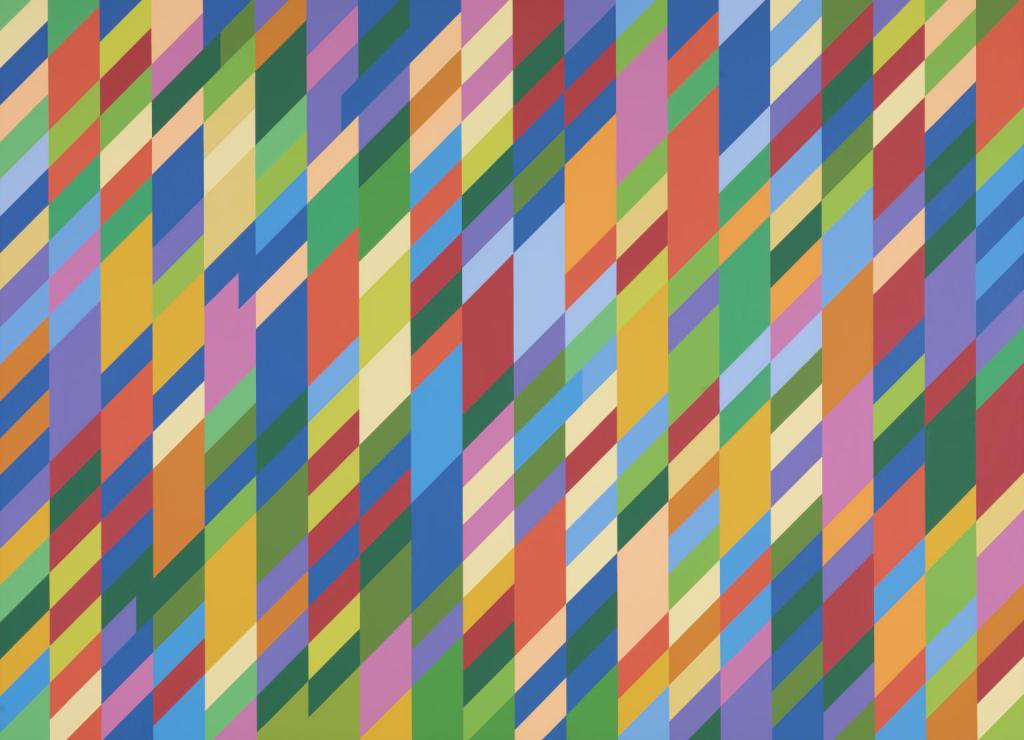
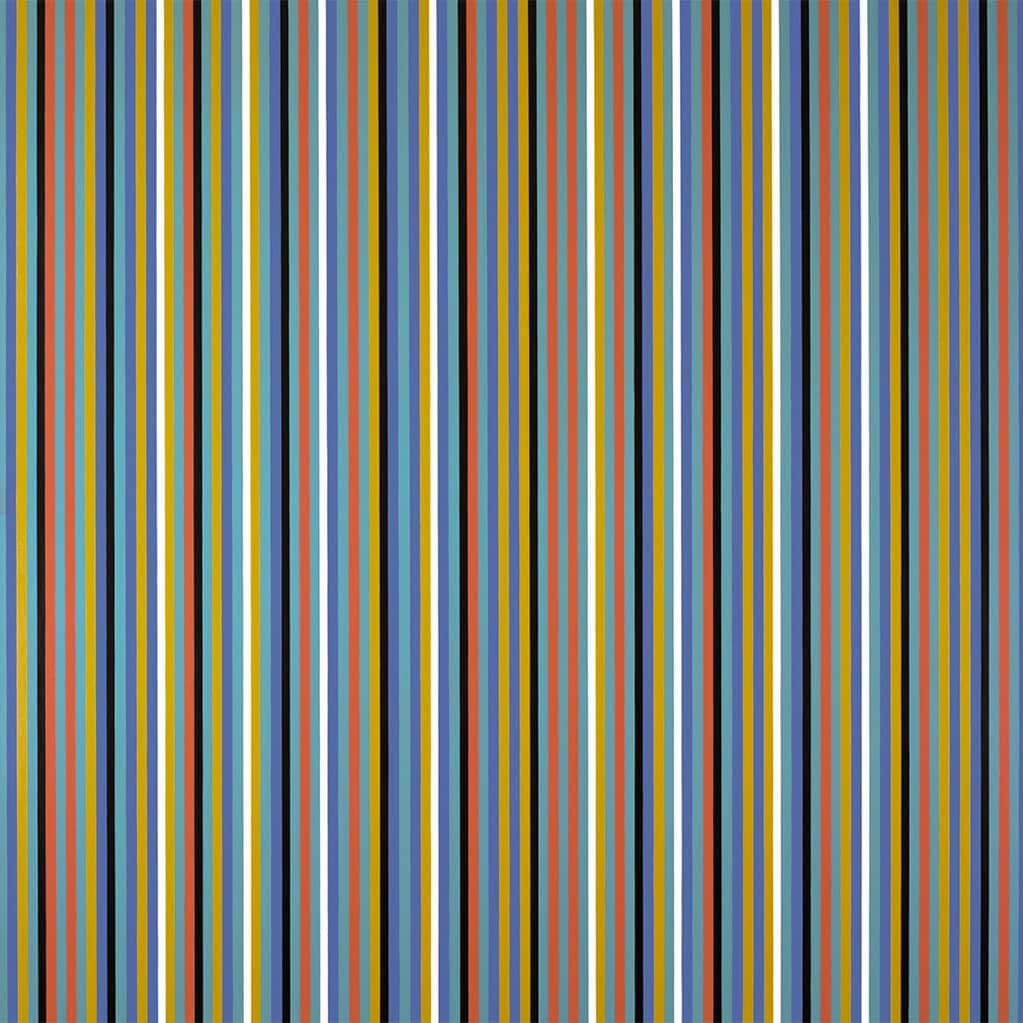
Yet to reduce Riley to the label of Op Art is to miss her true genius. Over time, she shifted her palette to color, exploring stripes, curves, and diagonals that move like symphonies across the surface. In works such as Nataraja (1993), with its rhythmical Indian influences, or the cascading color chords of her later stripe paintings, Riley’s art transcends category. It is as rigorous as it is sensual, a meeting of discipline and delight.

The Language of Line and Color
Riley works like a composer. Her stripes and arcs are not random but carefully orchestrated intervals, each hue chosen for the way it collides or hums against the next. She speaks of color as “the most fugitive of all perceptual elements,” and in her hands it becomes tangible. The viewer doesn’t just see her paintings; they feel them — a hum behind the eyes, a vibration across the body.
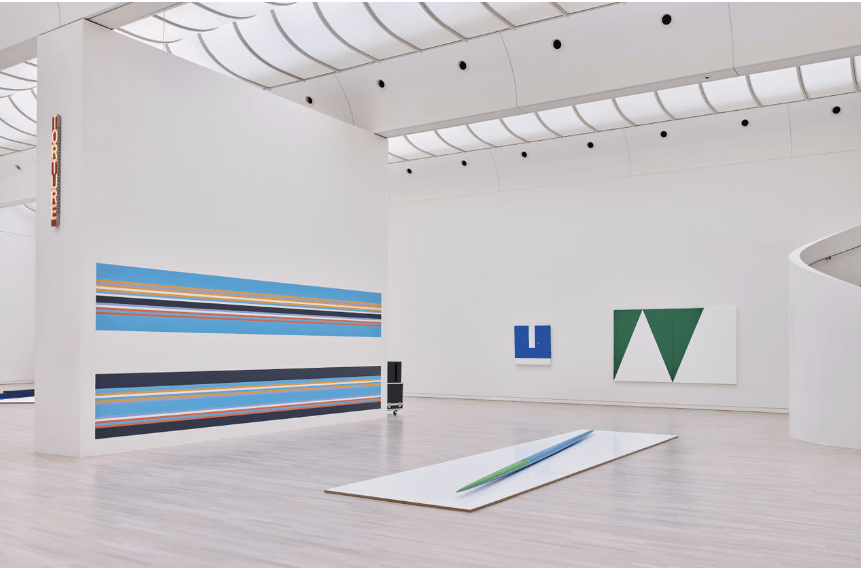
This is why Riley’s art has often leapt beyond the gallery into architecture, textiles, and stage design. Her wall paintings, such as those created for the Tate Britain and the London Underground, transform spaces into immersive fields. They are environments as much as they are images.
Key Works & Where to See Them
- “Movement in Squares” (1961) — Riley’s earliest black-and-white canvas, where geometry itself appears to warp and ripple. Arts Council of Great Britain, on view at Tate Britain, London.
- “Fall” (1963) — A hypnotic field of black-and-white curves, undulating as the viewer shifts perspective. Tate, London.
- “Nataraja” (1993) — Inspired by the Hindu god of dance, this monumental painting uses color arcs to embody rhythm and motion. National Gallery of Australia, Canberra.
- The Stripe Paintings (1980s–present) — From Achæan (1981) to Ra (1981), Riley’s chromatic stripes shimmer with Mediterranean light. Tate Modern, London; Centre Pompidou, Paris; MoMA, New York.
- Permanent Wall Paintings — Architectural interventions where paint becomes environment, notably her vast 2019 installation for the Duveen Galleries. Tate Britain, London.
Other important works can be found at the Art Institute of Chicago, the National Gallery of Art in Washington, D.C., and across Europe’s leading museums.
A Singular Career
Riley has been awarded almost every accolade in the art world: the International Prize at the Venice Biennale in 1968, the Praemium Imperiale in 2003, and a retrospective at Tate in 2003 that cemented her reputation as one of the most important living artists. Yet her process remains ascetic. She famously avoids working on a computer, preferring the discipline of hand-drawn studies, measuring tapes, and endless trial and error.
At 90-plus, Riley still works daily, her career testament to an unbroken belief in the primacy of looking. Her studio is a laboratory of perception — a place where she and her assistants test combinations of lines and hues, each adjustment shifting the entire experience of the work.
Legacy
In an age of relentless digital saturation, Riley’s art feels profoundly relevant. She reminds us of the act of seeing itself — of slowing down, of allowing the eye to adjust, of recognizing that perception is not fixed but fluid. Her works insist on time, attention, and presence.
For architects and designers, Riley offers a language of clarity: the ability to animate a space through nothing but proportion, rhythm, and color. For viewers, she offers immersion, wonder, and a reminder that vision itself is a gift.
Books on Bridget Riley:
Bridget Riley: A Very, Very Person. The Early Years. Paperback – Illustrated, 17 Sept. 2019
Bridget Riley Drawings: From the Artist’s Studio Hardcover – 11 Oct. 2022
Bridget Riley: Past into Present Hardcover – 9 May 2023
Bridget Riley Paperback – 10 Sept. 2019
 My World of Interiors
One thought on “Bridget Riley: The Discipline of Vision”