Essay · Education & Ideas
The College That Refused to Lower Its Voice
Bryn Mawr was founded in 1885 on a single, radical proposition: that women deserved not a version of higher education, not an approximation of it, but the genuine and uncompromised article — the same rigour, the same standards, the same unapologetic expectation of intellectual seriousness that the best men’s colleges offered their students. It has been living out the implications of that proposition ever since.
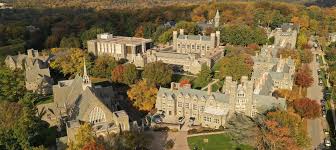
The campus sits on the western edge of Philadelphia’s Main Line, in a suburb of clipped lawns and stone houses that gives no particular warning of what is about to happen as you pass through the gates. Then the buildings arrive — Gothic, grey, unyielding, built in the manner of Oxford and Cambridge not as pastiche but as argument, as the claim, made in stone and pointed arch and leaded glass, that the education conducted within these walls was as serious as any conducted anywhere in the world, and that the sex of the people receiving it was not a relevant variable. The buildings are not beautiful in the soft sense. They are beautiful in the hard sense: demanding, slightly forbidding, designed to communicate that what happens here is not to be taken lightly and was not intended to be.
Bryn Mawr College was chartered in 1885 by a committee of Orthodox Quakers who had set aside land and money for the purpose, and who had in mind something more conservative than what they got. What they got, in large part because of the woman they hired to run it, was one of the most intellectually ambitious institutions in American educational history — a place whose standards were set deliberately and provocatively higher than those of the men’s colleges of the same era, whose faculty were recruited from the best universities in Europe and America regardless of conventional practice, and whose alumnae would go on to occupy, with a consistency that statistics cannot quite explain, positions at the absolute front of American intellectual and public life.
M. Carey Thomas and the Will to Seriousness
Martha Carey Thomas is one of the most important figures in the history of American education and one of the least celebrated outside the circles that know her well. She was born in Baltimore in 1857 into a Quaker family of progressive inclinations, and she understood, from an early age, that the thing she wanted — a rigorous university education, the kind that produced scholars and thinkers and people who could argue in Greek — was not intended for her. The Johns Hopkins University, founded in Baltimore in 1876 as America’s first research university on the German model, would not admit women. Neither would most of the institutions that Thomas considered her intellectual equals. She went to Europe — to Leipzig, to Zürich, where she completed a doctorate summa cum laude in 1882, the university having no particular objection to awarding a degree to a woman, provided she had earned it.
She returned to America and, at twenty-seven, was appointed dean of the new college being established on the Main Line. She became its second president in 1894 and held the position until 1922, twenty-eight years in which she made Bryn Mawr into something that had not quite existed before: a women’s college that did not apologise, that did not explain itself, that did not accept the premise that women required a different or gentler or more practically oriented curriculum than men. Thomas required Greek of her students. She required Latin. She set her doctoral programme — Bryn Mawr was the first women’s college to offer graduate degrees — to the same standards as the best European research universities, because she had been to the best European research universities and she knew what the standards were and she saw no reason, none whatsoever, to accept anything less for the women in her charge.
“Our failures only marry.”
M. Carey Thomas — attributed, and almost certainly apocryphal, but entirely in character
The quotation is almost certainly apocryphal, but it has survived because it captures something real about Thomas’s priorities. She believed, with the conviction of someone who had fought for every credential she possessed, that intellectual achievement and domestic life were, for women of her era, in genuine competition, and that the college’s function was to produce the former rather than prepare for the latter. This was not a position without cost — it left Thomas open, correctly, to the charge of elitism, of constructing a version of women’s liberation available only to those with the class background to access it — but it was a position held with full seriousness and executed with complete consistency, and the institution it produced was, as a result, entirely unlike any other.
Thomas was also, by the measures of her era and by ours, a troubling figure. Her racism was explicit and documented — she held views about the hierarchy of races that were not merely products of their time but were, even within that time, the views of someone choosing the wrong side of a genuine debate. Her antisemitism shaped admissions practices at the college in ways that caused real harm to real people. She was, in short, a figure of the kind that Bryn Mawr’s own intellectual tradition — committed to unflinching examination of evidence — obliges us to look at directly: a woman of transformative vision and genuine moral failure, whose institution has had to decide, in each generation, what to take from her and what to refuse.
The Gothic Campus and What It Means
The architecture of Bryn Mawr is not accidental. Thomas commissioned the Philadelphia architect Addison Hutton and his successors to build in the Collegiate Gothic style — the style of Oxford and Cambridge — and the decision was, like most of Thomas’s decisions, a deliberate provocation. The Gothic college was, in 1885, a male space: its cloisters and towers and dining halls encoded a particular idea of who deserved to think seriously about the world, and that idea did not include women. By building in that style, Thomas was making a claim — this is ours now, or it is ours equally, or more precisely it was always potentially ours and we are simply completing the argument the architecture always implied — that was as clear as any speech she gave and more durable than any of them.
Taylor Hall, the college’s central administrative building, completed in 1894, is the key building in this argument. Its tower dominates the campus with the unabashed authority of a building that knows its own importance — not grandiose, but entirely unashamed, built to last and to be seen to have been built to last. To walk past it is to receive a message that the college has been sending for a hundred and thirty years: we are here, we were always going to be here, and the question of whether we had the right to be here was settled before you arrived.
The landscape, too, is part of the argument. The campus was laid out with the same attention to the relationship between buildings and grounds that characterises the great English university towns, with lawns and paths and plantings that slow movement and encourage the kind of unhurried, reflective progress that serious thinking requires. There is a cloister. There are gardens. There is a sense, unusual in American academic architecture, that the outdoor space is not merely the space between buildings but a room of its own, with its own uses and its own atmosphere, designed for the kind of conversation that does not quite happen indoors.
The Alumnae and the Argument They Embody
The case for Bryn Mawr is made most vividly not by its architecture or its curriculum or its history but by the list of women it has produced, and the list is, even by the standards of the Seven Sisters colleges, remarkable. Katharine Hepburn graduated in 1928 — she has appeared in these pages before, in connection with the remarkable Hartford household that sent her there — and the connection between the Bryn Mawr education and the woman she became is not incidental. The college gave her a context in which intellectual seriousness and female ambition were not in tension but were, in fact, the same thing, and she carried that context with her for the remaining seventy-five years of her life.
Marianne Moore, one of the great American poets of the twentieth century, graduated in 1909. Her poetry — dense, formally innovative, driven by an exactness of observation that treats the natural world with the same rigour a scientist brings to a specimen — bears the marks of a Bryn Mawr education in every line: the insistence on getting it precisely right, the refusal of the approximate, the sense that a poem, like an argument, either holds or it does not. H.D. — Hilda Doolittle, the Imagist poet and intimate of Ezra Pound — attended Bryn Mawr, briefly, in 1905. The philosopher and sociologist Anna Julia Cooper was among the first Black women to earn a doctorate in America; her connection to the college’s graduate tradition was a thread in a larger fabric of Black women’s education that Bryn Mawr supported, imperfectly and unevenly, but more substantially than most institutions of its era.
“I go to Bryn Mawr because my mother went, and because there is no better place in the world to be taken seriously.”
Overheard in the cloister — attributed to no one in particular, and therefore to everyone
The economist Emily Greene Balch, who graduated in 1889 and won the Nobel Peace Prize in 1946 for her work on international peace and women’s rights, is perhaps the most dramatic example of what the college’s founding proposition — that women, given the same education as men, would do with it what men had always done, and then some — was capable of producing. Balch’s trajectory from Bryn Mawr undergraduate to Nobel laureate is not a coincidence. It is a demonstration.
The Question of the Single-Sex College
Bryn Mawr has remained a women’s college — one of a diminishing number — in an era when the arguments for single-sex higher education have had to be remade in a cultural context that has largely moved on from the assumptions that made those arguments urgent in the first place. The Ivy League colleges admitted women in the 1960s and 1970s. The case for the women’s college, in 1885, was that women could not get the education they deserved elsewhere. The case in 2024 is necessarily different, and Bryn Mawr has made it with varying degrees of conviction and clarity across the decades.
The case, as it is now typically made, rests on empirical observation rather than structural necessity: that women in single-sex educational environments participate more fully in intellectual and public life, speak more freely in seminars, take leadership positions at higher rates, emerge more consistently into demanding careers. The research is real and the findings are consistent enough to constitute an argument. Whether the argument is sufficient to justify maintaining an institutional structure built on a separation that was originally imposed rather than chosen is a question the college continues to negotiate, most recently through its policy on transgender and non-binary students, which has evolved to include students who were not assigned female at birth but who identify as women or non-binary — a development that Thomas, for all her radicalism, could not have imagined and might not have welcomed.
The college’s willingness to engage this question — to examine and re-examine its own founding premises in light of evidence and changing understanding — is itself a form of institutional fidelity to the tradition Thomas established: the tradition of not accepting received categories without examination, of insisting that the arguments be made and defended and tested against reality, and of changing position when the evidence requires it.
What It Means to Be Taken Seriously
There is a phrase that recurs in accounts of Bryn Mawr, spoken by alumnae of every generation with a consistency that amounts to testimony: the experience of being taken seriously. Not humoured, not accommodated, not managed — taken seriously, as an intellect, as a thinker, as someone whose ideas were worth engaging and whose arguments were worth refuting. The phrase sounds modest until you consider how rare the experience it describes has been, and in many contexts remains, for women who bring their minds to institutions built by and largely for men.
Bryn Mawr was designed, from the first, to produce that experience as a matter of course, as the ordinary texture of daily life rather than a pleasant exception. The design has worked imperfectly, as all institutional designs do, and the college has much in its history that does not survive honest scrutiny. But the core proposition — that intellectual seriousness has no natural sex, that the life of the mind is available to anyone willing to do the work, that the standards applied to women’s thinking should be identical to those applied to men’s — has been maintained, and the maintenance of it, across a hundred and forty years of American educational history, is not nothing.
It is, in fact, rather a great deal. The Gothic towers still stand on the Main Line, still grey, still refusing to soften themselves for anyone’s convenience. The cloister is still there. The argument the buildings make is still being made. And the women who walk through the gates still receive, in the architecture itself, before a single class has been attended or a single book opened, the message that Thomas intended them to receive: that they are here because they belong here, and that the question was settled a long time ago, and that the work — the serious, demanding, uncompromising work — is what comes next.
This essay draws on Helen Lefkowitz Horowitz’s The Power and Passion of M. Carey Thomas (1994), Bryn Mawr College’s published institutional history, and the biographies of individual alumnae referenced in the text. The college’s current admissions policies and their evolution are drawn from Bryn Mawr’s published statements. Emily Greene Balch’s Nobel Prize was awarded jointly with John R. Mott in 1946.

