
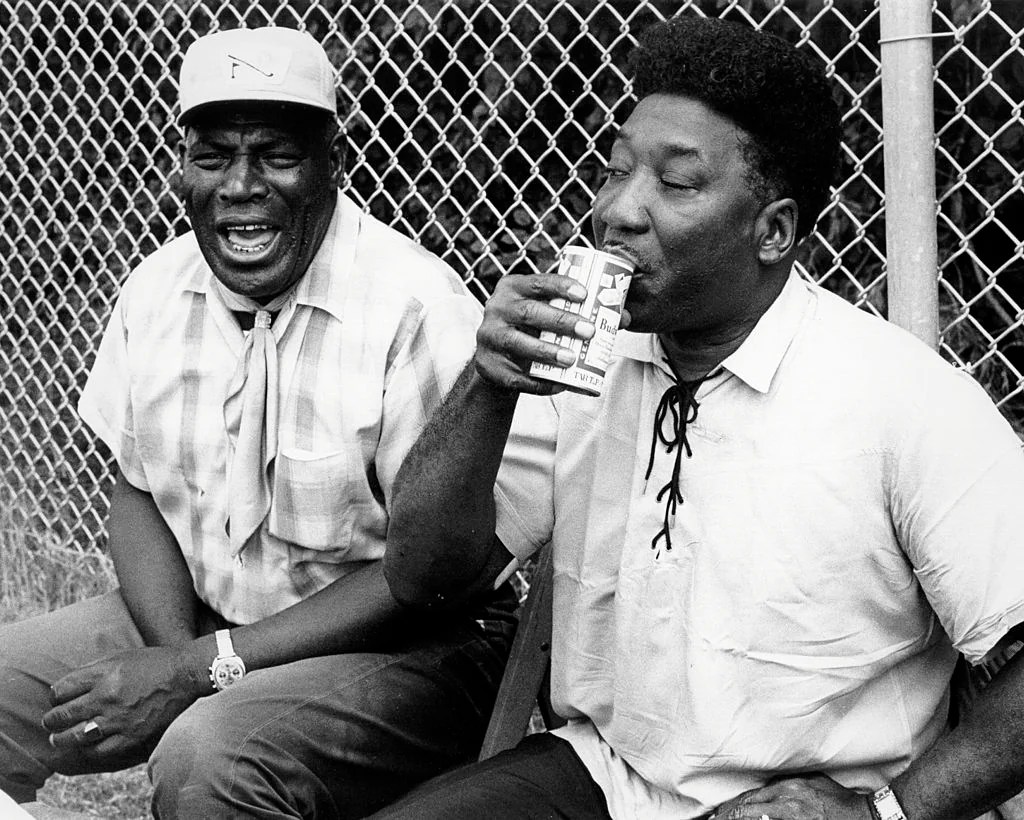
In the story of the blues, few names resonate as profoundly as Muddy Waters and Howlin’ Wolf. Each stood as a colossus of the postwar Chicago sound, electrifying the traditions of the Mississippi Delta and shaping what would become the bedrock of modern rock and roll. Together, they embodied a paradox: rivals as much as compatriots, their partnership was forged not in harmony but in tension—two magnets of equal strength repelling and attracting at once.
From the Delta to Chicago
Muddy Waters, born McKinley Morganfield in Rolling Fork, Mississippi, in 1913, was raised on the fields of Stovall Plantation. Influenced by Son House and Robert Johnson, Waters absorbed the Delta’s raw intensity, honing a guitar style that was rhythmic, pulsing, and hypnotic. Alan Lomax’s Library of Congress field recordings of Waters in 1941 introduced his sound to the world, marking him as the bridge between folk blues and urban electricity.
Chester Arthur Burnett, better known as Howlin’ Wolf, was born in 1910 in White Station, Mississippi. Towering at six foot three with a voice that could shake rafters, he was mentored by Charley Patton and taught guitar by Delta legend Willie Brown. If Waters’s sound was serpentine and sensual, Wolf’s was volcanic: guttural howls, growls, and falsetto cries that commanded attention.
Both men carried the Delta north during the Great Migration. In Chicago, they electrified the rural form, plugging in guitars and amplifying voices for a city sound that was gritty, urban, and unrelenting.
Chess Records and the Chicago Sound
The epicenter of their careers was Chess Records, run by Leonard and Phil Chess. Muddy Waters had been the label’s breakout star since the late 1940s, his band a crucible for talent: Little Walter on harmonica, Jimmy Rogers on guitar, Otis Spann on piano. Songs like Hoochie Coochie Man and I’m Ready codified the swagger of Chicago blues.
When Howlin’ Wolf arrived in Chicago in 1952, already in his early forties, the Chess brothers signed him immediately. His band included guitarists Hubert Sumlin and Willie Johnson, whose jagged riffs matched Wolf’s feral vocals. Tracks like Smokestack Lightning and Spoonful became blues anthems—dark, hypnotic, unmistakable.
Within Chess Records, rivalry brewed. Muddy resented the attention Wolf commanded; Wolf bristled at suggestions that he was in Waters’s shadow. Their bands often competed for gigs, musicians shifted loyalties, and the Chess brothers fanned the flames, using competition to keep both men recording prolifically.
Rivals and Counterparts
The contrast between Waters and Wolf could not have been sharper. Muddy, polished and stylish, was known for his charm, his command of rhythm, and his ability to seduce audiences. Howlin’ Wolf, raw and primal, performed like a force of nature, sometimes crawling across the stage on all fours, his voice more growl than croon.
Critics and fans often framed them as opposites: Muddy as the architect of Chicago blues sophistication, Wolf as its uncontainable id. But in truth, they were complements. Muddy gave the blues its urban cool; Wolf gave it its untamed soul. Together, they defined the spectrum of postwar blues, showing how a shared tradition could produce radically different forms of expression.
Influence and Legacy
Their rivalry belied a deeper partnership. Both carried the Delta into the modern era, ensuring its survival by adapting it for new audiences. Both mentored younger musicians who would shape rhythm and blues, soul, and rock.
The British blues explosion of the 1960s owed them everything. The Rolling Stones took their name from a Muddy Waters song; Cream and Led Zeppelin covered Howlin’ Wolf staples. Eric Clapton, Keith Richards, and Jimmy Page all acknowledged that their own music was unthinkable without Muddy and Wolf.
In later years, the two men appeared together on stage and in sessions, their rivalry mellowed into mutual respect. Wolf’s London Sessions (1970), featuring Clapton, Steve Winwood, and Charlie Watts, and Muddy’s own collaborations with Johnny Winter in the 1970s, kept their influence alive for new generations.
The Dual Pillars of the Blues
Muddy Waters died in 1983, Howlin’ Wolf in 1976. Yet their voices still reverberate: Muddy’s hypnotic slide guitar, Wolf’s seismic roar. They remain the dual pillars of the Chicago blues, embodiments of two sides of the same tradition—refined seduction and primal force.
Together, they ensured that the blues was not a relic but a living, evolving art form. Their partnership, rivalrous though it was, pushed each to greater heights, proving that competition can sharpen genius. More than contemporaries, they were mirror images of the blues itself: one smooth, one jagged, both essential.
Essential Listening
- Muddy Waters – Hoochie Coochie Man
http://www.allmusic.com - Muddy Waters – At Newport 1960
http://www.allmusic.com - Howlin’ Wolf – Smokestack Lightning
http://www.allmusic.com - Howlin’ Wolf – Moanin’ in the Moonlight
http://www.allmusic.com - Muddy Waters & Howlin’ Wolf – The London Howlin’ Wolf Sessions (1970)
http://www.allmusic.com - Documentary: American Folk Blues Festival (1962–69) – Footage of both artists touring Europe.
www.imdb.com
 My World of Interiors