
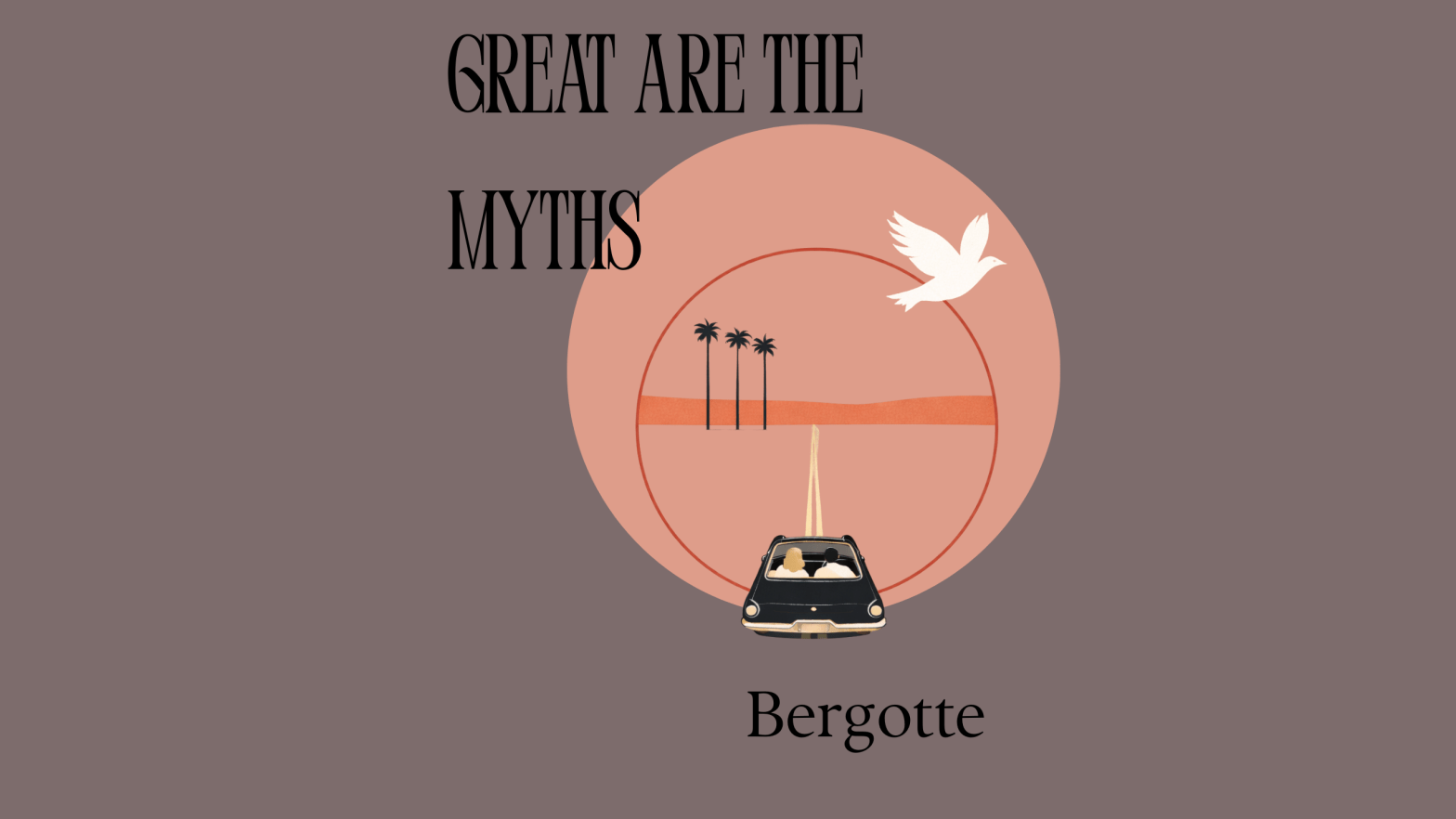
An Essay on Reading Great Are the Myths
“What if you’re my imaginary friend?”
The boy asks this near the very end. They are lying side by side on sun loungers in the California desert, covered in blankets, the way they used to lie in the garden in Memphis when they were thirteen and fourteen and the world was still small enough to hold. The novel has spent nearly three hundred pages building to this moment and then — true to itself — it refuses to resolve it. Birdie deflects. She laughs. She says, “If I am, you’ve made me so real I feel mighty alive.” And then, once he has fallen quiet, she thinks to herself: Sometimes I think he is my imaginary friend too.
The question hangs in the desert air like heat. And that is exactly where the novel wants it: unanswered, shimmering, alive with possibility.
This essay is about that possibility. It is about imaginary companions — what they are, what they do, what kind of soul tends to need them, and why the reading of Birdie as the boy’s imaginary companion may be not just one interesting interpretation of Great Are the Myths, but one of its most emotionally true ones. It is also about something more speculative, more metaphysically playful: the idea that an imaginary companion might not simply be invented but might instead arrive — a pre-existing entity who inhabits a dreamscape or parallel world until called forth by a longing soul — and then, once they are no longer needed as a daily presence, retreats back into that landscape, not gone but folded into the texture of memory, myth, and ongoing interior life.
What Is an Imaginary Friend?
The standard story developmental psychology tells about imaginary companions is reassuring and a little reductive. Children invent imaginary friends because they are lonely, or because they are eldest children with no ready playmates, or because they are creative and imaginative and need someone who will agree with them without qualification. The friend serves the child — as audience, as ally, as a mirror that never distorts. They are, in this telling, a benign fiction, a training wheel for emotional and social life, and they disappear (or retire) when the child no longer needs them.
This account is not wrong, exactly, but it flattens what is in fact an extraordinary psychological phenomenon. Studies of children who have imaginary companions consistently find that these children score higher on measures of creativity, have richer narrative abilities, are more adept at perspective-taking and theory of mind, and tend to display a more sophisticated capacity for empathy. The imaginary companion is not a symptom of deficit; it is a technology of the rich inner life.
What is more, the imaginary friend is rarely experienced by the child as a creation. Children do not, as a rule, say: “I made this person up.” They say: “This is my friend.” The companion arrives with the full weight of personhood — with their own preferences, their own opinions, sometimes their own stubborn refusals. Parents of children with imaginary friends often report that the child corrects them: “She doesn’t like carrots.” “He thinks you’re wrong about that.” The companion has a will of their own, and that will sometimes contradicts the child’s. They are not merely a puppet.
This is an important and strange fact. If the child were simply projecting what they already know and feel onto a blank screen, the companion would agree with everything. Instead, the companion is often experienced as a genuinely other presence — someone who challenges, argues, disappoints, even. And this, far from diminishing the relationship, is exactly what gives it depth and meaning. You cannot truly love a mirror.
The Companion Who Arrived
Before I wrote this novel, Elvis Presley was my imaginary friend.
Not a poster on the wall, not a parasocial attachment, but something more specific and stranger: an interior presence, a companion in the creative dreamscape. When I began to write this story, I found myself wondering what it would mean to turn the frame around — to imagine not a fan’s fantasy of Elvis, but his fantasy. What was his inner life reaching for? What shape would the companion of that particular, peculiar, luminous loneliness take?
The question opened something. Because Elvis was, by all accounts, a person of very unusual interior weather. He was not simply a performer; he was a visionary and a mystic, someone who read Kahlil Gibran with the earnestness of a novice, who talked to his stillborn twin in the dark, who believed deeply in spiritual forces and the movements of an invisible world. He was also, and critically, deeply lonely — not in the way of everyone who feels misunderstood, but in the way of a person set apart by something they did not ask for and could not name. Fame arrived not as a homecoming but as a disruption, a rupture between himself and ordinary life. From the moment he arrived in Memphis at thirteen, a working-class boy from Tupelo in a place that already had its hierarchies of who belonged and who didn’t, there was in him an acute need for a particular kind of companionship: someone who could see him without the distortion of who he was about to become.
What if that someone was not entirely of this world?
The Evidence in the Novel
Great Are the Myths is narrated by Birdie, which means we see everything through her perspective and everything remains, technically, explicable. She has a grandfather, a house, a nanny, a history. She has the full apparatus of a real person. And yet the novel accumulates, carefully and without insistence, a set of details that do not sit quite right.
She arrives in Memphis as if she has been placed there. Her grandfather, an almost mythic figure himself, chooses this specific city, this specific house, and she arrives on the very day the boy arrives too — his first day at a new school, in a new city, alone. She says she was “born there,” in America — but she has no American life before this moment. She describes her origins as “Heaven knows. A whole other world,” which is presented as the deflection of a shy, self-conscious girl, but which also reads, retrospectively, as something more literal.
Her house is extraordinary: not just grand but strange. It exists, as she tells the boy on his first visit, “outside of time and space.” Later, she will find rooms in it she has never found before — pale green carpet, a single bed, a swan figurine — rooms that simply appear and then close again. The house is real to everyone who visits it. But it has the texture of a dream mansion: the private cinema, the garden that stretches further than eyes can see, the mysterious new rooms. It is less a house than an interior space, a landscape that has taken solid form.
And there is the question of her parents. They are almost never there. When Mabel asks — as any rational friend would — “Was it even legal?” for Birdie to have lived in this house alone as a child, Birdie registers the strangeness: “There’s something in my mind that won’t let me look at it straight, like it’s fogged over.” It is one of the novel’s most quietly uncanny moments. She cannot examine her own origins too closely. The logic of her existence is not that kind of logic.
Most telling of all is the quality of her relationship with the boy. He says to her, very early, when they are just sixteen: “Feels like you already live in my head, so there’s no point hidin’ nothin’.” He says it casually, as a statement about intimacy, not metaphysics. But the novel has placed it here deliberately. She already lives in his head. He senses it. He cannot say what it is, only that there is no distance between her knowledge of him and his knowledge of himself.
As he grows famous, she retreats. This is rendered as a psychological response to fame — her discomfort with the machinery of stardom — but it also follows the logic of the imaginary companion perfectly. The more he is claimed by the real world, the more the crowd surrounds him, the more his identity is constructed for him by the culture and the camera and the screaming girls, the less room there is for the interior companion. She says herself: “I can’t be anywhere near the eye of the storm.” She runs in the opposite direction. Yet she remains — a presence felt from a distance, a warmth in the mind, a voice that carries across the country.
At Bryn Mawr commencement, she drifts into his mind “like a light, jolly fog.” She sees him eating lunch on a studio set in Los Angeles. She sees him sitting on his bed at the Beverly Wilshire. She hears him sing. And she hears him, across that distance, say to no one: “Go get ’em, little girl.” He is talking to a room. He is talking to her. He does not know the difference.
The Spirit Guide in the Dreamscape
Let me push further, into the territory the novel has earned but chosen not to occupy explicitly.
The imaginary companion, as children experience them and as the research describes them, arrives. They are not assembled from scratch but discovered. When asked about their imaginary friends, children often say things like: “She was just there one day,” or “I found him.” There is a mythology — very old, very widespread — of the spirit companion, the daimon, the fetch, the guide figure who exists in a parallel register of reality and makes contact with certain human souls at certain moments of need. Socrates had his daimonion, his interior voice that guided him. Native American traditions speak of spirit helpers encountered in vision states. The Romantics wrote extensively about genius as an external presence that visits the artist rather than an internal capacity they possess.
This tradition suggests something the clinical literature has no language for: that the imaginary companion may not be imaginary at all, in the sense of being fabricated, but may instead be a real presence in another register of experience, one that the child — more permeable, less defended by the thick wall of adult consensus reality — can access and give form to. The companion inhabits what Birdie calls, near the end of the novel, a “parallel universe” — a phrase she uses almost dismissively, then lets fall: “Maybe these times are just echoes of past lives, or different versions of a life just out of reach?”
In this reading, Birdie pre-exists the boy. She exists in a dreamscape — call it the mythical landscape the novel’s title invokes, the Whitman-land of imagination and longing and America-as-dream — and she has been waiting, in whatever form waiting takes in such places, for a soul who needs her particular quality of companionship. When a thirteen-year-old boy from Tupelo arrives in Memphis, lonely and already extraordinary, already carrying something the world is not quite ready for, she is drawn into proximity. She takes form — takes the form of a girl his own age, bookish, funny, strange, from somewhere inexplicably far away — and she arrives on his first day of school.
This is not magic in the flashy, supernatural sense. It is something quieter and stranger: the way inner life constellates around its needs. The way a dreaming mind, under sufficient pressure of longing, can summon its own comfort and interlocutor. The boy needed someone who would see him before the world decided who he was. Birdie saw him. Whether she arrived from within or without, from his own unconscious or from some adjacent frequency of reality, the function she served was that of the true companion: the one who knows you before you know yourself.
What the Imaginary Companion Does
There is a particular kind of loneliness that precedes greatness. It is not ordinary loneliness — it is the loneliness of being ahead of your time, of carrying a frequency that hasn’t yet found its broadcast tower. Elvis Presley felt this in Memphis in 1948. He was a boy who heard music that didn’t have a name yet, who moved in ways that hadn’t been codified as movement yet, who held in himself a synthesis of Black and white musical traditions that the culture was not yet ready to call beautiful. He was ahead. And ahead is a very lonely place.
The imaginary companion serves this kind of loneliness specifically. What the companion offers is not just company but recognition — the experience, so rare and so necessary, of being seen in full. Birdie sees the boy not as the town of Memphis sees him (poor, a little odd, not quite the right kind of people), not as his mother sees him (a miracle, a substitute for his dead twin, someone she must protect from her own love), and not as America will come to see him (a symbol, a threat, an icon, a product). She sees him as he is, in the continuous present tense of their friendship: funny, tender, vain, self-conscious, gifted, afraid.
This is the gift. This is what the companion provides. And notice what happens in the novel when he begins to achieve fame: Birdie’s hold on him both tightens and loosens simultaneously. He needs her more (“he needs me more now, and he needs me less — I don’t know how else to describe it”). The more the world constructs a version of him that isn’t him, the more he needs the companion who knew him before. But she cannot survive in the hurricane of fame. She keeps slipping out of the frame. She is not of that world. She belongs to an interior territory that the fame is crowding out.
This is, again, perfectly consistent with how imaginary companions work across childhood and early adulthood. They recede not because they are abandoned but because the external world grows louder and takes up more room. The companion does not die; they return to wherever they came from, which is to say: they move back into the deep interior, where they settle into the sediment of memory and myth, still present, still occasionally audible, but no longer needed as a daily face.
By twenty-three, the boy is Elvis. He is also, in some irreversible way, no longer only himself. Birdie has done what she came to do. She has walked him through the transition — from the lonely thirteen-year-old at Humes High to the young man arriving in California to make movies and begin the long strange business of being a symbol. She can fold back now into her mythical landscape. Not because she never existed, but because the need that called her forward has changed shape.
Why This Reading Is the Most True One
But here is where I want to be careful, because Great Are the Myths does not say this. It does not say Birdie is an imaginary friend. It puts the question in the boy’s mouth and immediately has him retract it — “it’s all nonsense, anyway” — and then has Birdie privately entertain it and then let it go. The novel earns its ambiguity. Birdie is a fully realised character with her own story, her own arc, her own interiority. She is not reducible to a projection or a function.
And yet — and this is what I mean by emotional truth — the imaginary companion reading is not a reduction. It is an elevation. It does not diminish Birdie to say that she might be the boy’s interior companion made flesh; it says something magnificent about the boy’s inner life, about the quality of the world he carried within himself, about the fact that a longing soul, given sufficient imaginative pressure and sufficient need, can summon a companion of extraordinary richness and complexity and vitality.
The imaginary friend is not less real than a real friend. Ask any adult who had one. Ask anyone who has lost one. The imaginary companion has weight, history, preference, and will. She can disappoint you. She can argue with you. She can go away and leave you in genuine grief. When Birdie says, “If I was your imaginary friend, why would we ever argue or have differences? Why would I have a life away from you?” — she is making the case for her own reality. And she is right. But she is also describing the most sophisticated and most emotionally honest form the imaginary companion takes: not a perfect mirror, not an endlessly agreeable puppet, but a genuinely other presence who sometimes stands apart.
This is Birdie. She is the companion who is other enough to be real. She loves him without serving him. She sees him without worshipping him. She leaves — genuinely leaves, has her own life, marries another man, has a child — and yet remains. The novel ends with her still present in the texture of the boy’s mind, still there in the room even when she is not in the room, and the Whitman poem that closes it — “I dream in my dream all the dreams of the other dreamers, and I become the other dreamers” — gives us the only mythology adequate to what they share: not mere friendship, not mere love, but a dreaming together that crosses the borders of individual selfhood.
The Myth She Comes From
The novel’s title is drawn from Whitman’s great democratic poem — “Great are the myths — I too delight in them” — and this is not incidental. Birdie is a myth. Not in the sense of being false, but in the sense of being what myths are: the stories we tell to carry what is too large and too essential for ordinary narrative. Elvis Presley became a myth in his lifetime. He was an American myth: the poor boy made good, the body that changed culture, the spirit that rose and fell and rose again. But before he was America’s myth, he was a thirteen-year-old boy in Memphis who needed the particular myth that would see him through.
That myth came in the form of a girl. A peculiar, funny, large-spirited, inexplicably placed English girl in a big white house at the edge of town, who saw him before he was anyone, who kept a room for him, who walked him through the early years of his becoming. And when he was ready — when he had settled into his own mythology, his own landscape — she returned to hers.
The dreamscape she came from, and returned to, is not nothing. It is the place where all the great imaginary companions live: the inner country that children visit and artists inhabit and saints and mystics sometimes stumble into. It is the country of genuine longing, where the imagination doesn’t merely decorate reality but generates it, calls presences forward, makes real what was only possible before. This is the territory Elvis Presley moved in all his life — in his music, in his spiritual seeking, in the intensity of his longing for something he could never quite name. He spent decades reaching toward something beyond the visible.
Maybe that reaching began at thirteen, in Memphis, on the first day of school.
Maybe she was already there, waiting.
A Note on the Author’s Origin Story
It is worth sitting with, for a moment, the way this novel began. As a child, Elvis Presley was the author’s imaginary friend. This is not a metaphor. It is a statement about the nature of imaginative life and what it makes possible.
To grow up with Elvis as an interior companion is to grow up with the mythology already inside you — not as received cultural material but as lived experience, as something you carried in your own self. And when it came time to write about him, the question naturally arose: what would his have been like? Not who did Elvis love or who loved Elvis, but what presence lived in his interior world the way he had lived in the author’s?
This is a profoundly generous imaginative act. It is not about a fan and their idol. It is about the mutuality of the imagined — the recognition that if imaginary companionship moves in one direction, it might in some sense move in both, that the energy of longing and recognition is not unidirectional. The child who needed Elvis as an interior companion and the young man who needed Birdie are, in some deep structural sense, asking the same question: Who will see me? Who will know me? Who is there before I become what the world makes me?
The novel is the answer to that question. And the imaginary companion reading is the key that opens it widest.
After She Goes
The boy ships out in October. Birdie’s baby arrives in November. The novel ends with its last great symmetry: his departure from the world of private life, her arrival into a new kind of permanence. They have both crossed over.
But notice what the novel does not say. It does not say Birdie disappears. It does not say the connection ends. What it says is that she sees him briefly at a funeral, that he doesn’t notice her pregnancy, that his mind is elsewhere — and then, tenderly, that she does not know whether to tell him about the baby, decides to let him decide for himself, and finally understands that this is a new kind of relationship now, not ended but transformed.
This is exactly how the imaginary companion ends — or rather, doesn’t end. They do not vanish. They settle. They move inward, deeper, into the place where formative experiences live as permanent fixtures of the self. The boy will carry Birdie the way he carries everything that shaped him: as part of his substance. Her presence in him is not archived or cancelled; it is metabolised. It becomes part of the quality of his longing, the texture of his art, the particular note of sweet sadness that lives in his best singing and that millions of people across generations have pressed their hands to their hearts to feel.
That quality — that longing — is what happens to love that has nowhere else to go. It becomes music. It becomes myth.
It becomes him.
Birdie is a myth. Elvis is a myth. And between them, in the great American dreamscape that Whitman described and Memphis made real, something happened that was both more and less than a love story, both more and less than an imaginary friendship: it was the meeting of two longing souls in the only territory where such meetings are possible, which is the territory of the imagination itself — where everything is real, and nothing is only what it seems.
For the podcast: further reading and listening
- D.W. Winnicott, Playing and Reality — on transitional objects and the space between inner and outer worlds
- Marjorie Taylor, Imaginary Companions and the Children Who Create Them — the foundational study
- Walt Whitman, Leaves of Grass — particularly “The Sleepers” and “Great Are the Myths”
- Kahlil Gibran, The Prophet — which Birdie gives the boy, and which he reads aloud to her in bed
- James Agee, A Death in the Family — on Southern longing and the texture of particular American grief
- Peter Guralnick, Last Train to Memphis — on the historical Elvis’s inner life and Memphis years
 My World of Interiors