
On toilets, cassette tapes, and the philosophical weight of a life lived well
Forget about the Oscars, Perfect Days (2023) is all you need this week.
There is a scene near the midpoint of Wim Wenders’s Perfect Days in which Hirayama, a cleaner of public lavatories in Tokyo, lies on his futon in the amber half-light before dawn and simply listens. The city is not yet awake. He is not yet required by the world. In this pause — this sliver of unremarkable time that most films would edit out entirely — Kōji Yakusho’s face does something extraordinary: it does almost nothing at all. And yet watching it, you feel as though you are witnessing a man in the fullest possible possession of himself. It is one of the most quietly devastating images in recent cinema, and it does not last more than fifteen seconds.
That Wenders, the great German poet of urban longing — the director who gave us Travis Henderson striding out of the Texan desert in Paris, Texas, who gave us the melancholy angels of Wings of Desire haunting a divided Berlin — should have made this film at the age of seventy-eight, in Japanese, about a middle-aged man who scrubs urinals and listens to Lou Reed on a battered cassette player, feels less like a late-career aberration than a kind of homecoming. Perfect Days is not, as some of its early reviewers suggested, a simple film about simplicity. It is a complex film about what simplicity costs, what it protects, and what — in the ruins of a hyperstimulated modernity — it might yet mean to choose it.
The Philosopher in the Lavatory
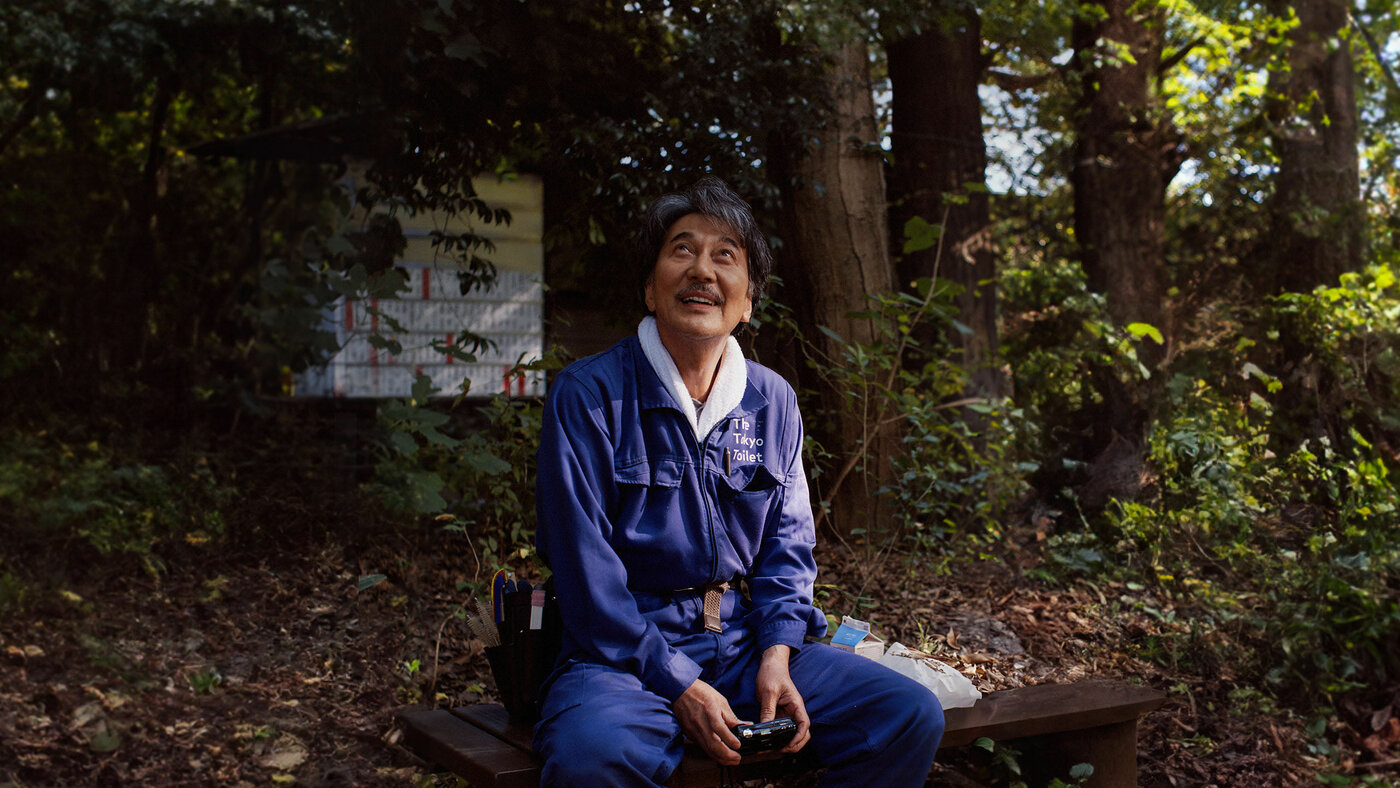
To understand Perfect Days, one must first take its central conceit seriously, which is something a good deal of its audience, charmed by the film’s warmth and reluctant to complicate their pleasure, has been understandably reluctant to do. Hirayama is not a simple man. He reads Faulkner and Patricia Highsmith by torchlight. He cultivates small trees from fallen seeds with the patience of a Zen gardener. He photographs the shifting light through tree canopies — komorebi, the Japanese word for that particular dappled luminescence, a word that, characteristically, has no direct English equivalent — on a film camera he winds manually. He is a man of cultivated interior life who has chosen, for reasons the film deliberately withholds, to live at the outermost margin of consumer society, cleaning the architecturally celebrated public toilets of the Tokyo Toilet Project with a concentration that borders on the devotional.
The temptation, for Western audiences especially, is to read Hirayama through the lens of romanticised Eastern philosophy — to see him as a walking kōan, a figure of Buddhist detachment who has achieved through renunciation what the rest of us frantically pursue through acquisition. This reading is not entirely wrong, but it is dangerously incomplete. Wenders, who has spoken in interviews about his long relationship with Japanese culture and his admiration for the films of Yasujirō Ozu, is too alert a filmmaker to offer simple beatification. There are silences in Hirayama’s life that are not peaceful but protective. There are questions, pressed upon him by his niece Niko and by the various figures who drift through his orbit, that he deflects with a courtesy that is also, unmistakably, a wall.
The philosopher Charles Taylor, in his landmark work Sources of the Self, distinguishes between what he calls “hypergoods” — the higher moral frameworks by which we orient our lives — and the “ordinary goods” of everyday experience. One of the central pathologies of modernity, Taylor argues, is the way in which the pursuit of hypergoods has severed us from ordinary goods: we have become so preoccupied with the grand narrative of self-actualisation that we have lost the capacity to inhabit the present moment. Hirayama, one might suggest, has performed this equation in reverse. His hypergoods are so thoroughly embedded in the textures of the ordinary — the first coffee from the vending machine, the warmth of sunlight on the walk to the van, the creak of the cassette deck — that the two cannot be separated. He does not live for something beyond the everyday. He lives entirely within it.
The Cassette Tape as Phenomenological Argument
Much has been made, rightly, of the music in Perfect Days. Each morning, Hirayama selects a cassette from the glove compartment of his cleaning van — Van Morrison’s Astral Weeks, Nina Simone, Patti Smith, The Animals, Lou Reed — and the choice functions less as soundtrack than as philosophical statement. These are not songs of resignation or retreat. They are songs of hunger, of searching, of a particular mid-twentieth-century yearning for something authentic beneath the noise of mass culture. That Hirayama listens to them on cassette tape — a format that requires physical commitment, that cannot be shuffled or skipped or algorithmically curated — is not nostalgic affectation. It is an argument about how to listen.
Walter Benjamin, in his essay “The Work of Art in the Age of Mechanical Reproduction,” worried that the infinite reproducibility of art would strip it of what he called its “aura” — the quality of singularity, of presence, of being here rather than everywhere. Cassette tape, of course, is itself a technology of mechanical reproduction, and Wenders is surely aware of the irony. But there is a distinction, phenomenologically speaking, between the cassette and the streaming playlist. The cassette imposes scarcity. It demands that you choose, and having chosen, that you commit. When Hirayama slides a tape into the deck and the opening notes of “Perfect Day” fill the cab of his van, the song is not background. It is an event.
This is the epistemological core of the film: that attention is not a passive capacity but an ethical practice. Hirayama’s photographs of komorebi are never shown to anyone. They accumulate in boxes in his small apartment, unpublished, unexplained. Their value is entirely in the making of them — in the act of looking, carefully, at something that most people walk past without seeing. Here Wenders is in conversation not only with Ozu, whose camera famously paused on objects and spaces after the human figures had left the frame, but with a broader tradition of phenomenological thinking, from Husserl’s notion of intentionality to Merleau-Ponty’s insistence that perception is not merely cognitive but bodily, relational, embedded in the world.
Wabi-Sabi and the Aesthetics of Impermanence
The Japanese concept of wabi-sabi — the aesthetic philosophy that finds beauty in imperfection, impermanence, and incompleteness — has been so thoroughly colonised by Western interior design discourse that it is now almost impossible to discuss without apology. And yet Perfect Days demands that we try. Hirayama’s apartment is not photographed as an aspirational lifestyle space. It is small, spare, and slightly worn in the way that lived-in spaces always are. His cassettes are battered. His camera is old. His potted seedlings are unremarkable. The point is not that these things are beautiful because they are imperfect, in the shallow Instagrammable sense of the term, but that they are his — that they bear the marks of duration and attention, that they exist in relationship with a specific human being across a specific span of time.
Mono no aware — often translated as “the pathos of things” — is the related aesthetic concept that animates the film’s emotional register. Usually attributed to the eighteenth-century scholar Motoori Norinaga, it describes a bittersweet sensitivity to the transience of things, an awareness that everything beautiful is also, always, passing. It is the feeling evoked by falling cherry blossoms, by the last note of a melody, by the face of someone you love caught in an unguarded moment. Wenders, working from a script co-written with Takuma Takasaki, builds this sensibility into the very grammar of the film: the recurring shots of canopy light that shimmer and dissolve, the sense that each day is both utterly like the last and utterly unrepeatable.
The film’s title, of course, carries its own freight. Lou Reed’s “Perfect Day” — one of the cassettes Hirayama plays — is a song that has always resisted easy interpretation. On its surface it describes a day of ordinary pleasures: a walk in the park, sangria, a movie, feeding animals. But it is a song shadowed by the knowledge that such days are rare and fragile, and that the person to whom it is addressed may not fully understand what they are being given. Wenders lifts the title from Reed and gives it a new valence: every day, in this film, is a perfect day, not because it is free from difficulty or loneliness, but because it is fully inhabited.
The Ghost in the Machine: Modernity’s Shadow
Perfect Days is not, despite its meditative surface, a film without conflict. Its antagonist is not a person but a condition: the condition of late capitalist modernity, with its relentless demand for productivity, connectivity, and narrative progress. This is most vividly embodied in Hirayama’s colleague Takashi — young, restless, perpetually on his phone, constantly scheming to make money quickly and escape the work he regards as beneath him. Takashi is not a villain; he is not even particularly unsympathetic. He is simply a man who has internalised the ambient logic of a society that measures worth by accumulation and velocity. Next to Hirayama, he appears not corrupt but impoverished — impoverished in the specific way that those of us who have never learned to stop are always impoverished.
The film’s most quietly devastating subplot involves Hirayama’s niece Niko, who arrives at his door having apparently fled her wealthy mother — Hirayama’s sister — and a life of material comfort that holds no meaning for her. Niko is young enough to still be romantically drawn to her uncle’s mode of being, and the scenes between them have a tenderness that Yakusho and the young actress Arisa Nakano communicate with extraordinary delicacy. But the film does not suggest that Niko will be able to simply choose Hirayama’s life. When her mother arrives — in a sleek car, with the air of someone for whom time is a resource to be optimised — the weight of class and expectation reasserts itself with a force that no amount of komorebi photography can dispel. Hirayama watches his sister drive away and stands for a moment in the street, and his face in that moment carries something we haven’t seen before: not contentment, but grief.
Yakusho and the Phenomenology of Performance
It would be remiss, in any serious engagement with Perfect Days, to understate the achievement of Kōji Yakusho’s performance, for which he won the Best Actor prize at Cannes in 2023 — a recognition that, given the competition, felt less like a prize than an acknowledgement of something almost beyond competition. Yakusho’s Hirayama is one of those screen performances so thoroughly inhabited that it ceases to register as performance. He does not signal his character’s interiority through the conventional architecture of dramatic acting — the swelling emotion, the explanatory dialogue, the meaningful glance. He simply is, in a way that is both technically extraordinary and philosophically apt, because the argument of the film is precisely that being, fully and attentively, is the hardest and most important thing a person can do.
This is a mode of performance one might call phenomenological realism: acting that does not represent interiority but embodies it, that makes the body itself the site of meaning rather than merely the vehicle for the face’s expressions. Yakusho’s way of wringing out a cleaning cloth, of parking his van with precise and practised care, of looking up at trees — these are not character notes. They are the character. The philosopher Gilbert Ryle warned against what he called the “ghost in the machine” — the Cartesian fantasy of a mind inhabiting a body as a pilot inhabits a plane. Yakusho’s Hirayama has no such division. He is, in every physical movement, entirely himself.
Why Now?
Perfect Days arrives at a peculiar cultural moment. We live, as we are constantly reminded, in an age of distraction: of doom-scrolling and notification alerts and the endless anxiety of the attention economy. The film’s celebration of slowness, of routine, of the radical sufficiency of the present moment, speaks directly to an exhaustion that many in its audience will immediately recognise. And yet the film is careful not to offer Hirayama’s life as a prescription. His choice — and it is, the film gradually makes clear, a chosen life, not merely an inherited one — is arrived at through some private reckoning that the film never fully discloses. It cannot simply be adopted, any more than enlightenment can be downloaded.
What the film offers instead is something more modest and more important: a recalibration of attention. For two hours, it asks us to look at the light coming through leaves, to listen to a cassette tape, to consider the precise and dignified labour of cleaning a public toilet. To take seriously the possibility that this — this ordinary, sufficient, irreplaceable day — might be enough. The question it leaves us with, as Hirayama drives toward work in the dawn light and tears begin, for reasons never specified, to move silently down his face, is not “Is this a good life?” but something harder: “What would it cost me to live one?”
It is a question that most of us, emerging from the cinema into the noise and speed of our ordinary lives, will find ourselves quite unable to answer. Which is precisely the point.
Perfect Days (2023), directed by Wim Wenders. Screenplay by Wim Wenders and Takuma Takasaki. Starring Kōji Yakusho. Winner, Best Actor, Cannes Film Festival 2023.
 My World of Interiors