
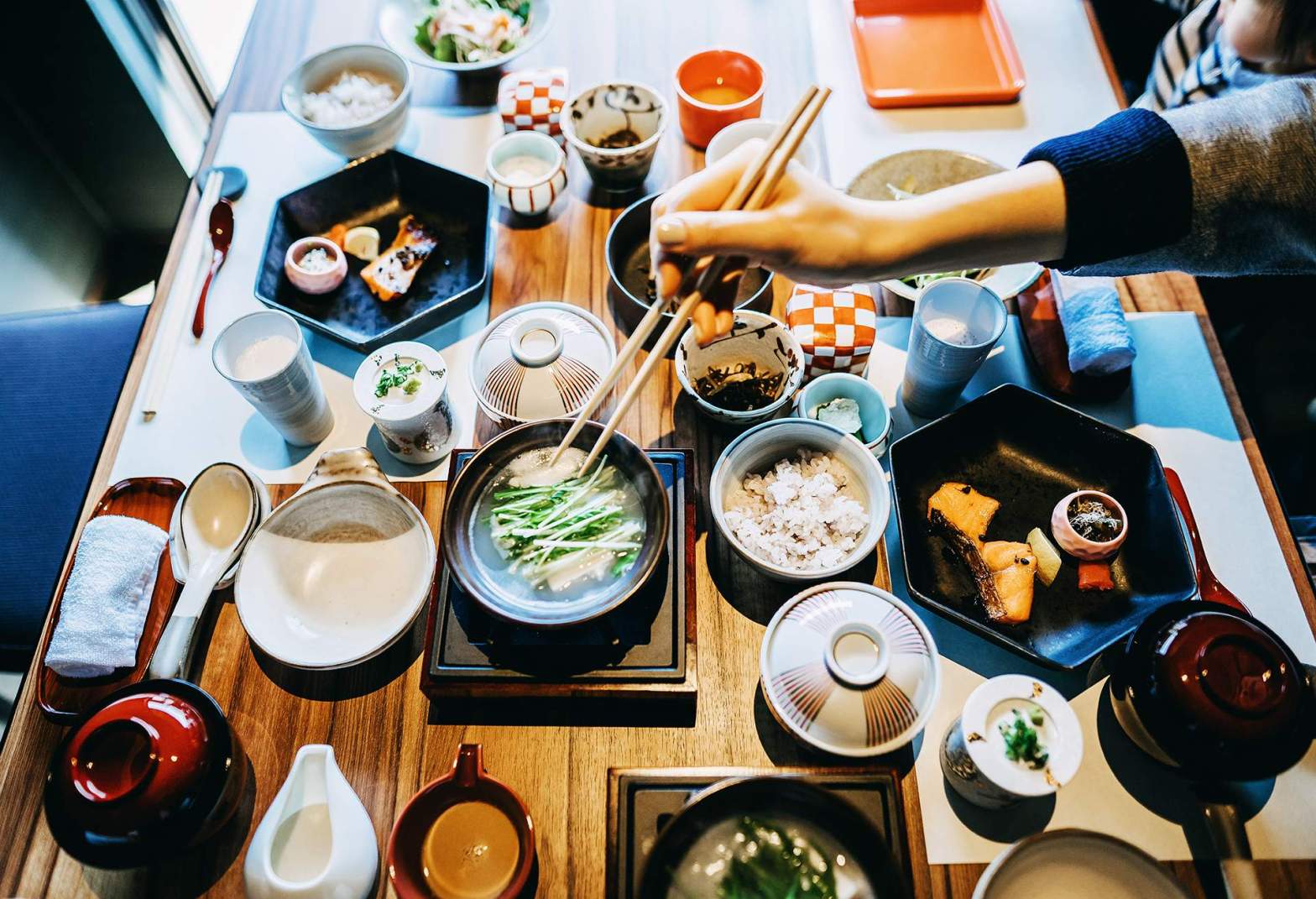
Japanese cuisine is less about invention than refinement — a philosophy that finds depth in simplicity, beauty in precision, and meaning in ritual. Rooted in seasonality (shun), harmony (wa), and respect for ingredients, it has shaped not only Asia’s culinary identity but the global language of taste itself. Its cornerstones — rice, dashi, umami, and the aesthetics of presentation — form one of the most profound culinary traditions in the world.
Rice as Foundation
Rice (gohan) is more than staple; it is sustenance, symbol, and measure of life itself. For centuries, it served as currency and offering, marking its place at the center of culture. From delicate sushi rice seasoned with vinegar to steaming bowls of plain white rice accompanying daily meals, it embodies the Japanese principle of purity and balance.
Dashi: The Invisible Broth
At the heart of Japanese cooking lies dashi, a stock traditionally made from kombu (kelp) and katsuobushi (bonito flakes). Clear, subtle, yet deeply savory, dashi provides the base for soups, sauces, and simmered dishes. Its genius is restraint: a liquid almost transparent, yet carrying the essence of umami — the “fifth taste” Japan gave to the world.
The Umami Principle
The discovery of umami, first identified by chemist Kikunae Ikeda in 1908, redefined taste globally. Found in miso, soy sauce, seaweed, and aged fish, it explains why Japanese cooking achieves depth without heaviness. More than a flavor, umami is a philosophy: the idea that satisfaction comes from harmony, not excess.
Sushi and Kaiseki
Sushi, born as a form of fish preservation, has become one of the world’s most recognisable dishes. At its best, it is the ultimate exercise in restraint: a single slice of raw fish balanced on rice, brushed with soy, presented with reverence. Kaiseki, Japan’s haute cuisine, extends this principle to multi-course meals that embody seasonality. Every dish, vessel, and garnish is chosen to reflect not only flavor but the fleeting beauty of nature.
Everyday Rituals
Japanese cuisine is also defined by daily rituals. The miso soup that begins a meal, the bento box arranged with care, the seasonal wagashi (sweets) that accompany tea — each moment is culinary art in miniature. Even convenience store onigiri reflect the national devotion to detail.
Aesthetic of Presentation
Presentation is never secondary. Food is arranged to balance color, shape, and proportion, often invoking landscapes or seasonal references. A lacquered bento, a porcelain sushi plate, a bamboo leaf wrapper — vessels and ingredients merge into one aesthetic whole.
The Eternal Table
What makes Japanese cuisine timeless is its philosophy: reverence for nature, devotion to season, and restraint in technique. It does not overwhelm; it refines. To sit at a Japanese table is to partake in a vision where food is not only nourishment but a way of seeing the world.
Five Essential Dishes of Japanese Cuisine
- Miso Soup
– A daily staple: dashi with miso paste, tofu, and seaweed, balancing savory warmth and subtlety.
– Recipe: Just One Cookbook - Sushi (Nigiri)
– The essence of precision: rice, raw fish, and minimal seasoning in perfect harmony.
– Recipe: Serious Eats - Tempura
– Seafood and vegetables dipped in a feather-light batter, fried to ethereal crispness.
– Recipe: NHK World Japan - Ramen
– Wheat noodles in broth — shoyu, miso, tonkotsu, or shio — a postwar street food elevated to global phenomenon.
– Recipe: Just One Cookbook - Matcha Wagashi
– Traditional sweets made with rice flour, bean paste, and seasonal motifs, designed for tea ceremony.
– Recipe: Japan Centre
Restaurants & Experiences
- Sukiyabashi Jiro, Tokyo – Legendary sushi temple.
- Kikunoi, Kyoto – Kaiseki dining at its most refined.
- Ippudo Ramen – Global ambassador of Japan’s ramen culture.
Producers & Shops
- Shirakiku Rice – Premium Japanese rice for home cooking.
- Marukome Miso – Traditional miso pastes for everyday cooking.
Cultural Institutions
- National Museum of Japanese History – For context on cuisine and culture.
- Urasenke Foundation – Preserving the Japanese tea ceremony tradition.
TL;DR
Japanese cuisine is philosophy on a plate: rice as foundation, dashi as soul, umami as principle. From sushi to ramen, kaiseki to wagashi, it embodies harmony, seasonality, and refinement. To taste it is to enter a culture where food is not excess but essence — a cuisine of eternal clarity.
Discover more from My World of Interiors
Subscribe to get the latest posts sent to your email.

