

If there is a single name that embodies the art of watchmaking as both precision and poetry, it is Patek Philippe. Founded in Geneva in 1839, the maison has become more than a watchmaker: it is a custodian of time itself, a family-owned institution that defines what it means to pass on not merely an object, but a legacy.
Beginnings in Geneva
The story begins with Antoni Patek, a Polish cavalry officer turned émigré, who partnered with French watchmaker Adrien Philippe, inventor of the keyless winding mechanism. Together they established a workshop dedicated not to quantity but to excellence, producing watches that married engineering with artistry. From its earliest commissions, Patek Philippe distinguished itself with complications — calendars, chronographs, minute repeaters — that turned telling time into intellectual craftsmanship.
Royal and Cultural Patrons
By the mid-19th century, Patek Philippe was supplying watches to aristocracy and royalty across Europe. Queen Victoria herself wore a Patek Philippe pendant watch at the Great Exhibition of 1851. Over the decades, clients have included Tolstoy, Albert Einstein, Paul McCartney, and countless statesmen. But the maison’s appeal extends beyond celebrity: it has always positioned itself as heirloom maker, its slogan — “You never actually own a Patek Philippe. You merely look after it for the next generation” — encapsulating a philosophy of time as inheritance.
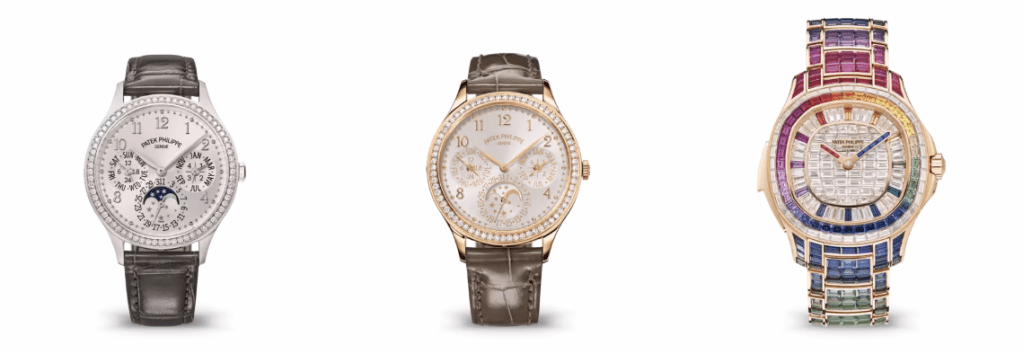
Complications as Art
What distinguishes Patek Philippe from other watchmakers is its devotion to complications — mechanisms that go beyond simple hours and minutes. Perpetual calendars, split-second chronographs, moon-phase indicators, and minute repeaters are not functional necessities but mechanical symphonies. The Calibre 89, created for the maison’s 150th anniversary in 1989, remains one of the most complicated watches ever built, with 33 complications and 1,728 components.
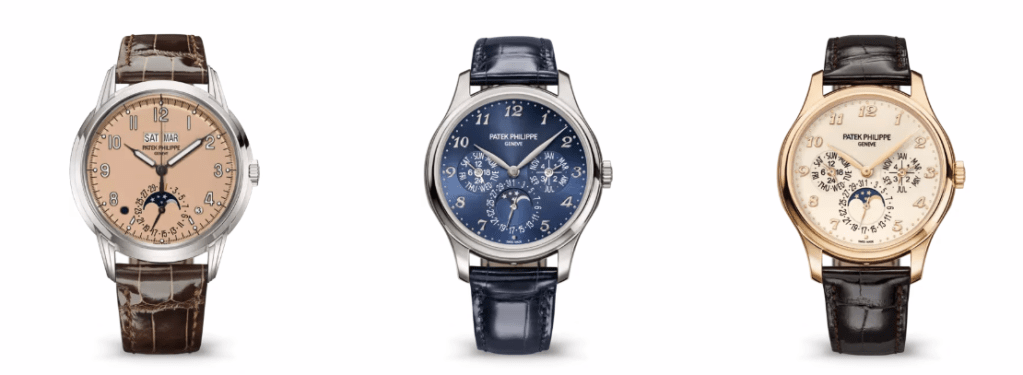
Icons of Style
Among collectors, several models have achieved cult status:
- Calatrava (1932): The quintessential dress watch, defined by Bauhaus purity.
- Nautilus (1976): Designed by Gérald Genta, it redefined the luxury sports watch with its porthole case and integrated bracelet.
- Aquanaut (1997): A younger sibling to the Nautilus, sporty and contemporary.
- Grand Complications: From perpetual calendars to tourbillons, the apex of horological artistry.
Each reflects a philosophy of timelessness: watches designed not for trend but for permanence.
Family Ownership and Independence
In an era when most haute horlogerie houses have been absorbed by conglomerates, Patek Philippe remains family-owned, under the stewardship of the Stern family since 1932. This independence allows it to pursue long-term excellence rather than short-term profit, ensuring consistency of design, craft, and philosophy.
Collecting and Cultural Capital
At auction, Patek Philippe reigns supreme. The Henry Graves Supercomplication, commissioned in 1925, sold for over $24 million at Sotheby’s in 2014. More recently, the Grandmaster Chime Ref. 6300A — created for charity — fetched $31 million at Christie’s in 2019, making it the most expensive watch ever sold. To own a Patek is to hold cultural capital: engineering, rarity, and symbolism in one.
Legacy Beyond Time
What makes Patek Philippe extraordinary is not just mechanical mastery but the way it frames time itself. A Patek is designed to outlast its wearer, to be worn by children and grandchildren. It is an object where craftsmanship meets philosophy, reminding us that while hours pass, artistry endures.
Five Signature Models of Patek Philippe
- Calatrava (1932)
– Elegant, minimalist, round case — the archetype of the modern dress watch.
– Patek Philippe Calatrava - Nautilus (1976)
– Gérald Genta’s masterpiece, a luxury sports watch in stainless steel.
– Patek Philippe Nautilus - Aquanaut (1997)
– Contemporary, rubber strap, youthful spin on the Nautilus.
– Patek Philippe Aquanaut - Perpetual Calendar Chronograph
– Iconic complication pairing; symbol of Patek’s mastery.
– Grand Complications - Grandmaster Chime (2014)
– The pinnacle: 20 complications, two dials, a case that flips. Record-breaking at auction.
– Patek Philippe Grandmaster Chime
Where to See Patek Philippe
- Patek Philippe Museum, Geneva – Houses over 2,000 watches, from early timepieces to modern masterpieces.
- Christie’s Watches – Auctions where Pateks routinely set records.
- Phillips Watches – Renowned for sales of rare and vintage models.
Further Reading
- Patek Philippe: Cult Object and Investment by J. Michael Mehltretter.
- Patek Philippe: The Authorized Biography by Nicholas Foulkes.
TL;DR
Patek Philippe is more than a watchmaker: it is a philosophy of time, inheritance, and artistry. From the Calatrava to the Nautilus, from Queen Victoria to record-breaking auctions, it has remained family-owned and fiercely independent — a maison where each watch is not only a measure of hours, but a legacy of eternity.
 My World of Interiors