
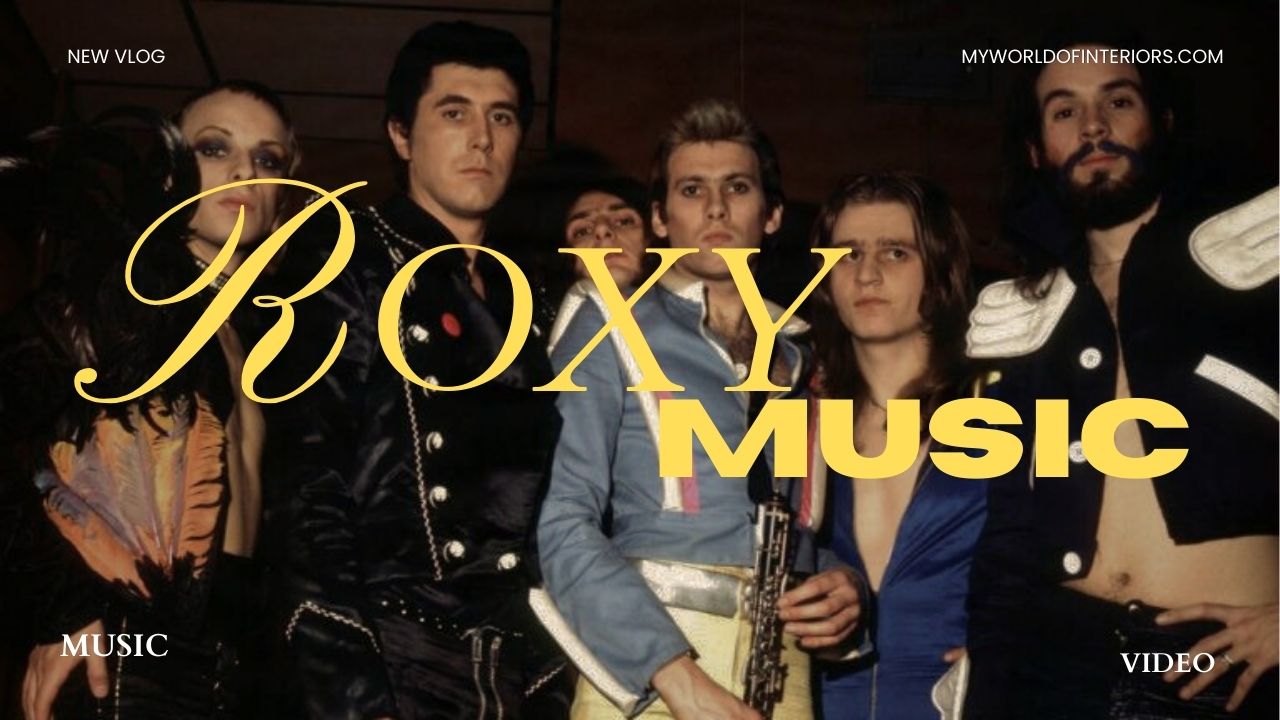
When Roxy Music appeared in 1972, they seemed less like a band than a cultural apparition. Emerging from Britain’s art school ferment, they fused glam rock’s theatricality with avant-garde experimentation, crafting a vision of music as both spectacle and intellectual provocation. Bryan Ferry, the band’s frontman, did not simply sing—he crooned with a studied detachment, half lounge singer, half futurist poet. Together with Brian Eno’s sonic wizardry, Phil Manzanera’s guitar work, Andy Mackay’s oblique saxophone lines, and Paul Thompson’s thunderous drumming, Roxy Music blurred the lines between rock band and conceptual art project.
Art School Origins
The early 1970s in Britain were fertile ground for hybridity. Ferry studied at Newcastle University under Richard Hamilton, one of the fathers of Pop Art, and absorbed the idea that style could be substance, that surface could be as radical as content. Roxy Music’s debut album Roxy Music (1972), with its pin-up style cover and surrealist collages of sound, was less an entry into rock than an act of cultural disruption.
Songs such as Re-Make/Re-Model and Ladytron demonstrated their dual allegiance: to rock ’n’ roll energy and to the conceptual experimentation of the avant-garde. They wore glam’s glitter, but beneath it ran a current of irony, of knowing artifice.
Glamour Meets Experiment
From the beginning, image was inseparable from sound. Ferry, clad in tuxedos and satin shirts, styled himself as the last decadent crooner of a bygone age. Eno, by contrast, appeared in feather boas, sequins, and makeup, an alien presence coaxing strange electronic textures from his synthesizers and tape machines.
The tension between these poles—Ferry’s suave nostalgia and Eno’s radical futurism—was the engine of their early brilliance. Albums such as For Your Pleasure (1973) and Stranded (1973) became cult classics, producing singles like Do the Strand and Street Life, that combined pop accessibility with artful subversion.
Reinvention and Elegance
When Eno departed in 1973, many predicted the end of Roxy Music’s avant-garde edge. Yet the band evolved rather than collapsed. Ferry, increasingly at the helm, steered Roxy toward a more refined, elegant sound. By the mid-1970s, albums like Siren (1975) showcased hits such as Love Is the Drug—a sleek, sophisticated slice of pop that proved their ability to seduce mainstream audiences without abandoning artfulness.
By the early 1980s, Roxy Music had fully transformed into the epitome of cultivated glamour. Their final studio album, Avalon (1982), with its lush textures and atmospheric production, embodied a new kind of sophistication—romantic, cinematic, and cosmopolitan. More Than This, the lead single, remains an anthem of longing and refinement, often cited as one of the era’s most enduring songs.
Cultural Impact
Roxy Music’s influence extends far beyond the charts. They shaped the aesthetics of glam rock, new wave, and synthpop, directly inspiring artists from David Bowie to Duran Duran, Talking Heads to Lady Gaga. Ferry’s cultivated cool presaged the rise of the rock frontman as style icon, while Eno’s innovations helped lay the groundwork for ambient and electronic music.
Their album covers—often featuring models styled in glamorous, hyper-staged poses—reinforced their ethos: music as a total aesthetic environment, as much about image and mood as sound. Roxy Music did not just release records; they curated worlds.
Legacy of Seduction
When the band reunited for tours in the 2000s, audiences responded not just with nostalgia but with awe at the enduring relevance of their sound and style. In 2019, Roxy Music was inducted into the Rock & Roll Hall of Fame, affirming their place as one of the most innovative bands of the twentieth century.
At their core, Roxy Music offered more than music. They offered a vision of glamour as performance, of elegance as artifice, of desire as something both ironic and sincere. They seduced their listeners into a world where pop could be intellectual, where experimentalism could be sensual, and where the boundary between art and life dissolved into velvet smoke.
In the end, Roxy Music’s legacy is not merely sonic. It is atmospheric, cultural, eternal. They made pop music feel like couture, and couture feel like pop.
 My World of Interiors