
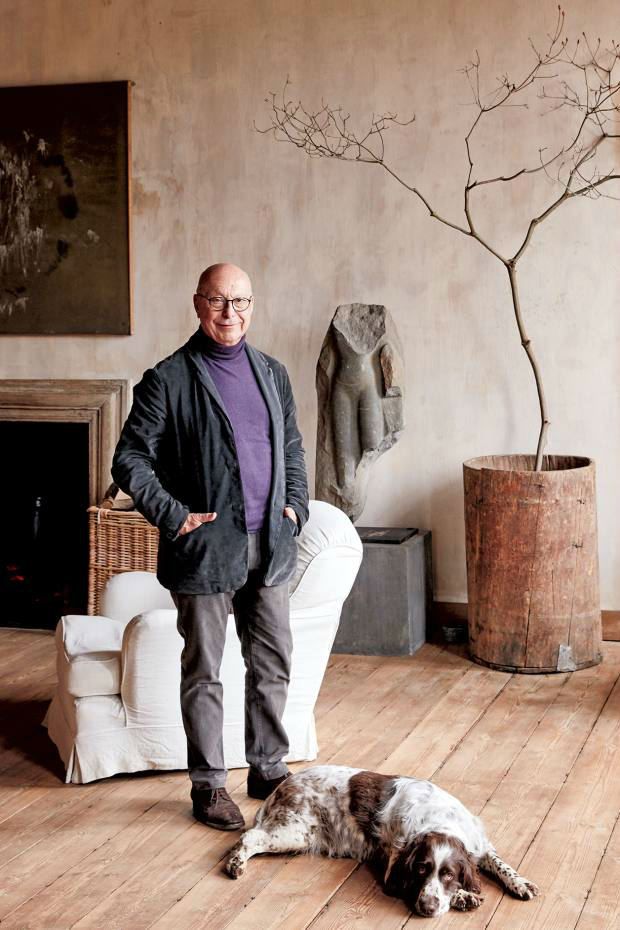
There are interior designers, and then there are philosophers who happen to work with furniture and space. Axel Vervoordt belongs to the latter. For more than half a century, the Belgian designer, collector, and dealer has cultivated a vision of interiors as places of contemplation. His aesthetic — part wabi-sabi, part European antiquarianism, part avant-garde minimalism — has shaped not only homes and galleries but also an entire philosophy of living.
Origins in Antwerp
Born in 1947, Vervoordt grew up in Antwerp, a city with a rich mercantile and artistic history. He began as an antiques dealer in the late 1960s, with a particular eye for overlooked objects: humble wooden stools, fragments of stone, weathered pottery. For Vervoordt, patina was not damage but history, an index of time’s passage. His early career taught him to see beauty in imperfection — a conviction that would later link him to Japanese wabi-sabi aesthetics and to contemporary minimalism.
In 1969, he and his wife May founded the Axel Vervoordt Company. From the beginning, it was more than a showroom; it was a universe, a space where antiquity met modernity and each object was chosen for its aura, not its market value.
A Philosophy of Space
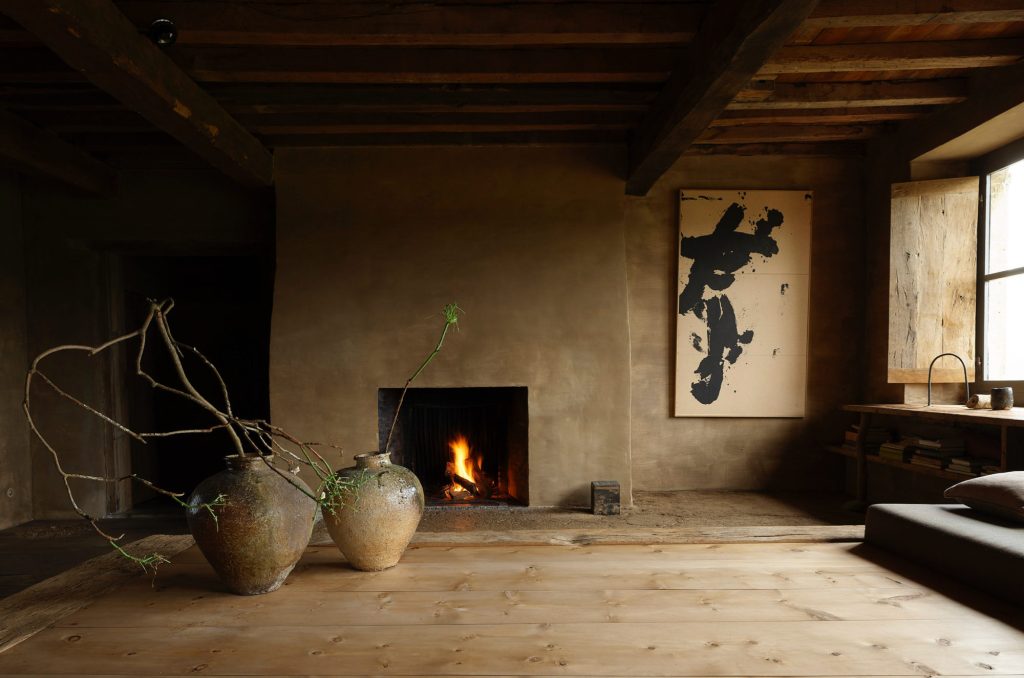
Vervoordt’s interiors are instantly recognizable: plaster walls in chalky whites, rough-hewn beams, unvarnished wood, ceramics in muted tones, a single canvas or sculpture placed with precision. These are not rooms designed to impress with opulence; they are spaces meant to slow time, to encourage reflection.
He often cites his love of emptiness — not absence, but fullness of possibility. Light and shadow are as important as furniture. Negative space becomes an active element. In this, Vervoordt’s work recalls both Zen temples and Flemish still-life paintings: austere, sensuous, spiritual.
Collecting as Art
Beyond interiors, Vervoordt is a legendary collector and curator. He championed artists such as Lucio Fontana, Anish Kapoor, James Turrell, and Gutai painters long before they were market darlings. His exhibitions at the Palazzo Fortuny in Venice (Artempo: Where Time Becomes Art, 2007; TRA: Edge of Becoming, 2011) were celebrated for dissolving the boundaries between art, design, and philosophy.
For Vervoordt, collecting is never about accumulation but about dialogue. A Roman bust might sit next to a contemporary sculpture, a medieval tapestry beside a raw linen curtain. Time collapses, and the objects speak across centuries.
The Kanaal Project
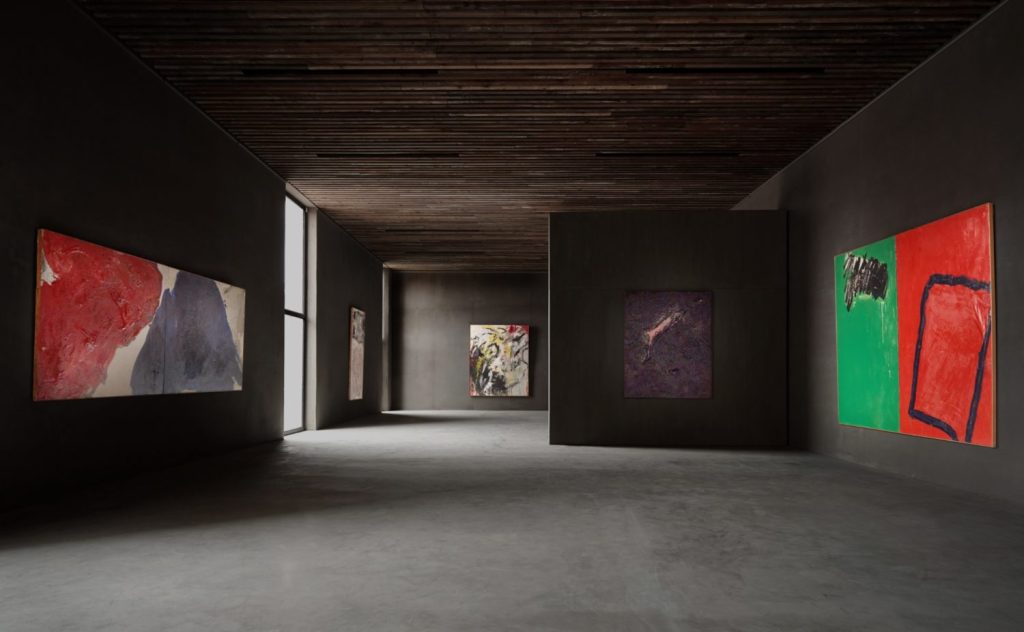
Perhaps his most ambitious undertaking is Kanaal, a former distillery and malting complex near Antwerp that Vervoordt has transformed into a cultural hub. Part gallery, part residential development, part think tank, Kanaal embodies his belief that art and life should not be separate domains. The spaces are monumental yet intimate, housing both his family’s collection and international exhibitions.
Kanaal is also an experiment in community: a place where art collectors, residents, and visitors gather around shared experiences of beauty and reflection. In many ways, it is the physical manifesto of Vervoordt’s philosophy.
Celebrity Clientele and Global Reach
Over the years, Vervoordt’s vision has attracted a formidable roster of clients. He designed spaces for Kanye West and Kim Kardashian, creating the much-discussed “monastic” Los Angeles home defined by pale plaster, flowing corridors, and near-total reduction of ornament. He has worked for Sting and Trudie Styler, Calvin Klein, and countless collectors across Europe, the U.S., and Asia.
Yet even when working for celebrities, Vervoordt resists flash. He gives his clients not spectacle but serenity — an antidote to excess, a reminder that luxury can mean silence and emptiness.
Publications and Influence
Vervoordt’s philosophy has been articulated in books such as Wabi Inspirations (2010), Axel Vervoordt: Portraits of Interiors (2019), and Stories and Reflections (2020). Each volume reveals the consistency of his vision: the belief that interiors should be timeless rather than trendy, soulful rather than showy.
His influence radiates widely. The vogue for plastered walls, natural materials, and patinated objects in contemporary design owes much to his example. He bridged the worlds of antiquarian eclecticism and minimalist restraint, creating a hybrid style that has become a global language of understated luxury.
Selected Works & Projects
- Kanaal, Belgium – A converted distillery turned cultural campus, uniting art, design, and community.
Visit: http://www.axel-vervoordt.com/kanaal - Palazzo Fortuny Exhibitions, Venice – Artempo: Where Time Becomes Art (2007) and TRA: Edge of Becoming (2011), landmark shows merging antiquity and avant-garde.
Visit: http://www.axel-vervoordt.com/exhibitions - Kanye West & Kim Kardashian Residence, Los Angeles – A collaboration that produced one of the most discussed celebrity homes of the 21st century.
Overview: Architectural Digest - Sting & Trudie Styler Residence – Interiors blending historic architecture with contemporary restraint.
Feature: AD Italia (archival coverage) - Books – Wabi Inspirations (2010), Axel Vervoordt: Portraits of Interiors (2019), Stories and Reflections (2020).
Available: http://www.axel-vervoordt.com/publications
A Legacy of Stillness
To enter an Axel Vervoordt space is to experience design as atmosphere. Nothing clamors for attention, yet everything resonates. A weathered stool, a shard of marble, a shaft of light across a wall — together they create a harmony that feels less decorated than composed, like music.
In a culture addicted to noise and novelty, Vervoordt’s achievement has been to cultivate silence and permanence. He reminds us that beauty lies not only in acquisition but in perception, in the willingness to pause and attend to what time has already given.
TL;DR
Axel Vervoordt is more than a decorator or dealer; he is a philosopher of space. His career demonstrates that design can be a form of meditation, that collecting can be a form of dialogue, and that the most radical luxury is not abundance but simplicity.
In the end, Vervoordt has not only shaped interiors but also redefined how we think about them: not as backdrops for life, but as living presences in themselves.
To learn more: https://www.axel-vervoordt.com/
 My World of Interiors