
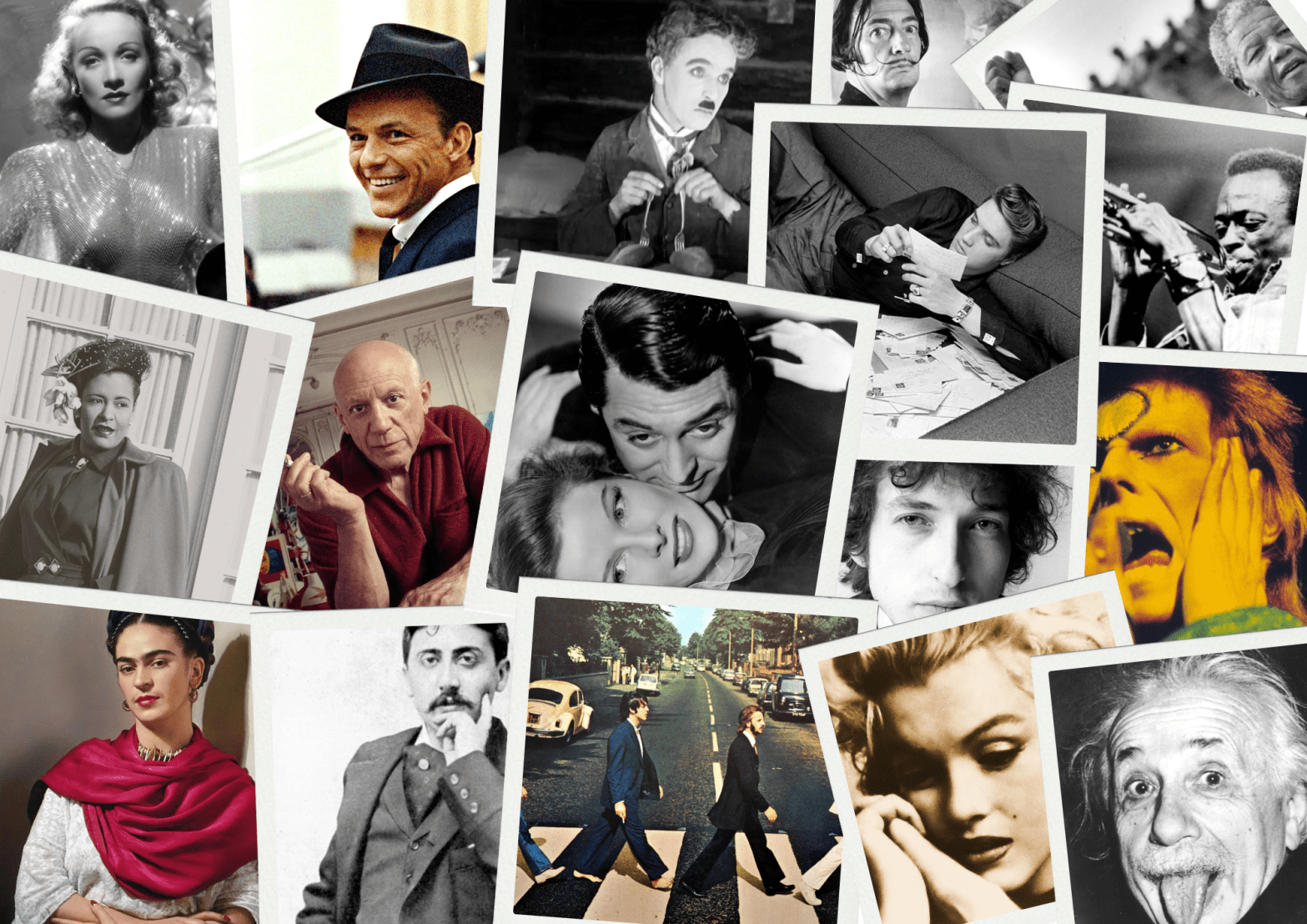
On the Making of Modern Stardom
The twentieth century did not merely produce stars; it manufactured the conditions in which stardom could exist. A set of new technologies—cinema, radio, the LP, television—met a set of modern habits: mass attention, reproducible image, a hunger for personality that could stand in for the unruly whole of culture. The machinery mattered (studio publicity, glossy magazines, talk shows), but the machine alone could never explain why one performer or thinker bent the world’s attention while another did not. A star is not simply someone widely known; a star is someone whose presence becomes a form of knowledge—an argument about how to look, listen, dress, love, rebel, believe.
Call it charisma, aura, magnetism—the language has always been approximate. The star’s force exceeds talent but never escapes it; the charisma is inseparable from a set of formal decisions. Chaplin’s walk is a theory of timing. Hepburn’s vowels are a theory of character. Dylan’s phrasing is a theory of history. Kahlo’s self-portrait is a theory of self. The audience, for its part, is not passive; we complete the figure. We read into Monroe what we wish to know of vulnerability; we enlist Ali to do our boasting; we draft Bowie for the freedoms we cannot yet claim. Stardom is a collaboration between a singular temperament, the available media, and a public that needs symbols as much as it needs facts.
The twentieth century also expanded the category of who could be a star. The model migrated from film to jazz clubs, fashion houses, artist studios, political pulpits, even laboratories. Einstein, whose hair was its own emblem, proved that intellect could be photogenic; Maria Callas that rigor could be scandalous; Simone de Beauvoir that criticism could be glamorous. If celebrity is a measure of visibility, stardom is a measure of consequence—how a figure alters the forms they work in, and how those altered forms change our sense of what is possible.
This roster is a map, not a census (I for one love many more, Hemingway being one): one hundred figures whose work and persona shaped the century’s cultural weather. It privileges impact over popularity, style over mere fame, and durability over momentary fashion. It is unapologetically cross-disciplinary and global, with special attention to European cinema (whose directors, actors, and movements remade the grammar of film). Omissions are inevitable; arguments are the point. What remains, across nations and mediums, is the feeling that certain people did not just make art or ideas—they made light.
Cinema (35)
1. Charlie Chaplin — He turned poverty and grace into a universal language; the Tramp’s walk is as legible as scripture, and almost as consoling.
2. Greta Garbo — Stardom by subtraction: a face that withheld as much as it gave, making privacy itself a form of glamour.
3. Marlene Dietrich — Irony draped in satin; she made androgyny chic and desire an analytic instrument.
4. Bette Davis — The flintiest intelligence in the classical studio system; her eyes weren’t windows so much as verdicts.
5. Katharine Hepburn — Yankee modernity with a patrician lilt; she gave the century a blueprint for female will.
6. Cary Grant — Self-invention perfected: Archie Leach refashioned himself into the grammar of charm.
7. Orson Welles — The prodigy who made authorship a public spectacle; Citizen Kane is still a lesson plan disguised as a melodrama.
8. Alfred Hitchcock — Anxiety’s great choreographer; he taught audiences how to be complicit.
9. Jean Renoir — Humanism with a camera: his deep focus was moral as much as optical.
10. Luis Buñuel — Surrealism’s most lucid mind; he made the dream life indict the waking one.
11. Federico Fellini — The ringmaster of memory; his circus was autobiography rendered as national myth.
12. Michelangelo Antonioni — He filmed the modern void and made alienation look architectural.
13. Luchino Visconti — Aristocratic decadence anatomized with operatic exactitude.
14. Roberto Rossellini — Neorealism’s conscience; he turned rubble into ethics.
15. Vittorio De Sica — Compassion as technique; Bicycle Thieves remains the cinema’s secular gospel.
16. Ingmar Bergman — Faith’s great skeptic; he gave metaphysics the intimacy of a close-up.
17. Akira Kurosawa — An epic classicist; his moral clarity traveled across languages, studios, and centuries.
18. Yasujirō Ozu — The poet of the horizontal line; stillness as revelation.
19. Satyajit Ray — A humanist cartographer of feeling; he brought Bengali life to the world without translation’s loss.
20. Sergei Eisenstein — Montage as thought; he taught cinema how to think in cuts.
21. Andrei Tarkovsky — Time’s mystic; he printed dreams directly onto the emulsion.
22. François Truffaut — Nouvelle Vague tenderness; cinephilia raised into autobiography.
23. Jean-Luc Godard — The sentence fragment as revolution; he broke film to see what else it could say.
24. Alain Resnais — Memory’s architect; his puzzles dignify confusion.
25. Agnès Varda — The movement’s conscience and its wit; she made the essay a feature-length form.
26. Carl Theodor Dreyer — Ascetic fury; The Passion of Joan of Arc remains cinema’s most chastening close-up.
27. Werner Herzog — Romanticism with a machete; he filmed obsession until it looked like nature.
28. Sophia Loren — Earthly glamour with comic intelligence; she made amplitude a virtue.
29. Marcello Mastroianni — Melancholy’s most elegant mask; he walked the tightrope between irony and ache.
30. Catherine Deneuve — Ice made incandescent; reserve as a philosophy of desire.
31. Jeanne Moreau — The face of thought; she made consciousness erotic.
32. Ingrid Bergman — Moral radiance; her luminosity argued that goodness could be interesting.
33. Marilyn Monroe — Vulnerability as an art form; she weaponized softness against a hard world.
34. James Dean — Three films, one archetype; youth’s permanent flinch.
35. Marlon Brando — He changed how acting sounded in the mouth and sat in the body; American naturalism begins and ends with him.
Music (23)
36. Louis Armstrong — He put swing into the bloodstream; his trumpet made joy a serious subject.
37. Duke Ellington — Orchestral jazz as civilization; his suites were cities with nightfall built in.
38. Billie Holiday — She bent time until it confessed; pain rendered with sovereign restraint.
39. Ella Fitzgerald — Virtuosity without vanity; the voice as immaculate architecture.
40. Charlie Parker — Speed as thought; he invented a modernity that left gravity behind.
41. Thelonious Monk — Dissonance as candor; his silences were part of the beat.
42. Miles Davis — Restless authority; each reinvention reset the compass for everyone else.
43. John Coltrane — Ascension as practice; he made the saxophone a searchlight.
44. Nina Simone — The concert hall as tribunal; she demanded that beauty have consequences.
45. Édith Piaf — Torch song as destiny; Paris compressed into a single cry.
46. Elvis Presley — A cultural fault line; the amalgam of Black music and white appetite that reconfigured the marketplace.
47. The Beatles — Collective genius with a backbeat; modern pop’s laboratory.
48. Bob Dylan — The American sentence unspooled across chords; he licensed ambiguity for radio play.
49. Joni Mitchell — The diary as prosody; she made harmony a form of thought.
50. Aretha Franklin — Authority incarnate; her voice didn’t ask for a throne—it was one.
51. Maria Callas — Operatic drama as autobiography; phrasing sharpened into scandal.
52. Igor Stravinsky — He detonated the concert hall and rebuilt it with new math.
53. Leonard Bernstein — Maestro as explainer; he made the canon feel metropolitan.
54. David Bowie — Identity as composition; he scored the idea of change.
55. Fela Kuti — Groove as dissent; Lagos became a doctrine.
56. Bob Marley — A planetary vernacular; liberation set to off-beat guitar.
57. Frank Sinatra — Intimacy engineered for microphones; he crooned as if confiding a crime.
58. Johnny Cash — The country baritone as moral witness; freighted simplicity.
Art & Photography (17)
59. Pablo Picasso — A career in phases that felt like eras; he made invention look inevitable.
60. Henri Matisse — Color as forgiveness; cut-outs that taught us how to breathe.
61. Marcel Duchamp — The readymade as grenade; after him, ideas had studio space.
62. Salvador Dalí — Precision applied to delirium; he popularized the subconscious like a press agent.
63. Frida Kahlo — Self-portraiture as cosmology; pain translated into heraldry.
64. Georgia O’Keeffe — Monumentality at intimate scale; the desert became a discipline.
65. Jackson Pollock — Gesture as ontology; the floor as battlefield.
66. Mark Rothko — Radiant fields that behave like moods; abstraction with pastoral gravity.
67. Louise Bourgeois — Memory’s sculptor; the body rendered as an architectural problem.
68. Andy Warhol — Repetition as critique; he turned fame into a medium and the market into a mirror.
69. Piet Mondrian — The grid as ethics; modernism’s quiet tyrant.
70. Henri Cartier-Bresson — The decisive moment as civic virtue.
71. Diane Arbus — A new frankness; she photographed the American id with clinical tenderness.
72. Richard Avedon — Fashion as anthropology; the studio backdrop became a stage for character.
73. Gordon Parks — Camera as citizenship; elegance pitched against injustice.
74. Dorothea Lange — The Depression’s visual conscience; documentary made indelible.
75. Diego Rivera — Muralism as public pedagogy; politics frescoed into daily life.
Literature & Criticism (15)
76. James Joyce — He turned the novel into a machine that could record consciousness in real time.
77. Virginia Woolf — The sentence as tide; she made domestic space a metaphysical site.
78. T. S. Eliot — Tradition scrambled and reassembled; modern piety with a broken meter.
79. Franz Kafka — Bureaucracy revealed as theology; our century’s patron saint of anxiety.
80. Marcel Proust — Memory’s epic; sensation offered as evidence.
81. Jorge Luis Borges — Infinity domesticated; he taught the short story to think like philosophy.
82. Gabriel García Márquez — The marvelous made local; Macondo as a second homeland.
83. Vladimir Nabokov — Malice set to music; style as sovereign law.
84. Samuel Beckett — Comedy at the heat-death of language.
85. Albert Camus — Clarity on the edge of the void; ethics without illusions.
86. Jean-Paul Sartre — Existentialism’s impresario; he made the café a faculty.
87. Simone de Beauvoir — Feminism as metaphysics; she recalibrated modern freedom.
88. Toni Morrison — American memory re-authored; her cadences remade the archive.
89. Italo Calvino — Lightness with engineering; the combinatorial novel as play.
90. Roland Barthes — Criticism as literature; he taught us how to read the weather of images.
Science, Ideas, and Public Life (10)
91. Albert Einstein — Theory rendered iconic; relativity became a lay metaphor because he was one.
92. Marie Curie — Radiance literal and figurative; she fused scientific rigor with public myth.
93. Alan Turing — Computation’s founding fable; a war hero whose afterlife is the century’s infrastructure.
94. Rosalind Franklin — Clarity at the atomic scale; her X-rays remain a moral document as well as a scientific one.
95. Jonas Salk — The vaccine as civic miracle; he refused to patent the sun.
96. Rachel Carson — Environmentalism’s lyric brief; she taught policy how to feel.
97. Martin Luther King Jr. — Rhetoric as nonviolent force; he re-tuned the nation’s ear to justice.
98. Mohandas K. Gandhi — Political asceticism; a new technology of mass conscience.
99. Nelson Mandela — Carceral time converted into authority; reconciliation as statesmanship.
100. Hannah Arendt — Political thought with novelist’s nerve; she named our nightmares and gave us a lexicon for them.
Coda
What the century learned from its stars is not simply how to adore but how to organize attention—how to attach ideas to faces, ethics to styles, futures to postures. The figures here did not only master their mediums; they expanded what the mediums could mean. If stardom is an art, it is the art of concentrating the era’s contradictions into a figure who can carry them without breaking—until, of course, they do. The light was never theirs alone; it was borrowed from us, then returned with interest.
 My World of Interiors