

Murano glass is more than artisan craft—it’s a living archive of Venetian science, design and family dynasties. Its history spans centuries of technical breakthroughs and stylistic revolutions. Below is an in-depth account of its origins, major firms, technique, and how to authenticate and collect.
To explore further on our Amazon store front: CLICK HERE
Origins & Early History
From Roman times and early Venetian workshops, glassmaking in Venezia refined over centuries. In 1291, the Venetian Republic mandated that all glass furnaces move from Venice proper to the island of Murano—to both reduce fire risk in the wooden buildings and to concentrate glass-making knowledge.
Murano’s guilds, privileges, export control, and secrecy fostered an environment where intensely refined techniques could develop: cristallo (clear, colorless glass), lattimo (opaque white), filigree, reticello, murrine, etc.
Through the Renaissance, Venetian glass was prized in courts across Europe, both for utility (glasses, bottles), for ecclesiastical use, and, increasingly, artistic and decorative objects.
Techniques & Material Innovations
Below are key techniques that define the Murano tradition. Many of them were once state secrets, or tightly held by certain families or furnaces.
- Cristallo: The “Venetian crystal” of the fifteenth century—colorless, high transparency (no lead or arsenic). Angelo Barovier was granted exclusive rights to make this from ~1455.
- Lattimo: Opaque white glass (“milk glass”) used often in juxtaposition with transparent cristallo pieces.
- Filigrana / Zanfirico / Reticello: Cane (glass rods) techniques producing striped or net-like (reticello) motifs.
- Murrine / Millefiori: Sections of patterned canes fused into slabs or elements, then sliced and incorporated into final works.
- Avventurina: Inclusion of copper-crystal or metallic particles to create sparkle.
- Sommerso: Layers of different coloured glass submerged beneath clear overlays; often associated with 20th-century glass aesthetics.
- Pulegoso: Intentional bubbles, texture, semi-porous surface effects; sculptural.
Dynasties, Houses & Their Contributions
Here are major Murano glassmakers—some ancient, others more modern—with what makes each distinct, and links.
Barovier & Toso
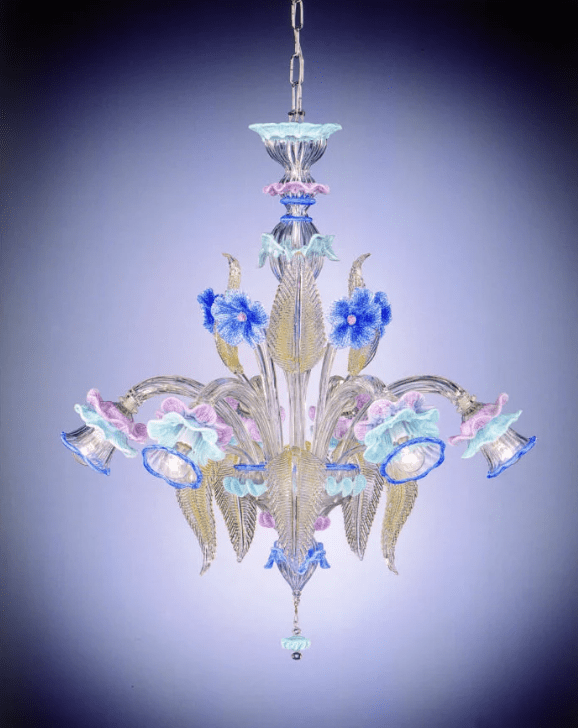
Traces back to the Barovier family around 1295; Angelo Barovier’s fifteenth-century work (especially cristallo) set standards. The “Barovier & Toso” name used after a merger with the Toso family in the 20th century. Known for Venetian Crystal (lead-free cristallo), chandeliers, lighting, table lamps, decorations; maintaining historic transparency, purity, and craftsmanship. The Barovier & Toso website is a good source for current collections and history.
Seguso
Family tradition since 1397; Seguso Vetri d’Arte (established 1933) revived many old techniques; today operates in glassware, lighting, interior commissions. Signature for exquisite murrine, decorative sculptural work, lighting; custom installations; balancing historic and modern styles. More information at Seguso’s website.
Venini
Founded in 1921 by Paolo Venini with Giacomo Cappellin; marked Murano’s re-engagement with modern design through collaborations with architects and designers. Signature styles include sommerso, masterglass sculpture, colored lighting, and pieces combining designer visions and artisan skill. The Venini site showcases many current and archival pieces.
Archimede Seguso
Part of the Seguso family; born 1909, influential in 20th-century Murano glass, especially for sculptural objects, heavy glass effects, and unique design exhibits. Known for animal forms, thick glass, expressive colour. Visit Archimede Seguso for gallery and biography.
Institutions & Research
These are vital for scholarship, comparing authentic works, seeing stylistic evolution:
- Museo del Vetro (Glass Museum), Murano: large chronological collection from Roman glass to modern Murano; excellent for comparing styles and maker signatures.
- Le Stanze del Vetro, Venice (San Giorgio Maggiore): Focused on 20th- & 21st-century Murano / Venetian glass & design; exhibitions, archives, study centre.
Collector’s Appendix: How to Read Signatures, Marks, & Date Periods
Factory Marks, Signatures, & Labels
- Many authentic Murano pieces bear etched or acid-etched signatures: furnace name, artist/designer, sometimes series or model.
- Vetro Artistico® Murano trademark is managed by Consorzio Promovetro. Labels/QR codes certify that an item was made on Murano by authorized workshops.
- Old furnace labels (often paper or decal) can help date a piece; newer adhesive or transparent labels are used today.
Dating Styles & Period Glossary
| Period | Years | Style Cues / Techniques |
|---|---|---|
| Renaissance / Early Venetian | 15th-16th c. | Cristallo; lattimo; early filigree; enamels; gold; colored glass decorations |
| 17th-18th c. | 1600s-1700s | Filigree / reticello; murrine; mosaic influences; colored crystals; baroque forms |
| 19th c. / Revival Period | ~1850-1900 | Industrial export; revival of classic techniques; increased clarity; mosaics, table decorations |
| Early 20th c. / Modernism | 1900-1945 | Bold color; artist collaborations; experimentation (avventurina, heavy glass); beginnings of sommerso |
| Mid-20th c. | 1945-1970s | Sculptural lighting; sommerso; pulegoso; strong designer style; bold forms |
| Contemporary | 1980s-present | Limited editions; design collaboration; global market; modern/abstract forms; high quality finishes; strong emphasis on origin marks |
Checklist for Authentication & Value
- Provenance: Is there documentation from the furnace or designer?
- Signature / Mark: Furnace name? Designer? Vetro Artistico® mark or authorized label/QR?
- Technique Integrity: Is the style consistent (e.g. layering in sommerso, pattern and spacing in filigree / murrine, clarity in cristallo)?
- Material Quality: Transparency, color purity, absence of impurities or unwanted bubbles (unless intended, as in pulegoso).
- Condition: Chips, stress lines, abrasions reduce value; ensure parts are original (lights, fittings).
- Style Confirmation: Compare with known examples of the same house/designer/period; museum or catalogued works help.
- Labels / Documentation: Retain any labels, receipts, catalogues; they help resale, value, and authenticity.
TL:DR
Murano is a case study in how technique, tradition, family enterprise, and evolving design converge. The 1291 relocation made Murano a crucible of technical refinement. Renaissance breakthroughs (cristallo, filigree) became international benchmarks. The 20th century saw a design renaissance under houses like Venini, Seguso, Barovier. Today, the Vetro Artistico® trademark, contemporary collaborations (e.g. through Berengo, though not detailed exhaustively above), and ongoing work of ancient furnaces keep the tradition alive. When you hold a piece of Murano glass, you hold generations of refining craft, scientific experiment, artistic collaboration, and familial lineage.
 My World of Interiors