
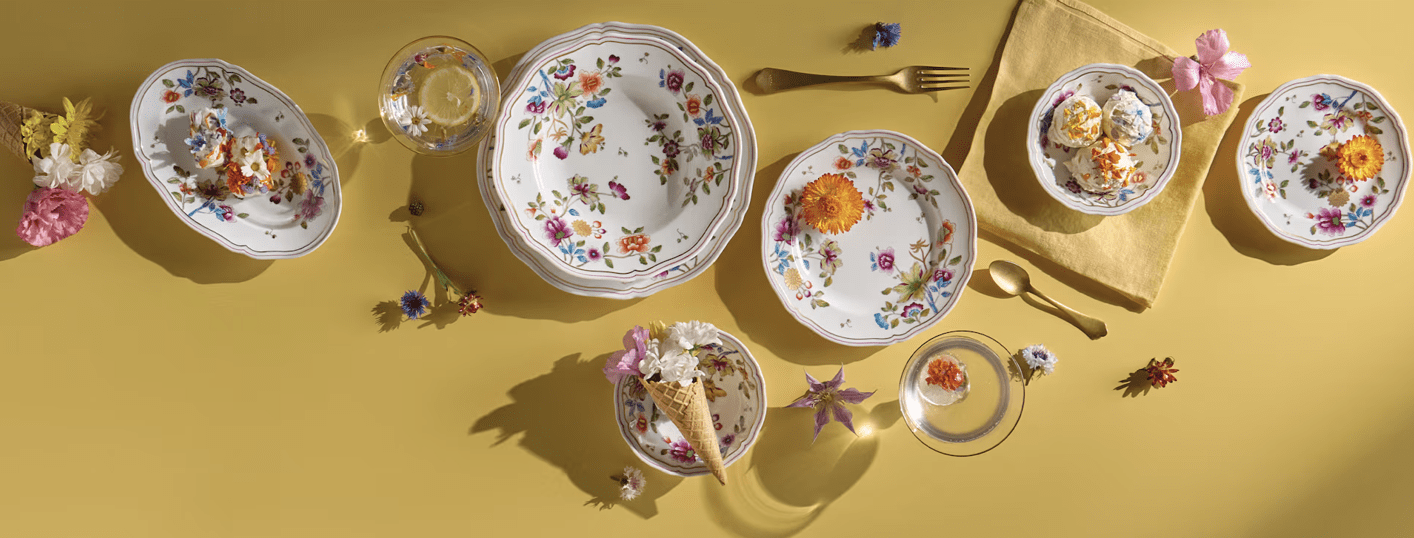
Few brands embody the continuum of history and modernity as gracefully as Ginori 1735. Born in the hills outside Florence nearly three centuries ago, the porcelain house has transformed from Enlightenment-era experiment to contemporary design icon. Today, under the creative orbit of Gucci’s Alessandro Michele and now emerging in dialogue with the worlds of art, fashion, and interiors, Ginori 1735 remains both heritage and avant-garde.
Origins: A Florentine Vision
In 1735, Marchese Carlo Ginori founded the Manifattura di Doccia in Doccia, a small town near Florence. Inspired by the grandeur of Meissen porcelain and the scientific curiosity of the Enlightenment, Ginori sought to bring Italy into the age of porcelain. His kilns produced exquisite tableware and decorative objects, adorned with mythological scenes, pastoral landscapes, and neoclassical motifs.
By the 18th and 19th centuries, Ginori had become a byword for refinement — porcelain that married Tuscan artistry with European innovation. Royal courts and aristocratic salons laid their tables with Ginori, cementing the brand as a symbol of cultivated taste.
20th Century Reinvention
The modern identity of Ginori was shaped in the 20th century. Collaborations with artists and designers — most notably Gio Ponti, who served as artistic director from 1923 to 1933 — infused the house with a radical modernist spirit. Ponti’s work introduced clean lines, architectural forms, and bold motifs, positioning Ginori not as a relic of the past but as a participant in the avant-garde.
The company evolved through acquisitions and partnerships, ultimately merging with Richard-Ginori, but the essential DNA remained: porcelain as a living art form.

A New Chapter: Ginori 1735
In 2013, Ginori was acquired by Gucci’s parent company Kering, a move that safeguarded its heritage while opening doors to fashion-driven creativity. Under Alessandro Michele’s influence, the brand reemerged as Ginori 1735 — its new name a deliberate nod to origins and continuity.
The collections today play at the intersection of tradition and imagination. Tableware ranges from timeless neoclassical forms to whimsical motifs — serpents, cosmic emblems, wildflowers — aligning with Michele’s eclectic aesthetic. Collaborations with artists and houses (from Luke Edward Hall to Off-White) have expanded Ginori’s reach, making porcelain not just functional but expressive.
Ginori Now: Porcelain as Lifestyle
Ginori 1735 today is positioned as a luxury lifestyle brand. Its output includes dinner services, candle collections, objets d’art, and bespoke projects for haute couture maisons. Its stores — from Florence to Milan, Paris to New York — are immersive, gallery-like spaces, designed to collapse the distance between heritage and contemporary culture.
The annual Salone del Mobile in Milan has become a stage for Ginori’s boldest expressions: porcelain chandeliers, installations that merge sculpture with set design, and collaborations that feel closer to fashion week than to tableware launches.
Ginori For All Times
In an age where craft risks being overshadowed by speed and technology, Ginori 1735 asserts the opposite: that heritage can be radical, that porcelain can be both timeless and utterly of the moment. Its artisans still work in the Doccia factory, hand-painting motifs and perfecting glazes with centuries-old techniques. Yet the brand’s language is fresh, experimental, fashion-forward.
In the porcelain of Ginori 1735, history does not sit on the shelf; it lives at the table, in the home, and in the imagination.
Ginori 1735: A Timeline of Porcelain and Prestige
1735 – The Beginning
Marchese Carlo Ginori establishes the Manifattura di Doccia near Florence, ushering Italy into the porcelain age.
18th–19th Century – Aristocratic Refinement
Ginori becomes synonymous with Italian elegance. Mythological and neoclassical motifs decorate the tables of Europe’s royal courts and salons.
1923 – Gio Ponti Arrives
The young architect and designer becomes artistic director. His bold, modernist designs transform Ginori into a leader of the avant-garde.
1950s–70s – Expansion & Everyday Design
Ginori adapts to the postwar era, expanding production and embracing mid-century tastes while maintaining artisanal quality.
2013 – The Kering Era
The brand is acquired by Gucci’s parent company, securing its heritage and positioning it within the global luxury landscape.
2016 – Alessandro Michele’s Influence
The Gucci creative director’s eclectic imagination inspires a new era of whimsical motifs and bold collaborations.
2020s – Ginori 1735 Today
Now a lifestyle brand, Ginori produces everything from hand-painted dinnerware to scented objects and large-scale design collaborations, bridging history with contemporary fashion and interiors.
Collector’s Guide: Iconic Ginori 1735 Collections
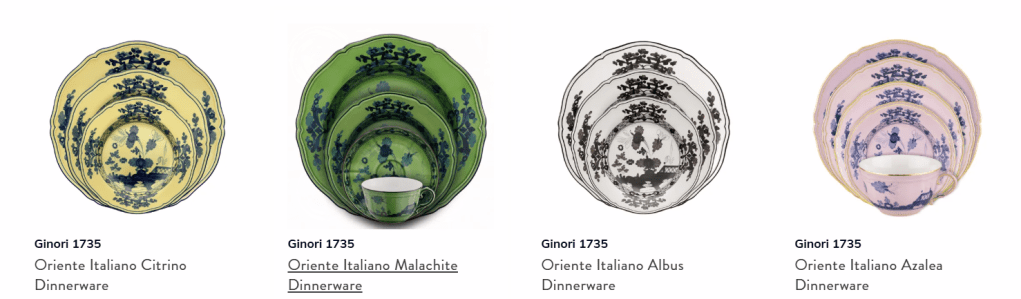
Oriente Italiano
Perhaps the house’s most recognizable pattern, a kaleidoscope of floral motifs in vivid pinks, blues, and yellows. Equal parts chinoiserie and Florentine fantasy.
Totem
Playful porcelain inspired by 18th-century heraldic animals, reimagined with bold colors and surreal charm. Think leopards, flamingos, and owls enlivening dinner services and decorative objects.
Cosmogony
A Michele-era collection that merges cosmic symbols with classical forms — porcelain as mystic storytelling, with serpents, suns, and stars painted in jewel tones.
Labirinto
A graphic, neoclassical pattern designed by Gio Ponti in the 1920s: interlocking geometric borders in striking monochrome palettes.
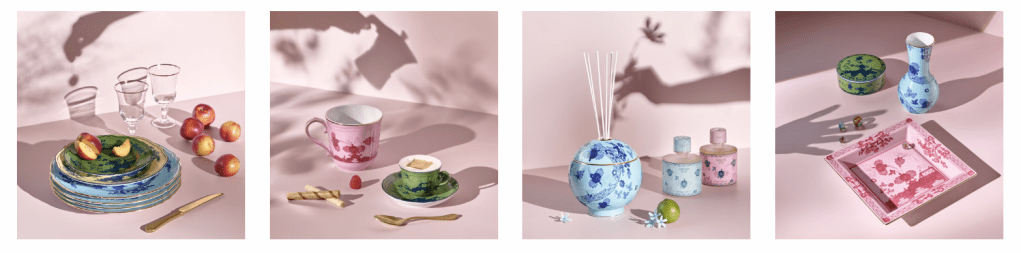
Aria and Oriente Italiano Home
Expansions into lifestyle: scented candles, vases, and objets d’art that carry Ginori’s aesthetic beyond the table and into interiors.
 My World of Interiors