
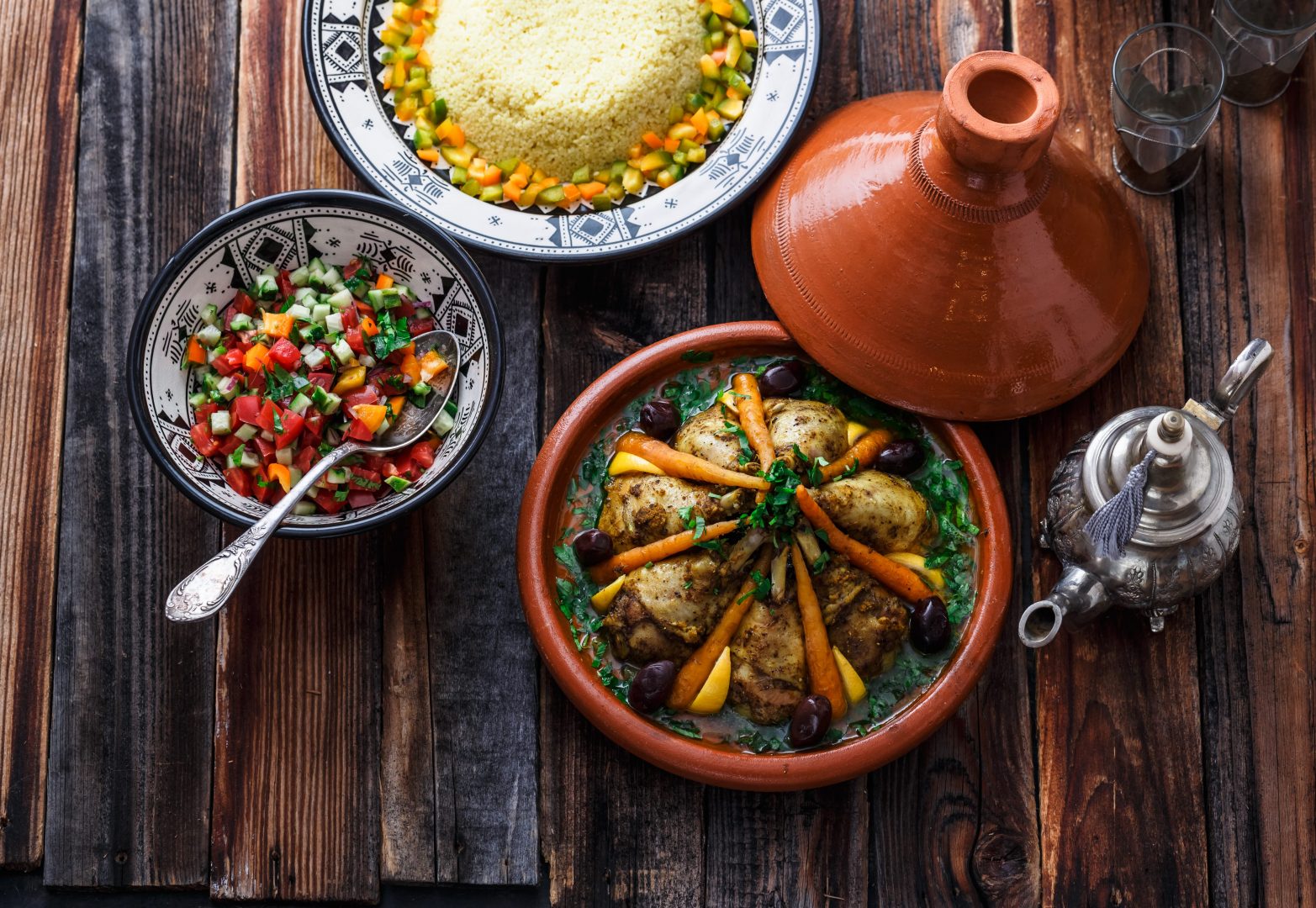
Moroccan cuisine is a mosaic of histories — Arab, Berber, Andalusian, Ottoman, and French — layered into one of the world’s most aromatic and visually striking culinary traditions. Defined by spice, ritual, and generosity, it balances sweet with savory, fire with fragrance, earth with light. To eat in Morocco is to be enveloped by hospitality, where food is not only nourishment but ceremony, and the table itself is a stage for culture.
Spice as Soul
Saffron, cumin, cinnamon, ginger, paprika — Morocco’s spice palette is its signature. Nowhere else do spices intertwine so delicately, never overwhelming but enhancing. Ras el hanout, a blend of up to 30 spices, epitomises this art: subtle heat, layered depth, an aromatic fingerprint unique to each household or souk.
The Couscous Tradition
Couscous is Morocco’s national dish and weekly ritual. Steamed semolina grains, impossibly light, are topped with vegetables, chickpeas, and tender meat or fish. Served communally, it embodies Moroccan hospitality, a dish as social as it is sustaining.
The Tagine
Perhaps the most iconic symbol of Moroccan cooking, the tagine is both vessel and dish. Its conical clay lid traps steam, slow-cooking meat, vegetables, and dried fruit until tender. The combinations are endless: lamb with prunes and almonds, chicken with preserved lemon and olives, vegetables with saffron and chickpeas. A tagine is less a recipe than a philosophy of patience.
Bread and Ritual
Flatbreads (khobz) accompany every meal, used as utensil as much as food. Baked in communal ovens, they bind neighborhoods together. Bread is treated with reverence: to waste it is taboo.
Mint Tea: The Ceremony of Hospitality
No visit, no conversation, no transaction is complete without mint tea. Poured from high above into small glasses, frothing with foam, it is both refreshment and ritual. Sweet, aromatic, endlessly replenished, it embodies Moroccan warmth.
The Sweet Counterpoint
Pastries laced with honey, almonds, and orange blossom water bring balance to Morocco’s savory depth. From chebakia (sesame cookies fried and glazed) to briouats (filo pastries filled with nuts), desserts are both delicate and exuberant, often paired with tea in a final gesture of generosity.
The Eternal Table
Moroccan cuisine endures because it marries contrasts: sweet and savory, fire and fragrance, the communal and the ceremonial. To sit at a Moroccan table is to enter a space where history is edible, hospitality is ritual, and food is always a gesture of love.
Five Essential Dishes of Moroccan Cuisine
- Couscous with Seven Vegetables
– A Friday tradition: couscous topped with carrots, zucchini, turnips, pumpkin, chickpeas, and meat or chicken.
– Recipe: Moroccan Food Tour - Chicken Tagine with Preserved Lemon and Olives
– The signature tagine: zesty, savory, and fragrant.
– Recipe: Serious Eats - Harira Soup
– Lentil, chickpea, tomato, and herb soup, often eaten to break the Ramadan fast.
– Recipe: BBC Good Food - Pastilla (B’stilla)
– A sweet-savory pie of pigeon or chicken, almonds, cinnamon, and filo pastry, dusted with powdered sugar.
– Recipe: The Spruce Eats - Chebakia
– Honey-drenched sesame cookies, twisted into flowers and fried; a Ramadan staple.
– Recipe: Taste of Maroc
Restaurants & Experiences
- Dar Yacout, Marrakech – A legendary palace restaurant, famed for lavish traditional banquets.
- Le Jardin, Marrakech – A lush courtyard restaurant blending tradition with modernity.
- Nomad, Marrakech – Contemporary Moroccan cuisine with rooftop views of the medina.
Markets & Ingredients
- Spice Souk, Marrakech – The heart of Moroccan flavors, from ras el hanout to saffron.
- Belazu – Specialist UK supplier for preserved lemons, harissa, and Moroccan pantry staples.
Cultural Institutions
- Maison de la Photographie, Marrakech – Exhibits daily life and traditions, including culinary ones.
- UNESCO Intangible Heritage – Couscous – Recognised for its cultural importance.
TL;DR
Moroccan cuisine is a feast of contrasts: saffron and cumin, sweet and savory, ritual and hospitality. From couscous and tagine to mint tea and honeyed pastries, it is less a set of recipes than a way of life — food as generosity, history as flavor, the table as culture itself.
 My World of Interiors