
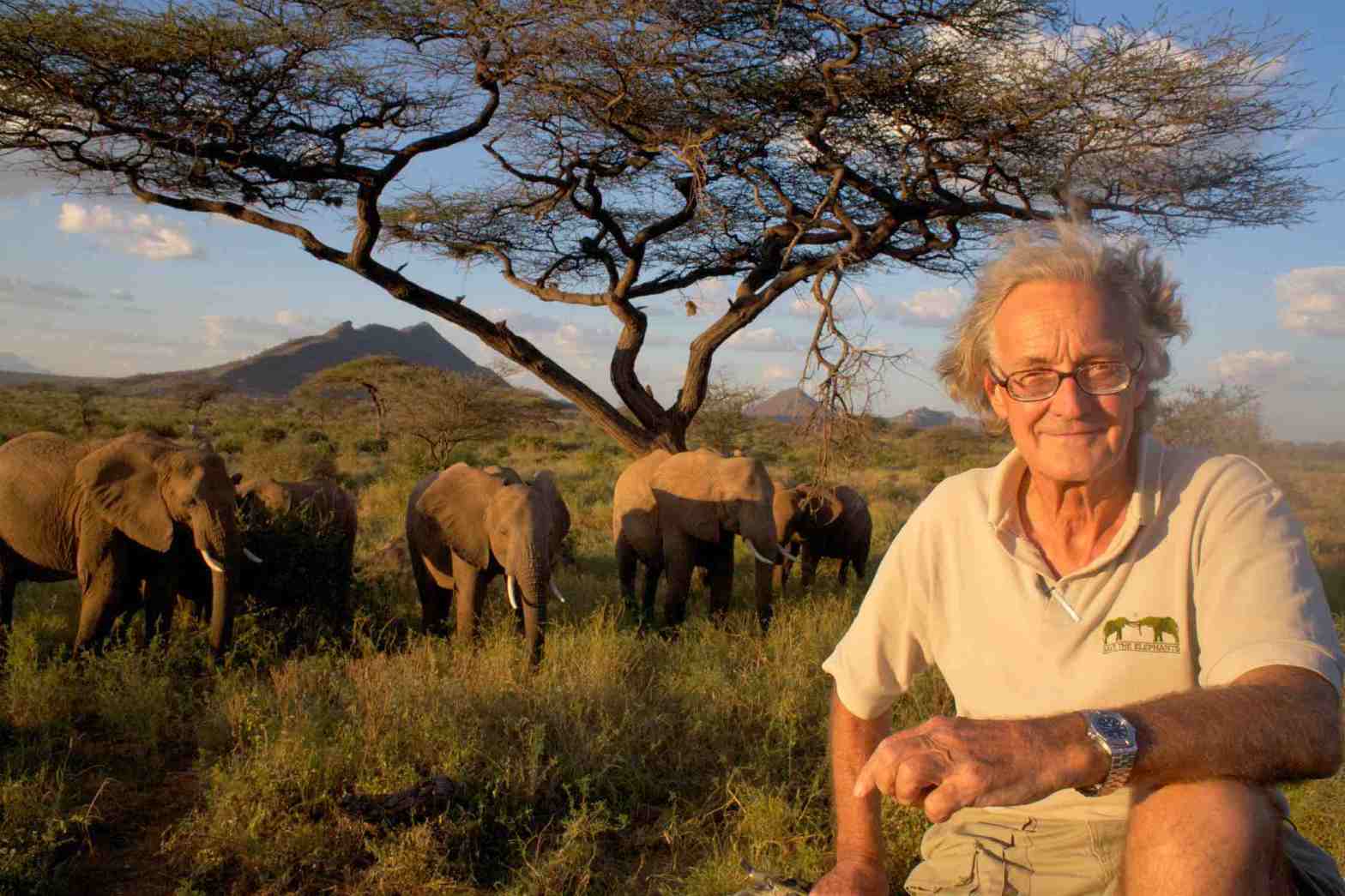
Dr Iain Douglas-Hamilton, who peacefully passed away last night, aged 83, was the pioneering zoologist whose six-decade campaign for Africa’s elephants reshaped both science and global conservation policy. From his early fieldwork in Tanzania in the 1960s to his role in exposing the mass slaughter driven by the ivory trade in the 1970s and 80s, he became one of the defining conservationists of the modern era, instrumental in the movement that led to the 1989 international ivory ban.
Born on 16 August 1942 in Dorset, Douglas-Hamilton was the son of Lord David Douglas-Hamilton, an RAF pilot killed during the war, and Ann Prunella Stack, whose own family had founded the Women’s League of Health and Beauty. From childhood he was captivated by Africa and by flight — an unlikely combination that would later become the basis of his life’s work as he surveyed vast landscapes from the air in search of elephants.
Educated at Gordonstoun and later at Oriel College, Oxford, he studied zoology under the celebrated ethologist Nikolaas Tinbergen. For his doctoral research he travelled in 1963 to Lake Manyara National Park in Tanzania, where he began what was then a radical approach: identifying and following individual elephants. By naming them, mapping their families and tracking their movements, he revealed a rich and complex society led by matriarchs, governed by memory, and bound by deep emotional ties.
In the 1970s he moved to Kenya and developed large-scale aerial survey techniques for counting elephants across the continent. The results were devastating. His data helped show the scale of what he called the “elephant holocaust”: hundreds of thousands of animals killed to feed the international ivory trade. His research and advocacy were central to the campaign that pushed governments towards the historic 1989 CITES decision to ban international ivory sales — a turning point that allowed many populations to begin recovering.
In 1993 Douglas-Hamilton founded Save the Elephants in Nairobi, combining detailed field science with innovative technology. The organisation became an early adopter of GPS tracking collars, producing real-time movement maps that transformed understanding of elephant behaviour while guiding anti-poaching missions and informing land-use planning. Save the Elephants later co-created the Elephant Crisis Fund, which has channelled major support to frontline conservation groups across Africa and Asia.
Over the course of his career he testified before governments, advised presidents, lectured globally, and mentored emerging African scientists. He remained equally at home in the bush, where he spent long stretches with research teams who knew individual elephants by sight and followed their fates across generations.
His achievements earned numerous honours, including the Order of the Golden Ark, an OBE later advanced to CBE, and the Indianapolis Prize, conservation’s highest award. He and his wife, Oria, wrote popular books such as Among the Elephants and Battle for the Elephants, and their work became the subject of documentaries that brought the story of elephant conservation to a wider audience.
Douglas-Hamilton was admired not only for the rigour of his science but for his evident affection for the animals he studied. His blend of hard data, field intuition, and emotional intelligence helped change the world’s perception of elephants — from anonymous members of a herd to sentient individuals with memories, bonds, and grief.
In 1970 he married Oria Rocco, an Italian-born conservationist and co-founder of Elephant Watch Camp in Samburu. They had two daughters, Saba, a wildlife filmmaker, and Dudu, also active in conservation. Their family life was deeply entwined with the landscapes and elephants of northern Kenya, forming a modern nomadic clan bound by shared purpose.
Even into old age Douglas-Hamilton continued to visit field sites, advise colleagues, and inspire new generations with his optimism and belief that good science, political will, and public engagement could still secure a future for elephants.
Iain Douglas-Hamilton was born on 16 August 1942 and died on 8 December 2025. He is survived by his wife, Oria, their daughters, and by the elephants and conservation movement he helped to protect.
To support: https://savetheelephants.org/
 My World of Interiors